Key Technical Points and Operation Methods for Apple Tree Training and Pruning
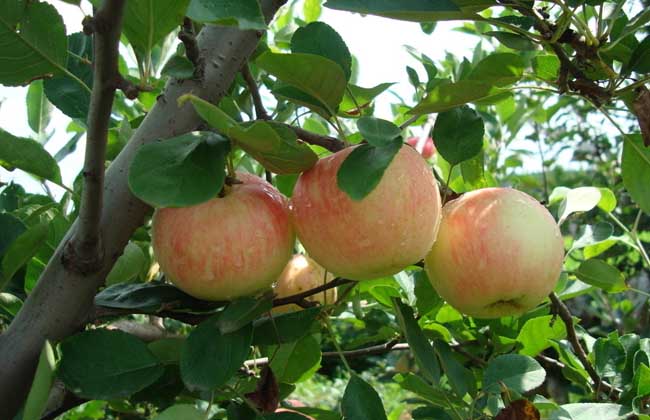
The apple tree is a deciduous tree of the genus Malus in the Rosaceae family. Trees can usually reach a height of 15 m, but cultivated trees generally grow only about 3-5 m tall. It originated in central and southeastern Europe, Central and Western Asia, and China**. In 2013, world apple production was 80.82 million tons, making it unquestionably the king of temperate fruits. Let us now take a look at apple tree training and pruning techniques!
Principles of Apple Tree Training and Pruning
Apple tree training and pruning should be based on differences in orchard site conditions, cultivar, rootstock, density and tree age, selecting a reasonable tree shape according to the site, the orchard and the tree, and adopting corresponding pruning methods to regulate the relationship between growth and fruiting, so as to achieve the goal of vigorous and balanced tree vigor, early bearing, high yield, high quality and high efficiency.
Indicators for Apple Tree Training and Pruning
1. Tree height: for dwarfing trees, trunk height 0.8-1.0 m and tree height 3.0-3.5 m; for standard trees, trunk height 1.0-1.5 m and tree height 2.5-3.0 m; no contact between trees within the row, with a 1-1.5 m working aisle kept between rows, and a canopy coverage rate of 75%.
2. Branch quantity: after pruning, about 80,000 branches per mu are retained in an apple orchard, of which medium and short branches account for 70%, and terminal flower branches account for about 30%.
3. Branch groups: in the early stage of the open-center form, the main focus is on developing small and medium branch groups, with emphasis on selecting various branch groups on the main branches that grow obliquely or downward, and thereafter gradually developing them year by year into large, three-dimensional fruiting branch groups in a pendulous form. In the spindle form, the small main branches are borne as branch groups, with wide opening angles.
Spindle Pruning of Apple Trees
1. Apple tree structure: tree height 3.0-3.5 m, trunk height 0.7-0.8 m, with 20-25 small main branches arranged on the central leader, spaced 10-15 cm apart, main branch angle 90-100°, shorter at the top and bottom and slightly longer in the middle, with the rate of contact between trees within the row not exceeding 10%. It is mainly applied to dwarfing and spur-type cultivars and to temporary standard trees.
2. Pruning of young trees: the key points for pruning young trees (1-5 years) are to properly form the tree shape and promote tree vigor, laying the foundation for early fruiting and high yield. Vigorous nursery stock is not headed; weak stock (below 1 m) is headed at a plump bud. Remove strong vigorous branches on the central leader to strengthen the dominance of the central leader. According to the requirements of the tree form, starting from above 70 cm from the ground, select and retain small main branches at 10-15 cm intervals, following the principle of spiral arrangement, and select and retain them upward year by year to meet the requirements of the spindle tree form. Remove water sprouts on the upper side of branches, overly dense branches and overlapping branches.
3. Pruning of mature trees: the key points for pruning mature trees (≥6 years) are to perfect the tree structure and develop fruiting branches. The central leader extends vertically, the small main branches extend on a single axis, and the branch-to-trunk ratio should preferably be 1:3. Small main branches are managed dynamically; by the method of removing large ones and retaining small ones and removing old ones and retaining new ones, over-large main branches exceeding 1/3 of the trunk are deliberately and mainly removed, and small main branches are developed, arranged in a spiral. To develop fruiting branches: first, select and retain moderate side-growing and pendulous branches as fruiting branches; second, remove strong vigorous branches on the upper side of the small main branches.
4. Pruning during the growing season: before and after bud break, make notches above the buds at positions on the central leader and main branches where branches are lacking, to promote new shoot growth. Bend branches according to the target tree form requirements. One- to two-year-old branches should preferably be bent from mid-August to mid-September; branches 3 years and older should preferably be bent from after spring flowering to mid-May (before bagging), using the steps of "first push, second knead, third press, fourth fix" so that they are bent to the required angle and are straight without "arching". For main branches that grow extremely vigorously and are not easily induced to flower, make ring cuts from late May to early June; remove useless branches such as suckers, water sprouts and overly dense branches; when the central leader and the extension shoots of the main branches of young trees reach 40 cm, pinch the tips to promote branching.
Open-Center Pruning of Apple Trees
1. Apple tree structure: tree height 2.5-3.0 m, trunk height 1.0-1.5 m, retaining 4-6 relatively large permanent main branches, with angles of 75° at the base, 85° at the middle and 80° at the tip, arranged to fill gaps, with the main branches extending indefinitely, and large, medium and small fruiting branch groups evenly distributed on the main branches, with the branch groups in a pendulous form. It is mainly applied to standard and semi-dwarf fruit trees.
2. Pruning of young trees: the key points for pruning young trees (1-7 years) are to properly form the tree shape, promote tree vigor and expand the canopy, laying the foundation for early fruiting and high yield.
① After planting, head the tree at a plump bud, and shorten the central leader and the extension shoots of the main branches at plump buds to promote vigorous shoots. Leave the remaining branches unpruned, and remove branches below 1.0 m on the trunk.
② According to the requirements of the tree form, starting from above 1.0 m from the ground, following the principle of spiral arrangement, select and retain branches with a relatively large base angle and vigorous growth at intervals of about 40 cm as permanent main branches, and support and boost their vigor, accelerating their extension growth, to meet the framework requirements of the open-center form.
③ Remove competing branches, water sprouts on the upper side of branches, overly dense branches, overlapping branches and diseased and pest-damaged branches; develop side-growing and pendulous branches on the main branches into pendulous branch groups to promote early fruiting.
④ On the premise of not affecting the growth of the scaffold branches, temporary branches not selected as main branches should be retained as much as possible, to promote the rapid transformation of the branches, the formation of flower buds and fruiting as early as possible.
3. Pruning of mature trees: the key points for pruning mature trees (≥8 years) are to develop fruiting branch groups, expand the canopy, complete tree training and achieve three-dimensional fruiting.