Culture, creativity and industry should be considered separately
Culture, creativity and industry should be considered separately
Every year the "cultural and creative industries" get taken to task once, and this year is no exception, except that this time the criticism is broader and deeper, and Songshan and Huashan, originally planned as "models" for the cultural and creative industries, have also been dismissed as "nothing but restaurants," with no culture at all. But the point of contention still lies in this: what is culture? What is creativity? What counts as an industry? In 2009, then Vice President Vincent Siew held a "Cultural and Creative Industries Roundtable Forum," which explored in depth which things can become industries, which cannot, and how to tell them apart.
Frankly speaking, not every kind of culture can be turned into an industry, mass-produced, priced and sold. Culture and thought are in themselves priceless. In ancient times, when Confucius was alive, he had only ideas and no one bought into them; he wandered from place to place teaching, yet his thought influenced later generations. Several hundred years later, Confucius's thought became mainstream and the basis of the imperial examinations, and the educational world immediately treated it as a money tree.
If we count up China's biggest cultural industry, from ancient times to the present, none surpasses the Confucian school of Confucius and Mencius. Yet thought is priceless; what has a price are the players in science, teaching, printing and examination publishing. That is the industry, now called the textbook industry.
Besides this, artistic creation is also priceless. Paintings cannot be mass-produced. Van Gogh sold no paintings in his lifetime, yet after his death his paintings turned into museums and became an industry. This is to say, creation cannot be mass-produced and cannot become an industry, but museums can, and the exhibition industry can. As for film and television, pop music, conventions and exhibitions, news, sports, advertising and other fields, where an industrial scale has long since taken shape, there is no need for special subsidies; it is enough to create good policies and a good environment.
Therefore, we must first distinguish what can be made into an industry from what cannot. For what can be made into an industry, what the government needs to do is enact good basic laws, set good policies, and create a sound creative environment and market, so that those who wish to take part in the industry find everything convenient in financing, obtaining venues, activities and exhibitions, and so on. That is enough.
As for what cannot be industrialized, such as literary creation, theater, and traditional opera, cultural subsidies already exist, so the subsidies due should be maintained. At the same time, to encourage creative vitality, a certain proportion of subsidies should go to creators. The reason is simple: all creativity necessarily comes from rebelling against past forms and ideas, mainstream values, and old ways of thinking. Only thus is there innovation.
But such rebellion, through the ages, succeeds in fewer than one case in a hundred. Not to mention that every artist's talent differs; even for the artist himself, not every creative experiment succeeds. Allowing failure and calmly continuing to create, that is the driving force of creation. What the government should do is give the subsidies due, so that passionate creators have more chances to conduct experiments that may succeed or fail.
As for the proportion of subsidies, the best is the three-thirds system. One third goes to young creators; the amount for each person need not be large, but it is given to many people, so that passionate ideas have a chance to be put into practice. Among them, perhaps 90 percent will not succeed, but that does not matter; accumulating creative experience matters more than anything. If the remaining one tenth achieves something, that is very lucky.
The second third of the proportion could subsidize these creators to develop upward, giving them a chance to become medium-sized groups, or to undertake larger creations. They may fail, so in the end only a very few will succeed, and these very few are the ones who can stand on their own, or represent Taiwan, China, in international performances. As for whether these creators can become an industry, that depends on the artist's various abilities. Creative success with business failure also happens; who dares to guarantee otherwise?
The point here is not to explain how the "cultural and creative industries" should be, but to explain that culture, creativity and industry should be considered separately, and cannot be run all the way through with a single concept. Culture has heritage, inheritance and innovation; the essence of creativity lies in rebellion; industry can be replicated and successfully marketed. The three cannot be equated. Therefore, whether a creative idea can become an industry often does not depend on the creative idea itself, but on many other factors; much hard work must go into production, circulation and display. Of the creative industries that appear successful, which one did not fight its way to success through long-term painstaking management and the building of connections? It is not one bit easier than traditional industry.
Artistic creation is rooted in the single mind, with no room for luck. Whether it becomes an industry is another matter. This is just as whether Van Gogh's creation is good is one matter; whether his works can be used to make an art museum is another. Think it through clearly, and the cultural and creative industries will be easier to carry forward.
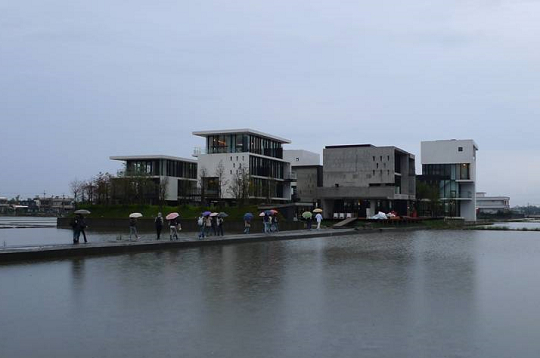
▲Culture, creativity and industry should be considered separately