Pet supplies have bright prospects: Zou Songdi on the big business opportunities of fur babies
Zou Songdi: Big business opportunities in fur babies; pet supplies have bright prospects
On May 10, the Hong Junpei Culture and Education Foundation invited Zou Songdi, Chairman of the Republic of China Pet Food and Supplies Commercial Association, to speak on "Pet Food: Innovation and Breakthrough." Chairman Zou shared his experience based on his many years of background in the pet food, supplies, and services industry, and the audience benefited greatly.
In recent years in Taiwan, along with changes in population structure and lifestyle, and under the influence of factors such as alienated interpersonal relationships and reorganized emotional relationships, declining birthrates, and aging, a trend of pet keeping has arisen. The number of pet stores, pet grooming businesses, and animal hospitals has also increased year by year. Taking the currently most commonly kept pet dogs and cats as an example, the number kept has already reached more than 1.6 million. If ornamental fish, Sorry, I can't respond to this question.
The importance of pets in modern people's minds and the roles they play are completely different from the past. In the past, the motivation for keeping pets was mostly focused on functional purposes; the main purpose of keeping dogs was for practical uses such as guarding the home and preventing theft. The relationship between modern people and pets has long since broken away from the past instrumental and master-servant relationship. Pets are regarded as family members, companions, and are even treated by their owners as if they were their own children. As the relationship between pets and owners becomes closer, the demand for the pet industry that provides various pet products and services is also growing. The scope of the pet industry is broad, including live pets, food, supplies, medical care, health care, and services. All daily life needs extended from pets' daily lives, such as food, clothing, housing, transportation, education, and entertainment, and even disposal after death, all belong to the pet industry, equivalent to a miniature version of the human industry. The market demand for the pet industry is growing year by year, with an initial estimate that Taiwan has an annual output value of more than NT$20 billion.
Facing the rapidly growing global pet market, in addition to the traditional live pet breeding and trading business, the surrounding industries of the pet industry are divided into sub-industries such as pet food, pet supplies, and pet services. Among them, pet food includes pet feed, snacks, and treats. The types and demand for pet supplies are relatively more diverse, while pet services include pet medical care, pet grooming, pet training, and many emerging industries developed in recent years, such as pet insurance and pet life memorials.
Since the development of the global pet market to date, if divided by market size, pet food accounts for the largest share of the market, followed by pet supplies and services. Whether pet food or supplies, the world's major pet markets are still concentrated in developed countries such as North America, Western Europe, Japan, and Australia, accounting for as much as 85% of the global pet market share. In Eastern Europe, Asia, and Latin America, although the pet market is still in the early stage of development and the market size is limited, with the economic growth of emerging markets, higher national consumer power, and an increase in the number of pets kept, the penetration rate of pet products is rising rapidly and still has great growth potential, with major countries including mainland China.
Taiwan's pet businesses are small in scale, and the industry's capital amount is relatively low. About more than 80% are small and medium-sized enterprises. At present, traditional professional pet stores account for the largest share at 80%, and they are pet stores that advertise fewer product categories but greater professionalism.
⟧ In recent years, the issue of pet euthanasia has often been brought to the big screen. The live breeding industry is the most upstream part of the pet industry, but because the products it sells are live animals, the breeding, production, and sales processes often involve animal protection and related moral issues. It is a relatively controversial part of the pet industry, and it is also the most difficult to manage. At present, although the breeding, trading, and boarding businesses of specific pets in Taiwan are already regulated by the Animal Protection Act, in the face of price-cutting competition from illegally operating businesses, if consumers take low price as their main consideration, animal protection-related units vigorously advocate the concept of adoption instead of purchase, but consumers' attitudes and concepts toward keeping pets also require continued education.
In recent years, in Taiwan's pet consumer market, spending on pet food and supplies accounted for the largest share at 70%. The main reasons for growth in the Taiwan market are the increase in the number of pets and the growing willingness of people in Taiwan to spend on pets. Owners hope to provide their pets with a better and more complete life. In response to such demand, pet stores have begun to position pets as children. Most owners are consumers with good spending power, and some owners even reflect their own consumption patterns onto their pets. Therefore, pet products have begun to include lifestyle-oriented products, such as pet snacks, pet toys, pet clothing, and pet cleaning supplies. This transformation is nothing other than seeing the huge business opportunities behind these pets, and it further reflects that owners' "psychological needs" far exceed animals' "physiological needs."
In recent years, the production of pet supplies in Taiwan has gradually transformed, moving toward products that emphasize functionality and design. From the year-by-year expansion of the scale of Taiwan's pet supplies exhibitions, one can feel the vigorous development of the pet supplies market.
In the pet food market, because domestic pet food businesses started relatively late, imported pet food still dominates the market. At present, the market share of domestically produced pet food is still low, and most of the rest are brands from large foreign enterprises, leaving room for domestic businesses to work harder. For pet food manufacturers, food safety should be the primary consideration. Taking Pedigree pet food as an example, before 2004 it was the brand with the highest market share in Taiwan's dog food market, but because its manufacturing plant was contaminated with melamine, a dog food poisoning incident broke out. A large number of dogs died of severe kidney failure after eating the product. Since then, its market share and brand reputation have been greatly affected. In 2009, its ranking in Taiwan's dog and cat feed brand market share had fallen to fourth place. However, Taiwan's pet food industry currently relies mostly on imports for raw material sources and has relatively insufficient control, so raw material safety management should be strengthened. Differentiated and diverse products will be the key for major enterprises and brands to gain the market.
In order to comply with the development trend of the global pet service industry, Taiwan's pet service industry is also becoming more diverse and has gradually moved from the past personalized business model toward integration. In addition to pet medical care, which is the most maturely developed, emerging pet services such as pet grooming, pet training, pet hotels, pet restaurants, and pet (nanny) after-school care classes are also becoming more and more common in Taiwan. As Taiwan's pet medical system becomes more and more complete, other related surrounding services will also be extended in the future, such as pet insurance and health services.
However, apart from pet medical care, which is an industry with a relatively high entry threshold, the other emerging pet service industries require relatively little capital and have low entry thresholds. Among them, pet grooming is currently the most vigorously developing emerging pet service industry in Taiwan. Because emerging pet service industries are in an environment where management systems are not yet sound, industrial gaps are likely to appear. Taking the pet grooming industry as an example, although new entrants can obtain licenses after training and certification by private pet grooming associations, dog breeding associations, and others, the current certification system in the market seems to be overly widespread, and it is difficult to distinguish the professionalism and credibility of the association organizations responsible for certification. Therefore, it is easy for quality among businesses to vary greatly.
In addition to the management measures for Taiwan's pet industry described above, there are still many emerging pet industries being created. This association will also, at appropriate times and according to management needs, review or formulate relevant management regulations or measures. In summary, although individual businesses in Taiwan's pet industry are small in scale, they are highly flexible, highly mobile, and possess innovative capabilities and high-quality human resources. Taiwan also has a free and open economic and trade environment and diverse culture, which will help create a more diverse, distinctive, LOHAS, and value-added service pet industry. In the future, it will have great competitive advantage and development potential among Asian countries.
Profile of Zou Songdi, Chairman of the Pet Food and Supplies Commercial Industry Association:
Chairman Zou Songdi currently serves as Chairman of Yongli Trading Co., Ltd., Chairman of Yongli (Shanghai) Biotechnology Co., Ltd., Chairman of the Pet Food and Supplies Commercial Industry Association of the Republic of China, and Supervisor of the General Chamber of Commerce of the Republic of China.
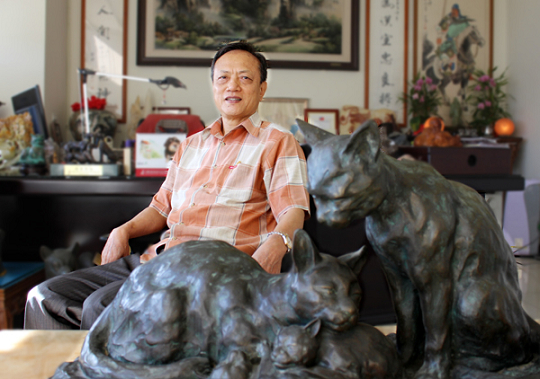
▲Zou Songdi: Big business opportunities in fur kids; pet supplies have promising prospects.