Detailed Explanation of the Key Points of Black Pearl Cherry Cultivation Techniques
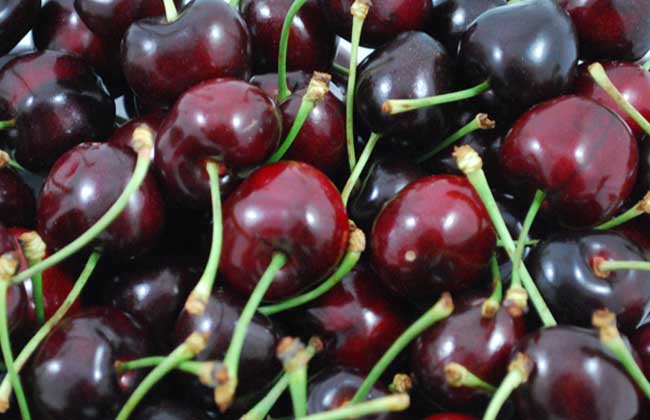
Black Pearl Cherry is a superior bud-sport cherry selected from Chinese cherry through cultivation. It has beautiful fruit shape, purple-red fruit color that is very attractive, and soft flesh that is juicy and delicious. It is a premium fruit on the market, sells at a higher price than ordinary fruits, and has excellent commercial value. Let us take a look at Black Pearl Cherry cultivation techniques together!
Growth Habits
Black Pearl Cherry generally begins to bear fruit in 3 years, with the full fruiting period at about 7-8 years. The tree crown is open, the tree vigor is moderate, the sprouting ability is strong, the branching ability is medium, and the latent buds have a long lifespan, which is good for renewal. It mainly bears fruit on medium and short fruit branches and bouquet-like fruit branches; long branches only form flower buds and bear fruit in the middle and upper parts, and young trees bear more fruit on medium and long fruit branches. It flowers easily, has a large number of flowers, and the self-pollination fruit-setting rate is 64.7%. Black Pearl Cherry originated in the high-temperature and high-humidity Chongqing area in the south. It has strong adaptability to high-temperature and high-humidity environments, strong disease resistance, does not crack fruit, and has very slight pre-harvest fruit drop.
Orchard Establishment
1. Orchard site selection: Black Pearl Cherry likes sunlight, is not tolerant of waterlogging, and is not drought-resistant. It is advisable to choose sloped land with good sunlight, good drainage, and relatively deep soil for orchard establishment, with sandy loam soil at pH 6-7 being the best. If establishing an orchard on flat land or clay soil, attention should be paid to ditching for drainage and soil improvement. One month before planting, trenches 80-100 cm wide and 60-80 cm deep can be opened according to the planting rows to improve the soil, with layers of weeds, crop straw, phosphate fertilizer, and pig and chicken manure water pressed in. It is also possible to plant first according to the designed density, and then expand the holes and improve the soil year by year.
2. Seedling planting: Planting can be done from September each year to February of the following year, but planting during the mild "Indian summer" climate from October to November is best. Use dwarfing and close planting, with a plant-row spacing of 1.5×3.0 m (150 plants per mu). Black Pearl Cherry has a high self-pollination fruit-setting rate and does not necessarily need pollinizer trees. However, in order to obtain more reliable yields, pollinizer trees can be planted at a ratio of 1:8, and the main pollinizer variety at present is Dahongpao Cherry. When planting, the settling water should be sufficient and thoroughly watered. After it has all penetrated, sprinkle a layer of fine niobium soil on the tree plate, and finally cover the tree plate within a diameter of 1.0 m with weeds (2-5 cm thick, to maintain soil moisture).
Training and Pruning
1. Training: Because it is a light-loving tree species, a small-crown delayed-open central-leader form is suitable for close-planting orchards, taking shape in 2-3 years. The training method is as follows: in the year of planting, leave 40-60 cm for trunk determination, select one strong upright branch as the central leader, and select another 4 branches as the first layer of main branches and 2-4 branches as auxiliary branches. When the main branches reach 30 cm, pinch the tips to promote branching, and select and retain extension branches. In early July, adjust the angle of the main branches so that they form an angle of 70-80 degrees with the trunk. For auxiliary branches, pinch the tips at 15-20 cm to promote branching, and in early May adjust the angle so that they grow horizontally and form bouquet-like short fruit branches. In July-August, combine chemical growth regulation and water control measures to promote flower bud differentiation. During spring pruning in the second year, shorten the central leader by leaving 60 cm to cultivate the second layer of side branches, and cultivate 3 main branches and 2 auxiliary branches in the same way. In the third year, cultivate the third layer of main branches in the same way, leaving 2 main branches. The tree takes shape in 3 years, and tree height is controlled between 2-2.5 m.
2. Pruning: During the young tree period, summer pruning is the main practice. In summer, vigorous branches can be pinched and bent to promote branching and form medium and short branches. In winter pruning, long release is mainly used to promote more bouquet-like fruiting branches. For high-yielding trees, winter pruning is mainly used, adopting thinning and renewal pruning to improve light and ventilation conditions in the tree body, achieving sparse outside but not sparse inside, and three-dimensional fruiting. Short-prune weak branches for renewal, and renew old large branches by cutting back. At the same time, cut back branches extending into the rows so that about 80 cm of ventilation and light-transmitting space is maintained between rows. For internal water sprouts, retain them appropriately according to the situation, and in summer twist and pinch them to cultivate renewal branches. In addition, cherry buds are solitary, so when pruning by shortening, be sure to select a leaf bud as the cut bud.
Flower and Fruit Management
1. Crown control and flower promotion: Crown control and flower promotion are the key to the success of close-planting orchards. Chemical and agricultural techniques can be used from May to August. Common methods include: spraying 300 times 15% paclobutrazol in early May, and controlling fertilizer and water, opening ditches for drainage, and keeping the orchard appropriately dry. From June to August, open the angle of upright branches and pinch tips, etc.
2. Flower and fruit protection: Methods for protecting flowers and fruits include: appropriately planting pollinizer varieties, placing bees during the flowering period, and spraying a mixture of 0.1% borax + 02% urea + 0.1% monopotassium phosphate 1-2 times. Fruit thinning can be carried out after the first physiological fruit drop in late March, mainly removing insect-damaged fruits, diseased fruits, and deformed fruits, etc.
3. Preventing fruit cracking: Fruit cracking and pre-harvest fruit drop are the main reasons for low cherry yields in southern regions. In years with uneven rainfall, Black Pearl Cherry still has slight fruit cracking and pre-harvest fruit drop. Measures such as irrigating during drought, covering grass on the tree plate and between rows, spraying phosphorus and potassium during the fruit swelling stage, and applying additional potassium fertilizer in early spring can be used to prevent them.
Fertilizer and Water Management