Key Points and Methods of Cherry Tree Pruning Techniques Explained
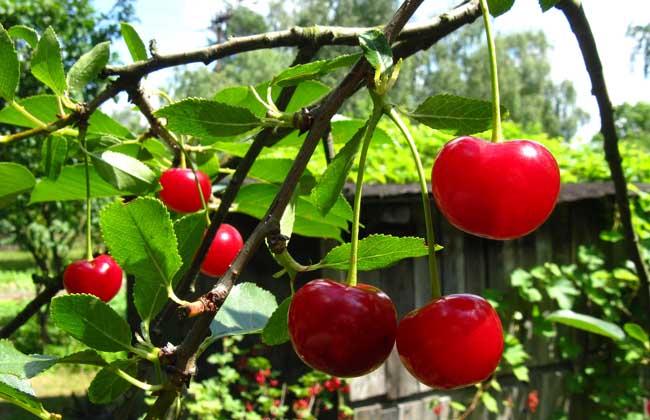
In principle, cherry pruning is mainly carried out during the growing season, but due to the constraints of actual production conditions, sometimes when growing-season pruning work is not done thoroughly enough, it needs to be adjusted through pruning before spring budbreak. Pre-budbreak pruning should avoid cutting large branches as much as possible, reducing wounds to prevent gummosis, and should focus on thinning out overly dense branches and competing branches, with few heading cuts. Let's take a look at cherry tree pruning techniques below!
Cherry Tree Pruning Timing
1. Summer pruning: The purpose of summer pruning is to reduce ineffective growth of new shoots, increase the amount of branches and leaves, improve light conditions, and enable the tree to take shape early, form flowers early, and bear fruit early. The main pruning methods include spreading the angle, pinching, twisting shoots, bud removal, girdling, and scoring.
2. Winter pruning: Winter pruning refers to pruning carried out after the tree enters winter dormancy. Its main methods include heading, leaving branches unpruned, renewal pruning, and branch thinning.
Cherry Tree Pruning Principles
1. Newly planted young trees: For young trees, remove overly vigorous upright main branches on the central leader and overly vigorous water sprouts on the main branches. For the retained main branches and lateral branches on the main branches, focus on bending branches to open the angle and scoring buds. The opening angle of main branches should be 60-70 degrees, and the opening angle of lateral branches should be 70-80 degrees. When bending branches, they should be pulled into a straight line, and must not be pulled into a bow shape. Bud scoring is generally carried out in early March before buds break, on the main branches, with the purpose of promoting lateral branches.
2. Trees in the early fruiting stage: For trees in the early fruiting stage, adjust the tree structure and pay attention to cultivating fruiting branch groups on the main branches. First, gradually thin out main branches that are too low or too dense, so that the main branches do not affect each other. Second, appropriately renew-prune branches without branching to promote branching. Third, renew-prune or head back overly weak lateral branches to rejuvenate them, and open the angle of overly vigorous ones to moderate their growth and promote flower formation.
3. Trees in the full fruiting stage: Adjust the tree structure well to improve light and airflow conditions within the canopy. Excess upright branches, overly dense branches, overlapping branches, and crossing branches that sprout within the canopy should be resolutely thinned out, and the spacing between layers should be opened up to avoid disrupting the tree shape and consuming nutrients. For trees that are too tall, promptly drop the top and open the center, using weak branches as the leader to control canopy height.
Cherry Tree Pruning Techniques
1. Natural open-center form: The tree shape is similar to the natural open-center form of peach trees, with a trunk height of 30-40 cm, no central leader, and 3-5 main branches for the whole tree, with an opening angle of 30-40 degrees. Each main branch retains 2-3 lateral branches extending outward, with an opening angle of 70-80 degrees. Different types of fruiting branch groups are cultivated on the main branches and lateral branches. The tree height is controlled at about 3 m, and the canopy is oblate or round.
2. Improved central leader form: Trunk height is 50-60 cm, with an upright central leader. More than 10 main branches extending in a single axis are arranged on the central leader, spiraling and distributed on the central leader at an angle close to horizontal. The main branches can be layered or not obviously layered, and fruiting branch groups are borne on the main branches. The tree height is generally about 3 m; when planting density is low, it can be taller, and when density is high, it can be shorter.
3. Free spindle form: There is 1 upright, robust central leader, and the whole tree retains 10-12 small main branches distributed on the central leader. The lower main branches are longer and the upper main branches are shorter, with a trunk-to-branch ratio of 3-3.5:1. The main branches can be arranged with 3-4 at the base as one layer, with an in-layer spacing of 30-40 cm, and above that the main branches are no longer layered, so that the main branches are arranged in a spiral, evenly staggered upward. The main branches are large at the bottom and small at the top; on the same tree, the opening angle of the main branches differs according to their position, with lower main branches at 80-85 degrees and middle and upper main branches at 85-90 degrees. The whole tree has main branches but no lateral branches, and fruiting branch groups are directly on the main branches.
4. Slender spindle form: It has a central leader, trunk height 40-60 cm, tree height 2-3.5 m, and canopy diameter 1.5-2.5 m. The first layer has three main branches, and the main branches have no lateral branches but directly bear fruiting branch groups. On the central leader above the first layer of main branches, 15-25 lateral branches of relatively uniform size and horizontal growth are evenly distributed, arranged in whorls without layering. The lower branches are slightly longer and the upper branches slightly shorter. The whole tree is slender, with an acute angle at the top, and the entire tree shape is a slender spindle, suitable for dense planting and dwarfing cultivation.
5. Small open-center layered form: Trunk height 30-60 cm, tree height 3.0-3.5 m, canopy diameter 3.0-3.5 m. There are 6 main branches in 3 layers: 3 in the first layer, 2 in the second layer, and 1 in the third layer. The basal angle of the main branches is 60-70 degrees, and the spacing between layers is 60 cm. Main branches above the second layer do not retain lateral branches and directly bear fruiting branch groups.
Precautions for Cherry Tree Pruning
1. Winter pruning can be carried out throughout the entire dormancy period, but for cherries, the later the better. Generally, pruning near budbreak is preferable.
2. Cherry flower buds are lateral pure flower buds, and terminal buds are leaf buds. After flowering and fruiting, flower buds form blind nodes and no longer sprout. When pruning fruiting branches, the bud at the cut must not be left on a flower bud; it should be left on 2-3 leaf buds above the flower bud section.
3. After the trunk and branches of the tree are injured, they are susceptible to infection by pathogens, leading to gummosis or disease. Therefore, in field management, special care should be taken not to damage the tree body and branches. Girdling should be used cautiously on cherry trees, as gummosis and breakage easily occur after girdling.
4. Cherry trees are light-loving and strongly apically dominant. If too many peripheral branches are headed back during training and pruning, the number of peripheral branches will become too large, branches will become crowded, the top will be strong and the bottom weak, and small branches and fruiting branch groups in the inner canopy will easily weaken and die.