Detailed Explanation of Key Techniques for Greenhouse Cherry Cultivation
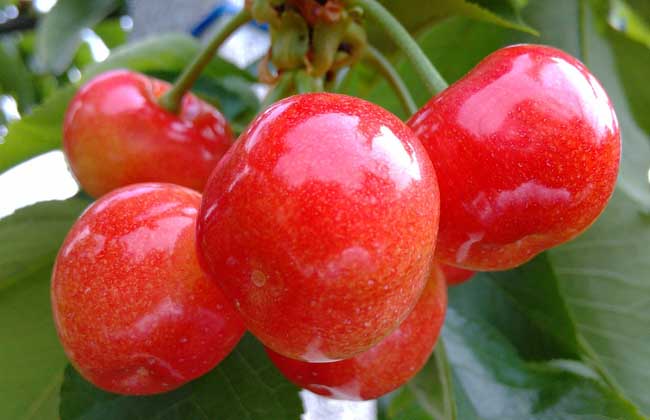
Greenhouse cherry cultivation requires low investment and yields high output value. Using greenhouse cultivation in early spring can bring cherries to market ahead of schedule and achieve considerable economic benefits. Through greenhouse trials, the yield reached fruiting in three years and over 1,000 jin per mu in five years, with income per greenhouse exceeding 30,000 yuan, demonstrating extremely high economic value. Now let us take a look at greenhouse cherry cultivation techniques together!
Cherry Tree Growing Environment
Cherry is a fruit tree that prefers light, warmth, moisture and fertilizer, suitable for growing under climate conditions with an annual average temperature of 10-12°C, annual precipitation of 600-700 mm, and annual sunshine hours of over 2,600-2,800 hours. Areas where the period with daily average temperature above 10°C lasts 150-200 days and the extreme minimum winter temperature is not lower than -20°C can all grow well and bear fruit normally. If the local area experiences frost damage, the cherry orchard site can be chosen on northwest slopes where temperature rises slowly in spring and air circulation is good. Considering that cherry roots are shallow and prone to windthrow, the orchard site should preferably be in areas not susceptible to wind damage, and the soil should preferably be loose-textured, deep sandy loam.
Cherry Orchard Greenhouse Construction
1. Site selection: When building the greenhouse, choose loam or sandy loam that is sheltered from wind and faces the sun, with sufficient sunlight, flat terrain, convenient drainage and irrigation, and loose soil texture. Based on the greenhouse's heat dissipation conditions, the greenhouse area should preferably be 300-400 sq m, and it should generally be built as an east-west oriented single-slope greenhouse.
2. Greenhouse construction: To reduce costs, the north wall can be made of earth. The east and west walls are 3 m high, and at 2 m from the north wall the height is 3.5 m, supported by gypsum strips (with steel bars inside). The south wall is 2.5 m high, and the east and west walls each have a working door and ventilation windows. The windows are 1.5 m above the ground. The inner sides of the north and south walls are both covered with mud plaster (except the windows) for cold protection and heat insulation. Inside the greenhouse, gypsum strips (with steel bars inside) serve as main columns, with row spacing and column spacing of 3.5 m. Above the columns, moso bamboo is used as the framework, connecting the south wall and north wall, tied into 50 cm square grids, covered with anti-drip film, and then a layer of straw curtains is laid on top of the film. The greenhouse covering time should be controlled between late December and early January.
Cherry Tree Variety Selection
1. The purpose of establishing greenhouse cherries is to bring cherries to market earlier and obtain higher economic benefits, so when selecting varieties, excellent varieties with early maturity and high self-pollination fruit-setting rate should be chosen. Such as Hongdeng, Dahong, Zhusha, Jianye and other varieties. At the same time, pollinator trees (such as Lapins or Stella) should be configured at a ratio of 4:1 to prevent situations such as low self-fruit-setting rate and poor quality.
2. In order to use land more economically and see benefits earlier, cherry saplings should be chosen as strong seedlings with robust roots, many fibrous roots, thick stems, and plump buds, or 5-8 year old early-fruiting trees that are relatively short with more inner-canopy branches. The rootstock should be wild cherry seedling rootstock, and dwarfing rootstock (such as Laiyang dwarf cherry) should be used as an interstock.
Cherry Tree Pruning Techniques
1. For young trees, remove excessively vigorous upright main branches on the central leader and excessively vigorous water sprouts on the main branches. For the retained main branches and lateral branches on the main branches, focus on bending branches to open the angle and notching buds. The opening angle of main branches should preferably be 60-70 degrees, and the opening angle of lateral branches should preferably be 70-80 degrees. When bending branches, they should be pulled into a straight line, and must not be pulled into a bow shape. Bud notching is generally carried out in early March before buds sprout, on the main branches with the purpose of promoting lateral branch development.
2. For trees in the early fruiting stage, 4-7 years old, it is necessary to adjust the tree structure and pay attention to cultivating fruiting branch groups on the main branches. First, gradually remove main branches that are too low and too dense, so that each main branch does not affect the others. Second, appropriately retract branches without branching to promote branching. Third, retract or heading-back overly weak lateral branches to rejuvenate them, and for overly vigorous ones, open the angle to moderate the growth vigor and promote flower formation.
3. For trees in the full fruiting stage, adjust the tree structure well and improve light and air conditions within the canopy. Excessively vigorous upright branches, overly dense branches, overlapping branches, crossing branches and others that sprout inside the canopy must be resolutely removed, opening the layer spacing to avoid disrupting the tree shape and consuming nutrients. If the tree is too tall, promptly drop the top and open the center, using weak branches as the leader to control canopy height.
Cherry Tree Flower and Fruit Management
1. During the initial flowering stage and around the full flowering stage of cherries, spray "Yunda - Quanshuguo" at 1,500-2,000 times dilution 1-2 times, which can fully promote the normal development and elongation of pollen buds and pollen tubes, significantly increase the fruit-setting rate, and at the same time help pollination and fertilization and reduce flower and fruit drop.
2. During the young fruit expansion stage of cherries, spraying "Yunda - Quanshuguo" at 2,000 times dilution can reduce detachment at the fruit stalk area, prevent the formation of the fruit stalk abscission layer, reduce secondary physiological fruit drop, and at the same time fully promote synchronous cell division and elongation, making the fruit stalk robust and elongated, accelerating uniform fruit growth, promoting the synthesis and conversion of fruit sugars, and can noticeably increase the selling price.
3. In the early stage of fruit coloring, take measures such as leaf removal and laying reflective film 10-15 days before harvest to promote fruit coloring. Spray calcium salt before harvest (spraying 0.3% calcium chloride solution 3 times consecutively at one-week intervals before harvest can reduce cracking of large cherries and extend shelf life).