What does a pomegranate tree look like? Detailed introduction to its morphological characteristics
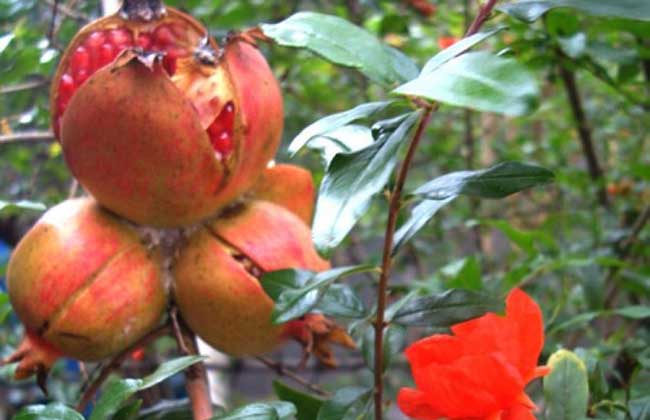
The pomegranate is a deciduous tree or shrub of the genus Punica in the family Lythraceae. The history of pomegranate cultivation in China can be traced back to the Han Dynasty; according to Lu Gong's records, it was introduced from the Western Regions by Zhang Qian. The fruit is rich in nutrients, with a vitamin C content one to two times higher than that of apples and pears. Many friends have eaten pomegranates, but have never seen what a pomegranate tree looks like. Below, let us take a look at what a pomegranate tree actually looks like!
Trunk
In the tropics, the pomegranate tree is an evergreen tree. Its crown is clump-shaped and naturally rounded. The roots are yellowish-brown, and the tree grows vigorously, readily producing root suckers at the base. The tree can reach 5-7 m in height, generally 3-4 m, but dwarf pomegranates grow only about 1 m tall or even shorter. The trunk is grayish-brown, with tumor-like protrusions, and the trunk often twists to the left.
Crown
The crown of the pomegranate has many branches. Young branches are angular, mostly square in shape; the twigs are flexible and not easily broken. Primary branches alternate oppositely on vigorously growing twigs and bear small thorns. The length of the thorns is related to the variety and growing conditions. Vigorous trees have more thorns, while old trees have fewer. The color of the buds changes with the seasons, appearing in three colors: purple, green, and orange.
Leaves
The leaves of the pomegranate are opposite or clustered, long-lanceolate to oblong, or elliptic-lanceolate, 2-8 cm long and 1-2 cm wide, with pointed tips, a glossy upper surface, a raised midrib on the underside, and short petioles.
Flowers
The flowers of the pomegranate are bisexual. Depending on whether the ovary is well developed, they are divided into bell-shaped flowers and tubular flowers; the former has a well-developed ovary and is good at fertilization and fruiting, while the latter often withers without setting fruit. The petals are obovate, equal in number to the sepals and alternating with them, arranged in an imbricate pattern. Flowers are divided into single-petaled and double-petaled types. Double-petaled varieties often have pistils and stamens transformed into petals and are sterile, with as many as dozens of petals. The flowers are mostly red, but there are also white, yellow, pink, and agate colors. The stamens are numerous, and the filaments are hairless. The pistil has 1 style, longer than the stamens, with 4-8 carpels and an inferior ovary.
Fruit
After the pomegranate fruit matures, it becomes a large berry with many chambers and many seeds, with numerous seeds in each chamber. The outer seed coat is fleshy, bright red, pale red, or white, juicy, sweet with a hint of sourness, and is the edible part. The inner seed coat is horny, and in some varieties it degenerates and softens, namely the soft-seeded pomegranate. The flowering period of the fruiting pomegranate is May to June, with pomegranate flowers like fire, and the fruiting period is September to October.