Is wild banana actually a banana? Explained clearly in one article
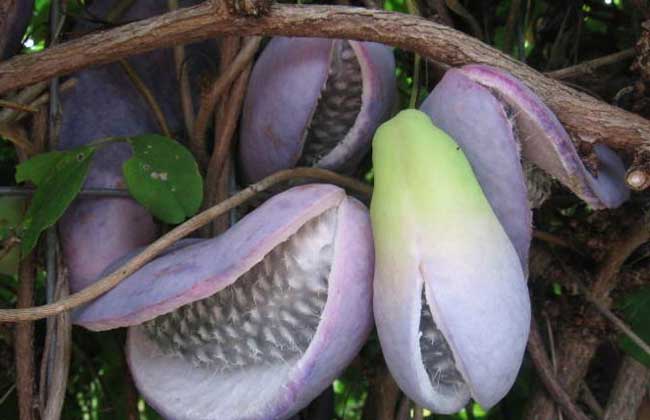
Wild banana is not a banana. It is also known as August melon, August crack, August yellow, August zha, three-leaf akebia, and so on. It is a perennial vine of the genus Akebia in the family Lardizabalaceae. It was originally a tribute of the ancient Chinese imperial court and is distributed from the Himalayas to southwestern China, mainly in the valleys of Guangyuan in Sichuan and Pingwu County in Mianyang City, and most valleys of Guiyang in Chenzhou, Hunan. It is also found in the Funiu Mountains of Luanchuan in Luoyang, Shaanxi and Henan, and is also commonly known as August zha in Zhejiang. In many places in Guizhou Province, it is called August melon.
The stems and branches of wild banana have obvious linear markings. The palmately compound leaves have 3 to 9 leaflets, and the petioles are slightly slender. The leaflets are nearly leathery and smooth, ovate, ovate-oblong, narrowly lanceolate, or linear-lanceolate, with acuminate or caudate-acuminate tips, rounded or broadly wedge-shaped bases, sometimes nearly truncate, dark green and glossy above, pale green below. Several flowers form a corymbose raceme, and the common peduncle is slender. The male flowers are greenish white, with oblong outer sepals and obtuse tips; the inner ones are narrower, oblong-lanceolate, and acute at the tip; the petals are very small, obovate, and less than 1 mm long. The female flowers are purple, with ovate-oblong outer sepals.
Because wild banana ripens in August, it is also called August melon in Guangyuan, Sichuan and Pingwu County, Mianyang City. Local people have a saying: August melon, September crack. So August melon only splits open in September, and its inner flesh is eaten. Most of the inside of the skin contains seeds, but the flesh is suitable for eating. It tastes sweet, juicy, and similar in texture to banana.
The fruit shape of wild banana is long, round, and unusual. A single fruit weighs about 130 grams. After the fruit ripens in the 8th lunar month, it cracks open naturally. The flesh is white, fragrant, sweet, and glutinous. It combines ornamental, edible, cosmetic, medicinal, and health-care functions, hence the name “Purple Treasure”. In summer, you can go up the mountain to look for this fruit to eat. It can be picked when 80% ripe and placed in rice bran for two days before eating. It is very delicious, with a thick skin. After peeling it open, it can be sucked directly; inside is yellow flesh and black seeds.
Wild banana has medicinal and health-care functions such as soothing the liver, tonifying the kidney, relieving pain, reducing inflammation, promoting urination, and removing dampness. Pharmacologically, it mainly treats conditions such as stubborn tinea, alopecia areata, impotence, and constipation. Fresh fruit is resistant to storage and transport, and dried fruit slices can be used directly as medicine. It is especially suitable for planting in parks, along highways, on streets, in courtyards, around houses, and in scenic areas. Relevant experts agree that developing this new health-care medicinal fruit industry can both beautify the environment and maintain ecological balance, and can also create wealth for society. The market is expected to have good development prospects.
Wild banana “Purple Treasure No. 2” is one of the very early-maturing improved varieties that researchers have developed through years of cultivation improvement and selective breeding. It has particularly strong stress resistance and no pests or diseases. Planted in the same year, it bears fruit in the same year. The fruit color is purple-red, and the largest single fruit can reach 200 grams. It matures in late July of the lunar calendar. It is cultivated and managed on trellises like grapes. It is coarse-growing and easy to grow. Plant 300 holes per mu, with 2 plants per hole. In full fruit period, the yield per mu is 2500 to 3000 kg. Propagation methods are division or cuttings, layering, and raising seedlings from seeds.