What Kind of Nut Is the Hickory Nut? Explained Clearly in One Go
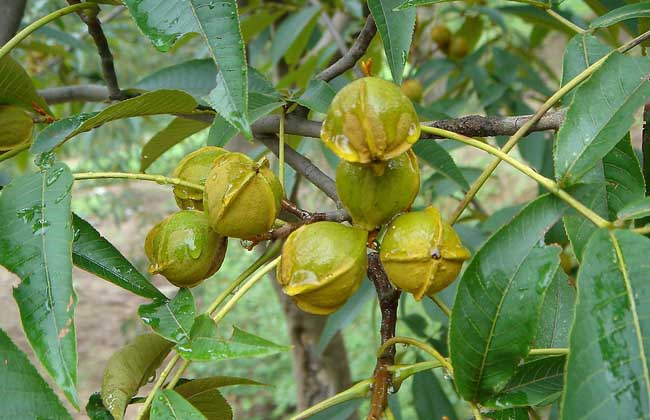
The hickory nut, also known as Manchurian walnut, Chinese walnut, small walnut, and so on, is a deciduous tree of the genus Carya in the family Juglandaceae. Because its fruit has extremely high nutritional value and a unique taste and flavor, it has won consumer recognition and gradually become a widely popular premium nut. China is one of its places of origin, and it is mainly produced in the Tianmu Mountain area at the border of Zhejiang and Anhui, the Changbei area, and Henglu Township, and other places. It is suited to growing in sparse forests at the foot of mountains or in valleys rich in humus.
The hickory tree reaches 10 to 20 m tall, with a diameter at breast height of 30 to 60 cm. The bark is smooth and grayish white, the twigs are slender, and the new branches are densely covered with shield-shaped orange-yellow glands. The compound leaves are 16 to 30 cm long; the petiole is covered with hairs and glands when young, and the hairs gradually fall off later, while the leaf rachis is rather densely hairy and the hairs do not fall off easily. The leaflet margins have fine serrations; when young, only the midvein, lateral veins, and leaf margins have soft hairs on the upper surface, while the lower surface has persistent or shed hairs on the veins and is fully covered with orange-yellow glands. The lateral leaflets have short petiolules or are almost sessile, lanceolate or obovate-lanceolate, with a wedge-shaped or slightly rounded base. The terminal leaflet has a petiolule about 5 to 10 mm long and is the same shape, the same size, or slightly larger than the lateral leaflets at the upper end.
The male catkins of the hickory tree are borne 3 together in a bundle, and the inflorescence axis is covered with soft hairs and glands. The male flowers have short stalks, the bracts are narrow, long-elliptic-linear, the bracteoles are triangular-ovate, and 2 to 7 stamens are borne on the slender receptacle; the anthers are hairy. The female spike is upright, the inflorescence axis is densely covered with glands, and it bears 1 to 3 female flowers; the female flowers are ovate or broadly elliptic. The fruit is obovate and gradually narrowed toward the base; the exocarp is leathery after drying, the nutlet is obovate or elliptic-ovate, the endocarp is hard and pale grayish yellow-brown, and there are no cavities within the septum or the wall. It flowers in April to May, and the fruit ripens in September.
The hickory nut kernel is crisp and sweet with an inviting aroma. It can be pressed for oil, stir-fried for eating, and also used as an ingredient in making candies and pastries. The kernel contains 7.8 to 9.6% protein, more than 7 kinds of essential amino acids for the human body with a content as high as more than 25%, and also 22 kinds of trace elements needed by the human body, among which calcium, magnesium, phosphorus, zinc, and iron are especially rich. Every 1 kg of hickory nut kernels equals the nutritional value of 9 kg of fresh milk, 5 kg of eggs, or 2 kg of beef, and its nutrients are easier for the human body to absorb than those of milk, eggs, and beef. It also has various effects such as moistening the lungs and tonifying qi, nourishing the blood and relieving asthma, moistening dryness and resolving phlegm, and dispelling deficiency cold.
The shells of hickory nuts can be made into activated carbon; the shells, husks, branches, and leaves can produce natural plant fuel; the involucre can be used to extract tannin; and the wood can be used to make furniture and for military use. The trunk of the hickory tree is straight, the crown is nearly broadly ovate, the root system is well developed, and it is tolerant of water and moisture. It can be planted singly or in clusters by lakesides and on lawns, is suitable as a shade tree and street tree, and is also suited to greening and afforestation along river banks and in plain areas. It is an excellent tree species for urban and rural greening and a dual-purpose tree for both fruit and timber, and large economic forests can be established on both banks of the Yangtze River in Jiangsu Province.