Where are mangoes grown? Introduction to the distribution of main producing areas
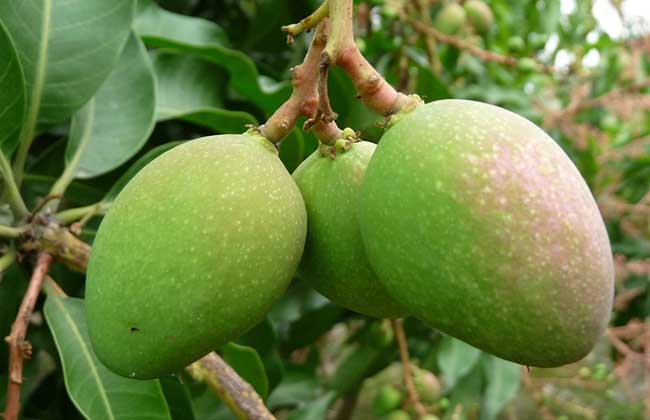
The mango is an evergreen large tree of the genus Mangifera in the family Anacardiaceae, also known as mameng, momengguo, mangguo, wangguo, and so on. It is one of the famous tropical fruits. Its content of carotene, the precursor of vitamin A, is remarkably high among all fruits, and its vitamin C content is not low either. Minerals, protein, fat, sugars, and so on are also its main nutrients. Now let us take a look at where mangoes are grown!
Where are mangoes grown?
The mango originated in India and is mainly distributed in India, Bangladesh, the Indochinese Peninsula, and Malaysia. It grows in forests on hillsides, in river valleys, or in open country at altitudes of 200 to 1350 m. It has been widely cultivated around the world, and more than a hundred varieties have been bred. In China, it is mainly produced in Yunnan, Guangxi, Guangdong, Fujian, Taiwan, China, and other places, and more than 40 varieties have been cultivated in China.
The production environment of mangoes
1. Temperature: The mango likes warmth and cannot tolerate cold or frost. The most suitable temperature for growth is 25 to 30°C. Below 20°C, growth is slow. Below 10°C, the leaves and inflorescences stop growing, and nearly ripe fruit suffers cold damage. The effective temperature for growth is 18 to 35°C, the suitable temperature for shoot growth is 24 to 29°C, and fruit set and young fruit growth require an average daily temperature greater than 20°C.
2. Light: The mango is a light-loving fruit tree. Sufficient light can promote flower bud differentiation, flowering and fruit set, and improve fruit quality and appearance. Usually, a single tree on the sunny side of the canopy or in an open environment flowers more and has a higher fruit-setting rate. Mangoes with excessive branches and leaves, a shaded canopy, and insufficient light flower and fruit less, and the fruit appearance and quality are both poor. Through pruning and shaping, the light conditions in the orchard and within the tree can be improved to increase yield and extend the peak production period.
3. Water: Mangoes grow well in areas with annual rainfall of 700 to 2000 mm. In South China, the uneven distribution of annual rainfall often affects growth and development. If the air is too dry during the flowering period and the early fruiting stage, it easily causes flower and fruit drop. Too much rain also leads to flower rot and poor pollination and fertilization. If summer rainfall is too concentrated, it often induces serious fruit diseases. Autumn drought after harvest mostly affects the sprouting and growth of the mother branches of autumn shoots.
4. Soil: Mangoes are not demanding about soil and can be cultivated in areas below 600 m in altitude. However, loam or sandy loam with deep soil layers, a groundwater level below 3 m, good drainage, and slight acidity is preferable.
Cultivated varieties of mango
1. Guiqi mango: Guiqi mango is also known as Guire No. 82, commonly called Guiqi mango. The tree vigor is medium, the branches are spreading, and the flowering period is relatively late. It is a late-maturing variety, ripening in mid to late August, with high and stable yields.
2. Tainong No. 1: Tainong No. 1 mango is a new dwarf early-maturing variety selected and bred by the Fengshan Tropical Horticulture Branch in Taiwan Province, China, by crossing Haden and Irwin. After being introduced to Hainan Province, it showed relatively high yield in trial planting in Sanya. Grafted seedlings bear fruit 3 years after planting, and the yield per tree can reach 5 to 10 kg or more. It ripens from late April to early May, and a single fruit weighs 150 to 200 g. It has strong resistance to anthracnose, tolerates storage and transport, and has a long shelf life. It is currently the main cultivar in Hainan.
3. Green-skinned mango: Thai Baihua mango is also known as green-skinned mango. It originated in Thailand. Its characteristic is that there is an obvious groove from the ventral shoulder to the belly of the fruit. The peel is mostly dark green, and the flesh is pale yellow, smooth in texture, richly sweet, aromatic, low in fiber, and excellent in quality. The seed is thin and flat, and polyembryonic. The yield is medium, and the plant is susceptible to gummosis. Its peel is green and its flesh color is pale, which in some places affects its market and value.
4. Jinhuang mango: Jinhuang mango is a variety bred in Taiwan, China. The tree is vigorous, and the canopy is tall and large. The flowers are large and sparse. The fruit is very large and the stone is thin. The taste is sweet, aromatic, and refreshing, with abundant juice, no fiber, and good storage tolerance. The average single fruit weighs 1200 g. When ripe, the peel is orange-yellow. The quality is excellent and the commercial value is good, with a sugar content of 17%. It is mid-maturing and resistant to anthracnose.
5. Keitt mango: Keitt mango is one of the main cultivars in the United States and also a main cultivar in Taiwan, China. In 1991, it was introduced from the United States to the South China College of Tropical Crops. Top-grafted trees bore fruit after 2 years, with a yield per tree of 10 kg. They bore fruit continuously from 1993 to 1994, ripening in July to August. A single fruit weighs about 400 g and is oval, with a yellow or orange-yellow ground color and a dark red blush. The flesh is thick, smooth in texture, low in fiber, sweet and aromatic, and excellent in quality. The seed is small, accounting for only 7.5 to 8% of fruit weight, and is monoembryonic.
6. Red Ivory mango: Red Ivory mango was selected by Guangxi Agricultural College from the seedling progeny of White Ivory. It has strong growth vigor and abundant branches and leaves. The fruit is long and round, slightly curved, with a light green peel color. During the fruiting period, the sun-facing side of the peel is bright red, and the appearance is attractive.
7. Yuwen mango No. 6: Yuwen mango No. 6 has large fruit, with an average single fruit weight of 1000 to 1500 g. The fruit shape is showy and purplish red. It has relatively much fibrous tissue, a thin stone, a high edible rate, delicate flesh, and a good taste. The soluble solids reach 17 to 19. Its yielding performance is relatively good. It was introduced from Taiwan, China, in 2002 and has a certain area and yield.
8. Binlin No. 1: Binlin No. 1 has a showy fruit shape and a peach-like color. Its sweetness is about 19 degrees, and its taste and flavor are especially good. The fruit weighs about 500 g. It was introduced from Taiwan, China, in 2002 and has a certain area and yield.
9. Guifei mango: Guifei mango is also known as Hongjinlong. It is a variety selected and bred in Taiwan Province, China, and was introduced to Hainan Province in 1997. It has strong growth vigor, early production, and high yield. A 4- to 5-year-old grafted tree has a yield per tree of 20 to 30 kg or more, bears fruit every year, and its fruiting performance is no worse than that of Tainong No. 1, but it matures earlier. A single fruit weighs 300 to 500 g. At present, it has become one of the main cultivars in Hainan.