What plant does the dragon fruit come from?
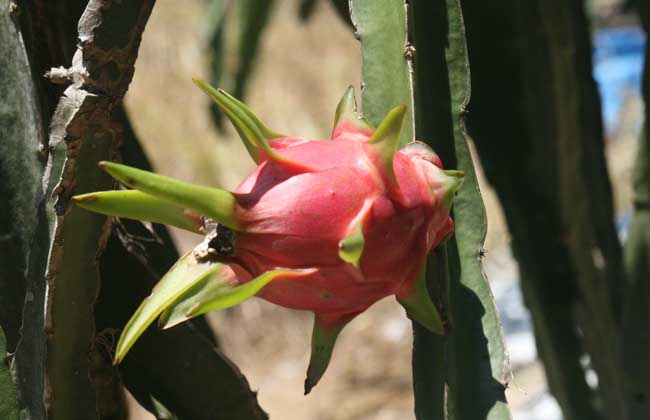
The dragon fruit is the fruit of a perennial climbing succulent plant in the cactus family, genus Hylocereus, also known as red dragon fruit, green dragon fruit, immortal honey fruit, jade dragon fruit, and so on. It originated in Central America, in places such as Costa Rica, Guatemala, Panama, Ecuador, Cuba, and Colombia, and was later introduced to Southeast Asian countries such as Vietnam and Thailand, and to Taiwan, China. It is also cultivated in the mainland Chinese provinces and regions of Hainan, Guangxi, Guangdong, Fujian, Yunnan, and Guizhou.
The dragon fruit plant has no main root, and its lateral roots are distributed in large numbers in the shallow surface soil layer; it also has many aerial roots and can grow by climbing. The stems are dark green, thick and sturdy, up to 7 m long and 10-12 cm thick, with 3 ribs. The ribs are flat with wavy edges, and climbing roots grow at the stem nodes, allowing it to attach to other plants and grow. There are mostly 3 ribs, and small spines are found in the depressions of each stem node. Because it has long grown in tropical desert regions, its leaves have degenerated, and the function of photosynthesis is carried out by the stems. The interior of the stem consists of a large number of thin-walled cells full of viscous liquid, which helps it absorb as much water as possible during the rainy season.
Inside the buds of the dragon fruit there are relatively many compound buds and mixed bud primordia, which can sprout into leaf buds or flower buds. In the early stage of flower bud development, under suitable temperature conditions, they can transform into leaf buds. The vigorously growing tissue at the tip of the branches can also produce flower buds under appropriate conditions. The flowers are white, with a huge inferior ovary, and the flower is about 30 cm long, hence it is also called the overlord flower. The calyx tube is tubular, about 3 cm wide, with green (sometimes pale purple) lobes and scales 3-8 cm long. The petals are broad, pure white, upright, oblanceolate, and entire. The stamens are numerous and slender, up to 700-960 in number, equal in length to the style or shorter. The anthers are cream-yellow, and the filaments are white. The style is thick, 0.7-0.8 cm, cream-yellow. The stigma lobes of the pistil number up to 24.
The fruit of the dragon fruit is oblong or ovate, with a red skin, fleshy, and bearing ovate scales with an acute tip. The fruit is 10-12 cm long, and the rind is thick and waxy. The flesh is white or red, and contains nearly ten thousand fragrant sesame-like seeds, which is why it is called the sesame fruit. It gets its name because its exterior looks like an angry red fireball, while the flesh inside is like sweet cream, yet filled with small black seeds; the texture is mild and the flavor is delicate and fragrant.
The dragon fruit is a tropical and subtropical fruit. It likes light and tolerates shade, tolerates heat and drought, likes fertilizer and tolerates poor soil. It grows rapidly in a warm, humid environment with ample light. When cultivated in the open field in spring and summer, it should be watered more to keep its root system in vigorous growth; during continuous rainy weather, drainage should be carried out promptly to avoid infection by pathogens that causes the stem flesh to rot. Its stems can also grow attached to rocks, and the plant has very strong wind resistance; as long as the support is firm, it can withstand typhoons. It can tolerate a low temperature of 0°C and a high temperature of 40°C, and the optimum temperature for growth is 25-35°C. It can adapt to many kinds of soil, but neutral soil and slightly acidic soil rich in humus and with good water and fertilizer retention are best.
The dragon fruit is a tropical fruit, and it is best to eat it soon after purchase. It is not only sweet and fragrant, but also has high nutritional value, combining the merits of fruit, flower buds, vegetables, and medicine. Its nutritional components include protein, dietary fiber, vitamin B2, vitamin B3, vitamin C, iron, phosphorus, calcium, magnesium, potassium, and so on. It is rich in a large amount of fruit flesh fiber and abundant carotene, vitamin B1, B2, B3, B12, C, and so on. The seeds are even richer in minerals such as calcium, phosphorus, and iron, as well as various enzymes, albumin, fiber, and high concentrations of the natural pigment anthocyanin. The flowers, stems, and young shoots also have the various effects of its close relative, aloe.