What are the reasons a miracle fruit does not bear fruit?
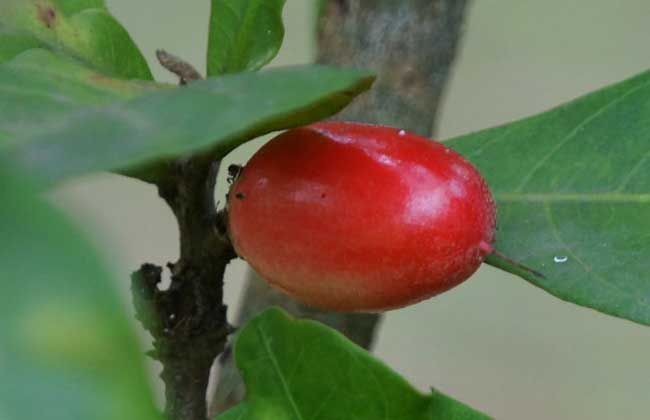
The miracle fruit (Synsepalum dulcificum) is a typical tropical evergreen shrub, native to the regions of West Africa, Ghana, and the Congo. It is cultivated in Guangdong, Guangxi, Yunnan, and Hainan in China. It prefers high temperatures and high humidity, with an optimum growth temperature of 20-30°C. Cultivation requires well-drained, organic-rich, acidic sandy soil with a pH of 4.5-5.8. Let us take a look below at why the miracle fruit does not bear fruit!
When does the miracle fruit ripen?
The fruit of the miracle fruit does not ripen uniformly, with peak fruiting periods usually in March, June, and October. The fruit is small and oval, turning bright red when ripe, with white, juicy flesh, and is pollinated by insects such as ants. The miracle fruit was introduced to China in the 1960s and is now cultivated as an ornamental garden plant in many regions. It produces small white flowers in September each year, sets fruit in October, and in November the fruit turns from green to red and ripens.
What is mysterious about the miracle fruit?
The miracle fruit contains a taste-modifying protease (miraculin). Although it cannot truly change the flavor of food, it can change a person's sense of taste, so after eating a miracle fruit, anything sour tastes sweet. After eating a miracle fruit, the miraculin is distributed on the taste bud cell membranes of the tongue. In a neutral pH environment, the sweet-tasting receptor protein on the miraculin does not bind to the sweet-taste receptor sites, so the miraculin itself is not sweet. Therefore, the taste-changing function of the miracle fruit is a safe change and is suitable for consumption as an everyday food.
Why does the miracle fruit not bear fruit?
1. Lack of pollination: Fruiting is the next generation produced by plant mating. If there are only males or only females, or if the male and female cannot mate, no next generation can be produced, and of course no fruit or seeds can be produced either. Therefore, artificial means can be used to help the miracle fruit pollinate. The method is to raise flies beside the pot during the flowering period; flies can also pollinate effectively.
2. Environmental factors: During the flowering period, the flowers and pollen of the miracle fruit have low resistance to the environment, so during the flowering period of the miracle fruit it is best to avoid factors such as low temperatures, cold waves, rainfall, and strong winds. In terms of human management, when watering it is best not to pour water over the whole plant, so that the pollen is not washed away.
3. Fertilizer issues: Using fertilizer with a high phosphorus and potassium content before the miracle fruit blooms can increase the fruit-setting rate of the miracle fruit.