How many years does a jujube tree generally need to be planted before it bears fruit?
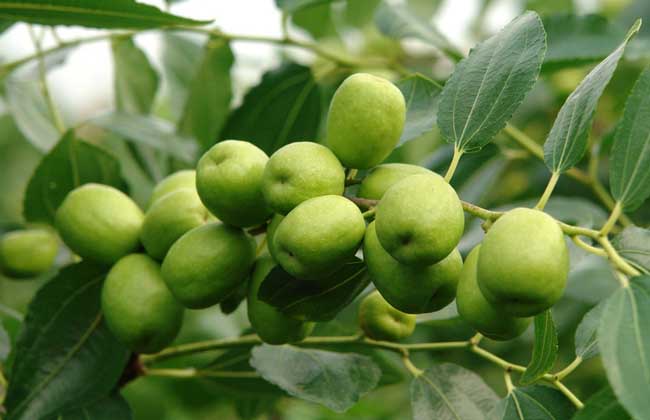
Red jujube grows in mountainous areas, hills or plains below 1700 m in altitude. It is a temperature-loving fruit tree with strong drought tolerance and waterlogging tolerance, but it requires relatively high air humidity during the flowering period, otherwise pollination and fruit set are adversely affected. It has a strong demand for light and is relatively sensitive to light response. It has strong adaptability to soil and tolerates poor soil and salinity-alkalinity, but it fears wind. Now let us take a look at how many years it takes for a jujube tree to bear fruit!
How many years after planting does a jujube tree bear fruit?
After a jujube sapling is planted, it generally bears fruit in the second year. As the saying goes, “Peach takes three years, plum four, pear five; walnut and persimmon six or seven; mulberry can feed silkworms in seven years; plant a jujube and you can sell it for money.” This refers to the short fruit-bearing period of the jujube tree.
How to protect flowers and fruits on jujube trees
1. Inhibit vegetative growth, regulate the contradiction between growth and fruiting, and promote fruit set. Such measures include root pruning, pinching, bud removal, branch thinning, girdling, ring cutting, scoring, and fertilizer and water management. Taking these measures can regulate the contradiction in nutrient distribution and transport between vegetative growth and flowering and fruiting, improve the nutritional level of the tree, and allow more nutrients to be supplied to the needs of flowers and fruits.
2. Spray water during the flowering period to increase air humidity. During the flowering period, air humidity should not be lower than 60-70%, otherwise it will have an adverse effect. Spraying in the evening or morning has a good effect, generally combined with foliar fertilization of 0.3-0.5% urea.
3. Place bees in the jujube orchard to increase pollination vectors. Some jujube varieties are self-pollinating and some are cross-pollinating. Pollination within a variety or between varieties can both achieve good fruit set, and increasing pollination vectors has a good effect.
4. Spray plant hormones and trace elements, mainly gibberellin, 2,4-D, paclobutrazol, chlormequat, B9, indolebutyric acid, indoleacetic acid, acetic acid, naphthaleneacetic acid, borax, boric acid, etc.
How can jujube trees bear more fruit
1. Three sprays during the flowering period: The flowering period of jujube trees is relatively long and is divided into three stages: early flowering, full flowering and late flowering. It can last more than one month, that is, from late May to the end of June, and generally enters full flowering around June 8. Jujube trees like humidity and fear dryness during the flowering period, but at this time the weather is hot and dry and there is a lot of windblown dust, which easily reduces the dense leaves around the stigma of jujube flowers, causing a large amount of fine dust to stick to the stigma and seriously affecting normal pollination. At the same time, under the harm of dry hot wind, the transpiration of jujube trees increases. If fertilizer and water are lacking at this time, the stigma is very likely to wither and drop. Therefore, spraying pesticides, fertilizers and water during the flowering period can greatly increase the fruit set rate of jujube trees.
2. Reasonable pruning: Pruning jujube trees can adjust tree vigor, make full use of nutrients, ensure ventilation and light penetration in the jujube tree, increase fruit-bearing positions, and reduce the number of rotten and dropped fruits, thereby achieving the goal of increasing yield. Pruning jujube trees is mainly based on thinning, combined with heading and renewal. It should be done as follows: thin overly dense branches, remove crossing branches, cut off drooping branches, shorten excessively high branches, lightly renew vigorous trees, heavily renew weak trees, appropriately remove old branches from old trees, and prune young trees around shaping. Pruning should be carried out after the Beginning of Spring and before the jujube tree buds.
3. Girdling at the right time: Girdling is ring barking. Girdling can inhibit vegetative growth, prevent jujube witches' broom disease, improve the nutritional conditions of jujube flowers and young fruits, and enable more flowers and fruits to set and fewer to drop. Therefore, the farming proverb says, “Cut a few times when flowering, and the jujube tree will bend under the weight of fruit.” Girdling jujube trees can generally increase yield by about 30%. Girdling should be carried out when one third of the jujube trees are flowering, at a position 30-40 cm from the ground, with an opening width of 0.5-0.7 cm, reaching the xylem in depth, but not damaging the cambium of the xylem. The cut should be smooth, with no burrs left. After opening, apply an appropriate amount of pesticide to the girdle opening to prevent insect damage. Jujube trees less than 7 years old, with a trunk diameter within 10 cm, or not vigorous should not be girdled. The girdling position should be changed year by year.
4. Pinching the tips of new branches: Pinching the tips of new branches can control irregular growth of the jujube tree canopy, help form a reasonable canopy, make branches evenly spaced and improve ventilation and light penetration, control the excessive growth of branches that do not need to extend, save nutrients, and help improve fruit set and fruit development and growth of jujube trees. Experiments have shown that after pinching, the longest jujube cluster on new branches can reach 45 cm and bear up to 12 fruits, which are large and plump, while on branches without pinching, the longest jujube cluster is only 25 cm and bears at most 5 fruits. Pinching should be carried out in mid-to-late May during the stage when jujube branches sprout, selecting new branches 5-7 cm long that grew that year in areas where jujube branches are dense.
5. Fertilization and watering: Jujube trees need water and fertilizer during the early flowering and late flowering stages. Generally, each mature tree is given 15 kg of cake fertilizer and 1 kg of ammonium bicarbonate or 50 kg of human excrement and urine at the early flowering stage, and 1 kg of urea or 1 kg of compound fertilizer at the late flowering stage, which can significantly increase yield. The application method is: dig a ring-shaped trench 40 cm deep and 40 cm wide two meters from the trunk, spread the fertilizer in, fill with enough water, and after the water seeps away, fill the trench level.
6. Placing bees during the flowering period: Jujube trees are typical insect-pollinated flowers and cannot pollinate themselves or rely on wind pollination, but their nectar is rich and their fragrance is strong, and bees are the best pollination vector. During the flowering period, place beehives evenly in the jujube orchard, with spacing between hives not exceeding 300 m. Bees begin activity at 11°C and are most active at 16-29°C. Using bees to collect pollen and pollinate can greatly increase the fruit set rate. However, during the period when bees are placed in the jujube orchard, it is strictly forbidden to use carbaryl and pyrethroid pesticides that are highly toxic to bees.