Detailed Explanation of Jujube Tree Planting Techniques and Cultivation Management Key Points
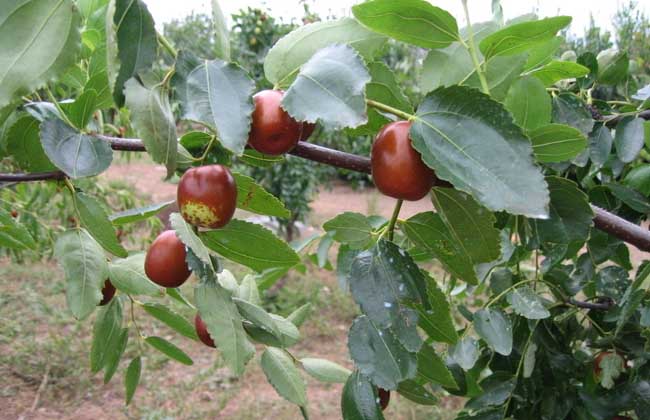
Red jujube, also known as zaozi, dazao, cizao, guanzao, etc., is a deciduous small tree of the genus Ziziphus in the Rhamnaceae family, native to China and now commonly cultivated in Asia, Europe and the Americas. It is rich in vitamin C and vitamin P. Besides being eaten fresh, it can often be made into preserved fruits and candied fruits such as candied jujube, red jujube, smoked jujube, black jujube, wine jujube and yazao, and can also be made into jujube paste, jujube flour, jujube wine, jujube vinegar, etc., giving it high planting value.
Jujube Tree Growth Habits
Jujube trees grow in mountainous areas, hills or plains below 1700 m in altitude. They are a warmth-loving fruit tree, with an average annual temperature in producing areas of about 15°C. The temperature during bud break needs to be 13-15°C, during shoot growth and leaf expansion 17°C, during flowering and fruit setting 22-25°C, and during fruit ripening 18-22°C. Jujube trees are relatively drought-tolerant and waterlogging-tolerant, but require relatively high air humidity during the flowering period, otherwise pollination and fruit setting are unfavorable. In addition, jujube has strong light requirements and is relatively sensitive to light response. It has strong adaptability to soil and is tolerant of poor soil and saline-alkali conditions. However, it is afraid of wind, so wind gaps should be avoided when establishing an orchard.
Jujube Tree Propagation Methods
1. Grafting: The main grafting methods are wood bud grafting and branch grafting. The key points of grafting technique can be summarized in six essential characters. "Fresh" - the scion should be kept fresh without water loss. "Flat" - the cut surface of the scion should be flat. "Accurate" - the cambium of the scion and rootstock should be aligned. "Tight" - after grafting, it should be wrapped tightly. "Fast" - the operation speed should be fast. "Wet" - after grafting, soil should be mounded or plastic bags should be used to maintain humidity. At the same time, 5-7 days before grafting, irrigate the rootstock nursery to make bark separation easier.
2. Root cutting: Select self-rooted plants of excellent varieties. Before sprouting, dig trenches 30-40 cm wide and about 50 cm deep around the outer canopy, cut roots with a diameter of 2 cm or less, apply organic fertilizer in the root-cutting trenches, and backfill immediately. Root suckers can emerge during the growing season. In the following spring, dig out the root suckers, treat them with ABT rooting powder or other hormones, replant them in the nursery, and cultivate strong seedlings.
3. Root cuttings: In late autumn, in combination with autumn plowing, collect roots from robust jujube trees, cut them into root segments 20-30 cm long and 1-4 cm in diameter, and store them in sand in cellars. In the following spring, open trenches for seedling cultivation, insert the root segments into the trenches at a 45-degree angle, with 2 cm exposed above the ground, and water immediately after insertion. Treating the root segments with rooting hormones and covering with plastic film gives better results.
4. Cuttings: Before cutting, first moisten the sand bed. The moisture standard is that after holes are made in the sand bed, the holes do not collapse. When cutting, use a small wooden stick to make holes in the sand bed while dipping the cuttings in slurry and inserting them. The diameter of the small holes should be larger than the diameter of the slurry-dipped cuttings, so as to avoid the medicinal solution being squeezed off by the hole walls and reducing its effectiveness. The cutting depth is about 3 cm. Too deep easily causes basal rot; too shallow causes the cuttings to topple and the roots to be exposed after rooting. After cutting, the holes should be pressed tightly so that the river sand and cuttings are closely combined.
Jujube Tree Planting Techniques
1. Orchard site selection: Jujube trees have relatively strong adaptability and do not have strict requirements for soil conditions. Wasteland and saline-alkali land can be fully used for cultivation in various places. However, in order to achieve relatively high economic benefits and produce high-quality, pollution-free products, it is best to choose orchard sites where air, water sources, soil and other environments are not polluted, the terrain is flat and open, drainage conditions are good, soil permeability is strong, aeration is good, the groundwater level is relatively high, and the soil is fertile. When planting jujube trees in mountainous and hilly areas, sunny slopes with deep soil layers should be selected; shady slopes are not suitable for planting.
2. Planting varieties: There are many varieties of jujube trees. A high-quality variety must have good tree vigor, strong resistance to diseases and insects, fruit that is resistant to cracking, good fruit shape, good fruit color, high nutrient content and good taste. At present, excellent varieties used for drying include Jinsifeng, Jinsimi, Wuhehong, Wuhe No. 1, Wuhe No. 3, Zanhuang Dazao, etc. Among early-maturing varieties, excellent varieties for fresh eating include Zaocuiwang, Jingwei Xianzao, Zaoshu Lizao, etc., and excellent varieties for processing include Lizao, Zanhuang Dazao, etc. Late-maturing varieties are mainly used for fresh eating, and high-quality varieties include Jingwei Daxuezao, Dongzao, etc. New and special varieties include Mopanzao, Hul uzao, etc. with peculiar fruit shapes, and Tailihong, Longx uzao, etc. with peculiar tree shapes.
3. Cultivation models: The first is dwarf close planting, mainly suitable for varieties that bear fruit early and have small tree types, with a plant-row spacing of 2 m × 3 m or 3 m × 2 m. The second is intercropping cultivation, mainly suitable for varieties with medium or larger tree types and later fruiting, with a row spacing of 8-10 m and a plant spacing of 3-5 m. Other crops can be interplanted among the trees in the early stage.
4. Cultivation time: Jujube trees can be planted throughout the entire dormant period from leaf fall to sprouting the following year, and this is divided into spring planting and autumn planting. According to many years of cultivation experience, when planting with 2-year-old and older root sucker seedlings, spring-planted trees should be watered thoroughly immediately, and the survival rate can easily reach more than 90%, while for autumn-planted trees, even if watered after planting, the survival rate is difficult to reach more than 90%. However, for autumn-planted trees, even without watering after planting, the survival rate can still reach more than 70%, while for spring-planted trees, if not watered, the survival rate is clearly lower than that of autumn planting.
Jujube Tree Pruning Techniques