What is the scientific name of the Elaeagnus fruit? Read this one article to understand this fruit
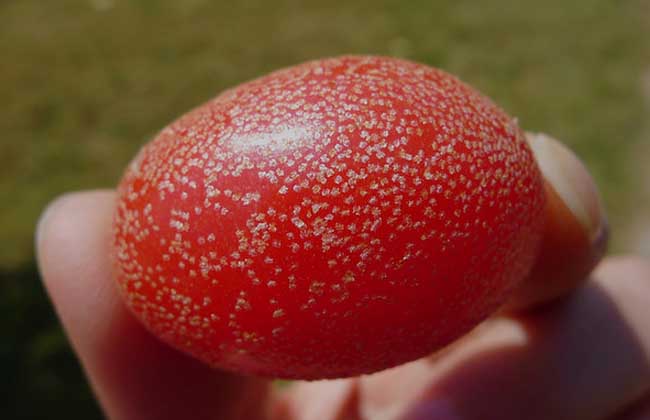
The scientific name of the Elaeagnus fruit is Elaeagnus pungens, also known as Elaeagnus pungens, Banhunchun, Luduzi, Que'ersu, Tianbangzi, Niunaizigen, Shigunzi, Sizao, Banchunzi, Shimo, Sanyuezao, Yangnaizi, Niunainai, etc. It is an evergreen upright shrub of the genus Elaeagnus in the family Elaeagnaceae. It is generally used as a fruit for eating. There are two varieties: one is sweeter, and the other has smaller fruit. The small-fruited type still grows wild on mountains now.
The Elaeagnus fruit is 3-4 m tall, thorny, with thorns terminal or axillary, 20-40 mm long, sometimes shorter, dark brown. Young branches are slightly flat and angular, densely covered with rusty scales; old branches lose their scales, are black, and glossy. Leaves are leathery, elliptical or broadly elliptical, rarely oblong, 5-10 cm long, 1.8-5 cm wide, obtuse at both ends or rounded at the base, margins slightly revolute or wrinkled-wavy, with silvery-white and a few brown scales above when young, shedding after maturity, glossy, brownish-green or brown after drying, densely covered with silvery-white and a few brown scales below, and the inner surface of the pit has white silky cotton wool. Flowering period is September-December, and fruiting period is April-June of the following year.
The Elaeagnus fruit has relatively strong cold resistance and can overwinter in the open in the southern part of North China. It can endure an absolute low temperature of about -8°C, and the suitable growth temperature is 24-34°C. It tolerates high temperature and severe summer heat. Although in its place of origin it grows under sparse forests on hillsides and in shady, humid valleys, it is not afraid of sun exposure and also has strong shade tolerance. It has low requirements for soil and can grow in neutral, acidic, and calcareous soils. It is drought-tolerant and barren-tolerant, and not waterlogging-tolerant. Its shade tolerance is average; it likes high temperature and a humid climate. Its salt tolerance, drought tolerance, and cold tolerance are good, and its wind resistance is strong. It grows in mixed mountain forests and beside sunny gully valleys. Or it may be cultivated.
The Elaeagnus fruit grows on sunny hillsides or roadsides below 1000 m elevation. Its main producing areas are Jiangsu, Zhejiang, Fujian, Anhui, Jiangxi, Hubei, Hunan, Guizhou, Guangdong, Guangxi, and other places, and it is also distributed in Japan. The roots, leaves, and fruits are all used medicinally, and it also has certain ornamental value. The main chemical components of the fruit include volatile oil, terpenoids, alkaloids, flavonoids, etc. Its pharmacological activities mainly include lowering blood sugar, lowering blood lipids, anti-lipid oxidation, anti-inflammatory and analgesic, immune, and other effects.