Key Techniques for Hazelnut Cultivation, Detailed Explanation of Cultivation and Management Methods
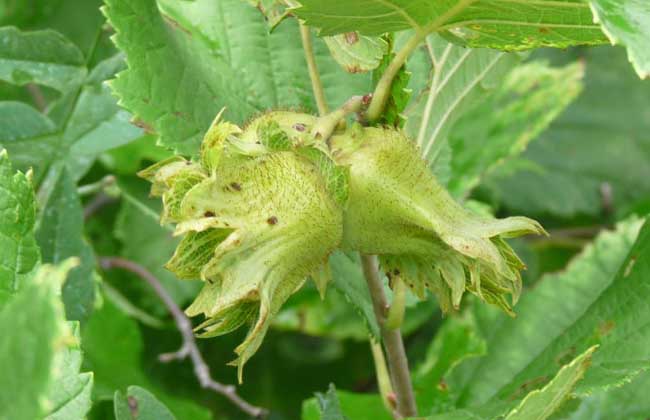
The hazelnut is a shrub or small tree of the genus Corylus in the birch family (Betulaceae), and one of the world's four major dried nuts. It has strong adaptability and can grow in mountainous areas, hilly land, gullies, and along riverbanks. Planted artificially, it begins to bear fruit in 2 to 4 years and enters full production in 5 to 7 years. Artificially reclaimed wild hazelnut groves show obvious economic benefits in 2 to 3 years, offering very high prospects for cultivation. Let's take a look at hazelnut cultivation techniques below!
Hazelnut Growing Conditions
1. Temperature: Different species of hazelnut trees have different temperature requirements. The European hazel (Corylus avellana) prefers a warm, humid climate. It is suitable for areas with an average temperature of 13 to 15°C, an absolute minimum of -10°C, and an extreme high of 38°C. Ping'ou hybrids are more cold-resistant than the European hazel and are suitable for cultivation in areas with an average annual temperature of 7.5 to 13°C and a minimum temperature that can reach -30°C.
2. Light: The hazelnut tree is a light-loving plant and generally requires annual sunshine hours of more than 2100 hours; otherwise, flower bud formation is reduced and yields are low.
3. Soil: The hazelnut tree prefers to grow in fertile, well-aerated sandy loam. Ping'ou hybrids in particular have high soil requirements; dry sandy soil, heavy clay soil, marshy land, saline land, and low-lying land are all unsuitable for establishing a hazelnut orchard. Ping'ou hybrids require a soil pH of 6.5 to 7.5, while the European hazel requires 5.5 to 7.
Hazelnut Propagation Techniques
1. Seed propagation: In wild hazelnut groves, select high-yielding plant clumps with large fruit and no pests or diseases as mother trees for seed collection, and from them choose hazelnuts with large kernels, plump kernels, and no pests or diseases for sowing. Hazelnut seeds retain germination capacity for 1 year. Spring is the suitable sowing time, generally carried out in mid-to-late April. For ridge planting, the row spacing is 60 cm and the plant spacing is 6 to 8 cm; for bed planting, the row spacing is 20 cm and the plant spacing is 5 to 6 cm. When sowing, first open furrows on the leveled ridge surface to a depth of 5 to 6 cm. Then scatter the pure seeds screened out from the moist sand into the bottom of the furrows at the above row and plant spacings, cover with 3 to 5 cm of soil, and press lightly.
2. Division propagation: There are two methods of division propagation. One is to dig up the entire mother plant and divide it into several small clumps or individual plants, each with a root system and 1 to 2 branches. The other is to dig out root suckers around the mother clump and separate out several plants while retaining the mother plant. Division seedlings should retain a 20 cm root section and a certain number of fibrous roots. After the division seedlings are separated from the mother plant, the branches should be shortened to 15 to 20 cm in length, and they should be heeled in immediately to keep them moist and prevent water loss.
3. Root sucker propagation: There are two methods of root sucker propagation. One is to dig up the root suckers around existing plant clumps to obtain nursery stock. The other is to propagate in a dedicated mother plant orchard. Mother plants intended for propagation should be cut back to the ground in spring to promote the production of root suckers from the clump. During the growing period, ensure sufficient fertilizer and water supply, and thin appropriately so that the root suckers are not too dense, ensuring both good development and growth of the root suckers and convenience for digging seedlings in autumn.
4. Layering propagation
① Horizontal layering: This can be done in autumn or spring, but spring is the most suitable. Pull vigorous one-year-old branches out horizontally and spread them on the ground, fix them in place, and do not cover with soil. Carefully protect the leaf buds so that they sprout. In this way, almost all buds on the horizontal surface can grow into new shoots. When the new shoots grow to 10 to 15 cm, wrap soft wire horizontally 2 to 3 times around each node on the one-year-old branch (that is, the base of each new shoot) to promote new root formation. Then earth up the new shoots to two-thirds of their height, and earth up 1 to 2 more times according to the growth height of the new shoots. After leaf fall in autumn, cut apart each node, thus forming nursery stock with vertical new shoots and roots at the base.
② Arch layering: Arch layering is divided into hardwood layering and softwood layering. Hardwood layering is carried out in early spring. Dig furrows 15 to 20 cm deep around the plant clump, scatter decomposed farmyard manure mixed with soil into the furrows, and keep the furrow depth at 10 to 15 cm. The distance between the furrow and the base of the plant clump should be such that when the branch is bent down, its lower middle part can touch the bottom of the furrow. Select well-developed one-year-old branches and bend them toward the bottom of the furrow. Fix them in place, then cover with soil, fill the furrow level, and firm it. In this way, the buds and branches exposed above the ground sprout and grow, while the part pressed in the soil develops roots. To promote good rooting of the branches, you can also girdle the part of the branch pressed at the bottom of the furrow to a width of 1 to 2 mm, removing the phloem, or make several transverse cuts. Softwood layering can be carried out in early to mid-June, when the current-year basal shoots have grown to 60 to 80 cm; the method is the same as hardwood layering.
Hazelnut Planting Management
1. Planting density: If you want the hazelnut tree to achieve high yields, then the planting density of the hazelnut tree should be reasonable. The rational choice of hazelnut planting density is closely related to many factors, such as species, variety, rootstock, cultivation techniques, tree form used, terrain, soil, and climatic conditions. Therefore, when choosing the planting density of hazelnut trees, many factors must be considered so that the hazelnut trees can grow robustly.
2. Planting density: In fertile, flat places, the planting distance of hazelnut trees should be larger; in mountainous hazelnut orchards with steeper slopes and thin soil, the row spacing can be smaller. For varieties with vigorous growth and an open canopy, the planting row and plant spacing should be larger; for varieties with weak growth and an upright, compact canopy, the planting row and plant spacing can be smaller. According to different cultivation purposes, the planting density should also differ. If early high yield is desired, planned close planting can be adopted; plant closely in the early stage, and later when the orchard canopy closes, thin out by cutting.
3. Planting depth: As for planting depth, the root system must not be buried too deep or too shallow; after planting, the root crown should be level with the ground or slightly lower than the ground by 5 cm. A soil burial depth of 6 to 10 cm above the root system is appropriate. If the soil in the hole is loose, to prevent the soil from sinking too much after watering and making the planting depth difficult to control, water appropriately before planting, or press the soil in the hole firmly with your foot.