What Do Sea Urchins Eat? Understanding Sea Urchin Feeding Habits in One Article
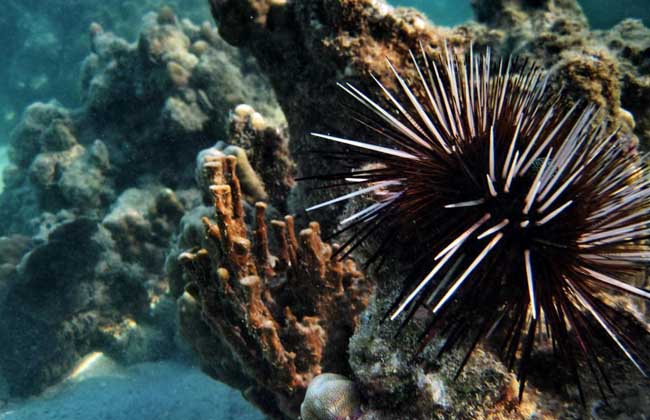
Sea urchins are a group of invertebrates that live in shallow ocean waters. Their main features are a spherical, discoid or heart-shaped body, no arms, and an internal skeleton that fuses together to form a hard shell. Most species have a complex chewing apparatus in the mouth. They can be divided into two subclasses, the Regularia and the Irregularia, with more than 900 species in total, mostly concentrated on rocky or sandy seabeds in coastal zones. Let us take a look below at what sea urchins eat!
What do sea urchins eat?
Sea urchins have quite broad feeding habits. They can be carnivorous, feeding on gastropods and other echinoderms. They can also be herbivorous, feeding on various seaweeds. Species on soft seabeds and irregular sea urchins mainly feed on organic debris, collecting organic particles from their surroundings through tube feet or spines, which are then moved to the mouth by the action of cilia. The mouth is located in the center of the peristomial membrane on the oral surface (in irregular sea urchins it may be located at the front end of the body). Inside the mouth is the oral cavity, which contains a complex feeding structure, namely a lantern-shaped structure made up of a series of ossicles, teeth and muscles connected together, used for cutting and chewing food.
Where are sea urchins distributed?
Sea urchins live in oceans around the world, with the greatest number of species found in the Indian Ocean and the western Pacific Ocean, from shallow waters to depths of 7000 m. Most sea urchins prefer to live on rocks, coral reefs and hard seabeds, and mainly move by means of tube feet and spines, with movement often related to feeding. When food is abundant around them, they rarely move, moving only a few cm per day. They usually hide in crevices or depressions. Because irregular sea urchins mostly burrow in sand, they mainly rely on their spines to move within their burrows or on the sand surface.
What kinds of sea urchins are there?
1. Horse dung sea urchin: The horse dung sea urchin has a solid, hemispherical shell, 30-40 mm in diameter, up to a maximum of 60 mm. The aboral surface is low and slightly raised, while the oral surface is flat. The ambulacral zones and interambulacral zones are equal in width, but the interambulacral zones are slightly more inflated than the ambulacral zones, so that the shell viewed from the oral surface is a smooth regular pentagon close to a circle. It is generally considered a herbivorous animal, usually feeding on brown algae, red algae and green algae, and mainly lives on seabeds such as rocky reefs, gravel and sandy stone in shallow seas.
2. Crown-of-thorns sea urchin: The crown-of-thorns sea urchin is 70-80 mm in diameter, and its height is slightly greater than the shell radius. The shell is thin and low hemispherical. The large spines on the aboral surface are slender and needle-like, hollow, with ring-like bands on the surface, about 3-5 times the shell diameter in length, reaching up to 26 cm at the longest. When alive, the whole body is purple-black, and the color of the large spines often varies. The spines are especially sharp and slender; after piercing the skin they break off inside the human body, causing severe pain.
3. Heart urchin: Heart urchins are usually oval or heart-shaped, with a relatively brittle shell and 4 ambulacral zones. The body surface is covered with short, fine spines. They live in burrows whose inner walls are coated with mucus. The tube feet are long and extend onto the sand to capture small food particles; some tube feet serve respiratory and sensory functions. They move by the action of their spines. They constantly dig in the deep mud and sand of the seabed, moving slowly beneath the mud and sand and collecting food particles with their tube feet.
4. Sculptured sea urchin: The sculptured sea urchin has a thick and solid shell, and its shape varies greatly. The ambulacral zones are slightly raised, about 2/3 the width of the interambulacral zones. On the horizontal sutures of the ambulacral plates above the equatorial region, there are large and distinct triangular depressions, and the tube feet pores are arranged in an arc in every 3 pairs. Each ambulacral plate in the equatorial region has one large tubercle, one medium tubercle and many small tubercles.