What Are the Natural Enemies of Hippos? Animals in Nature That Can Threaten Hippos
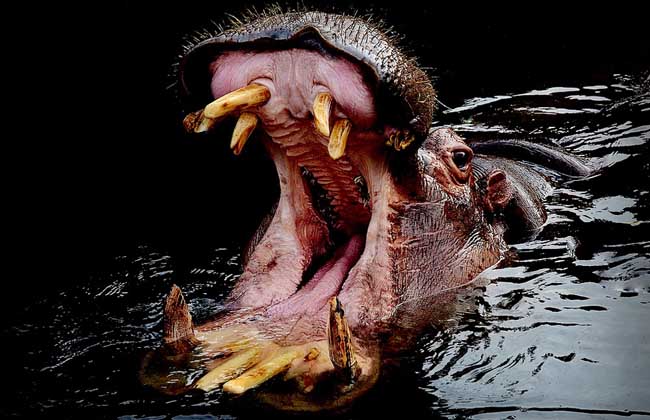
The hippo is a mammal that ranks on land only after the African elephant, Asian elephant, African forest elephant, white rhinoceros, and Indian rhinoceros. It has a massive and clumsy body covered by a thick layer of skin. The skin is blue-black with brick-red markings, and apart from some short hairs on the tail, there is almost no hair on the body. Let us take a look below at what natural enemies hippos have!
What are the natural enemies of hippos?
Hippos have no natural enemies in nature. The hippo ranks third among land animals in weight, after only elephants and rhinoceroses, and can reach 3 tons, with a total length of 3.8-4.6, a tail length of 0.6 m, a shoulder height of 1.5 m, and two very large lower canine teeth. Even the most ferocious crocodiles in its habitat do not dare to provoke a hippo lightly, so it has no natural enemies, but calves may be killed by vicious males or attacked by crocodiles. The hippo's only natural enemy is humans themselves, as it is heavily hunted for its ivory-like tusks as well as its hide and meat.
What food do hippos eat?
The hippo is a herbivore, but its sparse tusks grow to ten cm, and female hippos are highly territorial and aggressive in protecting their calves. They live in pairs or small groups, and older males often live alone. They sleep or rest in rivers or near rivers almost the entire day, and come out at night to feed. Sometimes they swim more than 30 km downstream to forage. They mainly feed on aquatic plants, occasionally eat land crops, and mainly eat grass. Sometimes they go to fields to eat crops, and when food is scarce, they will also actively prey on other herbivores. Their daily food intake is more than 80 kg.
The current population status of hippos
The main common threats to hippos are illegal and unrestricted hunting for meat and teeth and habitat loss. Illegal hunting is considered most severe in areas of habitat affected by war. During more than 8 years of civil unrest and fighting in the Democratic Republic of the Congo, local hippo populations declined by more than 95%. Burundi and Cote d'Ivoire have also reported widespread poaching for meat. For countries with a high proportion of common hippo population protected areas, the rate of decline is much lower, so habitat protection should be rewarded and punitive measures should be established for illegal hunting. The hippo has been listed in the International Union for Conservation of Nature (IUCN) ver3.1: 2012 Mammalia Red List——Vulnerable (VU).