Detailed Explanation of Watermelon Cultivation Techniques and Management Key Points
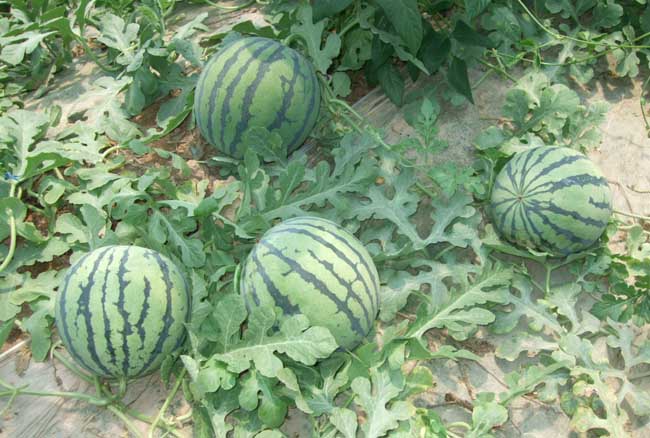
Watermelon is a major summer heat-relieving fruit. Its flesh is crisp and tender, sweet and juicy, and rich in mineral salts and multiple vitamins. It is the largest-selling fruit in China during summer and autumn. To improve yield and quality, the watermelon cultivation techniques are introduced as follows:
Biological Characteristics
1. Morphological Characteristics
① Roots: The roots of watermelon are a deep root system. The main root can reach more than 1 m deep, and lateral roots can extend horizontally 4-6 m. The main root mass is distributed within the 10-40 cm soil layer, with strong ability to absorb fertilizer and water. The regeneration ability of the roots is weak, and they are not easy to recover after injury. In production, direct seeding is often used. If raising seedlings and transplanting, be sure to pay attention to root protection.
② Stems and leaves: The watermelon stem is also called a vine. The main vine grows upright before 5-6 leaves, and when it exceeds 30 cm and continues to grow to a certain length, because the mechanical tissue is underdeveloped and cannot support its own weight, it grows prostrate on the ground. The branching ability of the stem is very strong, and it can sprout 3-4 levels of lateral branches, but the lateral branches emerging from the leaf axils of the 3rd-5th nodes of the main vine are relatively robust. Adventitious roots are very easily produced at the nodes of the watermelon stem. By using the method of pressing the vine, adventitious roots can be promoted to form, increasing the absorption area, fixing the plant, and preventing the vine from rolling. The leaves are alternate, with types such as deeply lobed, shallowly lobed, and entire margins.
③ Flowers, fruits, and seeds: Watermelon flowers are small and yellow, monoecious with unisexual flowers, and borne singly in leaf axils. Early-maturing varieties bear the first female flower at the 6th and 7th nodes of the main vine, while mid- and late-maturing varieties produce the first female flower after the 10th node. The interval between female flowers is 7-9 nodes. During the peak flowering period, a small number of bisexual flowers may appear. The flowers open in the early morning and close in the afternoon. The fruit is oval or spherical, and the color may be dark green, light green, or with dark green stripes or markings. The flesh may be red, yellow, white, etc. Seeds may be black, white, or red, etc. Watermelons can also be divided by seed size into large-seeded watermelons, small-seeded watermelons, and seedless watermelons. The 1000-seed weight is 100 g-150 g for the large-seed type, 40 g-60 g for the medium-seed type, and 20 g-25 g for the small-seed type.
2. Growth Cycle
The whole growth period can be divided into four stages: germination stage, seedling stage, vine-running stage, and fruiting stage.
① Germination stage: From seed swelling to cotyledon expansion and true leaf emergence is the germination stage. After the seedlings emerge, excessive vegetative growth should be prevented in order to promote the development of roots and leaves.
② Seedling stage: From true leaf emergence to 5-6 leaves is the seedling stage. During this period, the growth amount is small, and good conditions should be provided in cultivation to promote seedling root development and organ differentiation.
③ Vine-running stage: From the beginning of vine growth at 5-6 leaves to the opening of the female flower at the fruit-setting node is the vine-running stage. During this period, the growth rate is fast and the growth amount is large. In cultivation, stem and leaf growth should be promoted to form a certain vegetative system, while excessive vegetative growth should be controlled to ensure flower formation.
④ Fruiting stage: From the opening of the female flower at the fruit-bearing node to the beginning of vigorous fruit growth. It can further be divided into 3 periods: fruit-setting period, vigorous fruit growth period, and flesh-ripening period.
⑤ Fruit-setting period: From the opening of the female flower at the fruit-setting node to the beginning of vigorous fruit growth. Photosynthetic products begin to be transported into the fruit. In cultivation, the main task is to regulate the balance between vegetative growth and fruit development to ensure fruit set.
⑥ Vigorous fruit growth period: From rapid fruit growth to the point when fruit size is basically fixed. During this period, fruit growth is large, nutrient absorption is greatest, and it is the key period for yield formation. In cultivation, heavy fertilizer and abundant water should be applied to promote rapid fruit growth.
⑦ Flesh-ripening period: From basically fixed fruit size to the mature stage. During this period, sugars are rapidly transformed, and the appearance acquires the inherent color of the variety. In cultivation, premature senescence of stems and leaves should be prevented to ensure yield and quality.
3. Requirements for Environmental Conditions
① Temperature: Watermelon likes a warm, dry climate and is not cold-tolerant. The optimum temperature for growth and development is 24-30 degrees, the optimum temperature for root growth and development is 30-32 degrees, and the minimum temperature for root hair formation is 14 degrees. During growth and development, watermelon requires a relatively large day-night temperature difference, and a relatively large day-night temperature difference can cultivate high-quality watermelons.
② Water: Watermelon is drought-tolerant and not moisture-tolerant. When there are many rainy days, humidity is too high, it is susceptible to disease, yield is low, and quality is poor.
③ Light: Watermelon likes light. Under conditions of sufficient sunshine, yield is high and quality is good.
④ Nutrients: Watermelon has a long growth period and high yield, so it requires a large amount of nutrients. For every 100 kg of watermelon produced, about 0.19 kg of nitrogen, 0.092 kg of phosphorus, and 0.136 kg of potassium need to be absorbed. However, there are obvious differences in nutrient absorption among different growth stages. It accounts for 0.01% in the germination stage, 0.54% in the seedling stage, and 14.6% in the vine-running stage. The fruiting stage is the period of most vigorous nutrient absorption by watermelon, accounting for 84.8% of the total nutrient amount. Therefore, as the plant grows, the fertilizer requirement of watermelon gradually increases, reaching the maximum when the fruit grows vigorously.
⑤ Soil: Watermelon has strong adaptability, and sandy soil with loose texture, deep soil layer, and good drainage is best. It prefers weak acidity, pH 5-7.
Suitable Sowing Period
Open-field watermelon cultivation is cultivation without protective equipment. Generally, when the local last frost has passed and the soil temperature is stable at about 15°C, it is the suitable time for open-field sowing. The best sowing time should also be determined according to conditions such as variety, cultivation season, cultivation method, and consumption season. Generally, sowing and raising seedlings in mid-to-late March, transplanting in mid-to-late April, and harvesting for market from late June; autumn watermelon is sown in early-to-mid July, and harvesting for market begins in late September.
Land preparation and applying sufficient base fertilizer