A Detailed Guide to the Cultivation Techniques and Management Methods of the Noble Bottle Tree
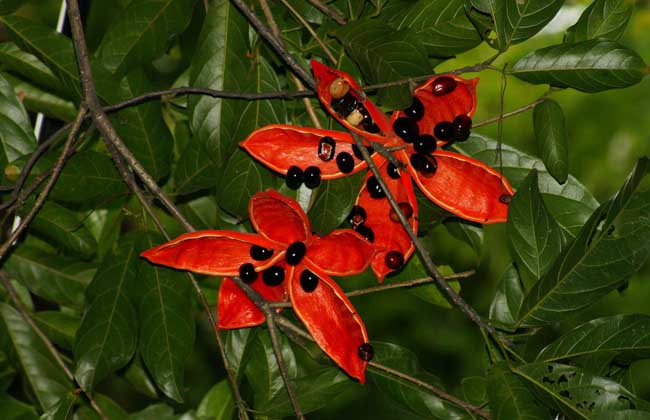
The noble bottle tree, also known as the phoenix eye fruit, is an evergreen tree of the genus Sterculia in the family Sterculiaceae. In Guangdong customs, it is used as an offering for traditional festivals. Because of its low annual yield and the decline of sacrificial customs, there are rarely large orchards for cultivation, only scattered plantings. However, the cultivation conditions for the noble bottle tree are not particularly demanding. Let us take a look at the cultivation techniques of the noble bottle tree below!
Growth Habits of the Noble Bottle Tree
The bark of the noble bottle tree is brownish-black, and the young branchlets have slight stellate hairs. The leaves are thinly leathery, oblong or elliptical. The panicles are terminal or axillary, slender and spreading; the pedicels are much longer than the flowers; the calyx is milky white at first, then turns pale red, bell-shaped. The follicles are bright red, thickly leathery, oblong-ovate. The seeds are elliptical or oblong, dark brown. The flowering period is April to May, but a few plants often can be seen blooming a second time in October to November. It prefers well-drained fertile soil and tolerates shade. It likes a warm and humid climate.
Propagation Methods of the Noble Bottle Tree ⟧7⟧1. Seed propagation: Before sowing the noble bottle tree, the sand bed and seeds can be sterilized with thiophanate-methyl or chlorothalonil, and sowing is done by the dibbling method. After sowing, attention should be paid to shading and moisture retention; sprouts can appear after 7 days, and by the second spring the plants can reach 20-40 cm, and they can be transplanted in March to April.
1. Propagation by sowing: Before sowing the seeds of the Chinese chestnut (Sterculia monosperma), the sand bed and seeds can be sterilized with thiophanate-methyl or chlorothalonil, and the seeds are sown by the dibbling method. After sowing, be sure to provide shade and keep the soil moist; sprouts emerge after 7 days, and by the following spring the plants can reach 20-40 cm, so they can be transplanted in March to April.
2. Cutting propagation: The branches of the noble bottle tree root easily, and cutting propagation is mostly used. Semi-lignified branches, lignified branches, and even old branches can all survive as cuttings. Generally, 2-3 year old lignified branches are selected, and the cuttings are cut to about 15 cm and inserted in the seedbed in spring and autumn.
3. Root sucker propagation: The noble bottle tree has a relatively developed root system and strong regenerative ability. The root system often exposed above the ground can sprout root suckers, which can be dug out and planted, and this is also very simple.
Cultivation Techniques of the Noble Bottle Tree
1. Timely planting: For planting the noble bottle tree, spring is suitable, and a spacing of 4×5 m is more appropriate, with 33 plants per mu. The digging hole size is 80×80×60 cm. Organic fertilizer is the main type, combined with a small amount of chemical fertilizer, and base fertilizer is applied to promote early growth and rapid development of the seedlings and early production.
2. Reasonable fertilization: Young noble bottle trees are generally fertilized 4-6 times a year, once every 2-3 months, and either organic fertilizer or chemical fertilizer can be used. Adult fruiting trees need more nutrients. To prevent tree decline, they should be fertilized more than 2 times a year.
3. Flowering period management: The noble bottle tree tolerates waterlogging but not drought. During the flowering period and young fruit period, appropriate soil moisture and atmospheric humidity are required, commonly known as “mango in sunny weather, noble bottle tree in rainy weather”.
4. Pruning and shaping: If the noble bottle tree grows vigorously but flowers and fruits little, it must be properly pruned and shaped to facilitate ventilation and light transmission inside the canopy, which can reduce psyllids and the sooty mold caused by them, and is also conducive to flowering and fruit setting.
5. Pest and disease control: The main pests and diseases of the noble bottle tree include anthracnose, root rot, and psyllid damage. Combined with winter fertilization, do a good job of cleaning the orchard, collect diseased fallen leaves and burn them centrally, which can reduce sources of infection.
6. Timely harvesting: The noble bottle tree bears fruit 3-4 years after planting, reaches full fruit period at 15 years, and the yield tends to stabilize. A 30-year-old plant produces 125 kg of fruit. The main crop blooms from March to May and the fruit ripens from July to September; the secondary crop blooms from August to October, and the fruit begins to ripen in mid-December.