How to prevent and treat watermelon blight? A full analysis of practical methods
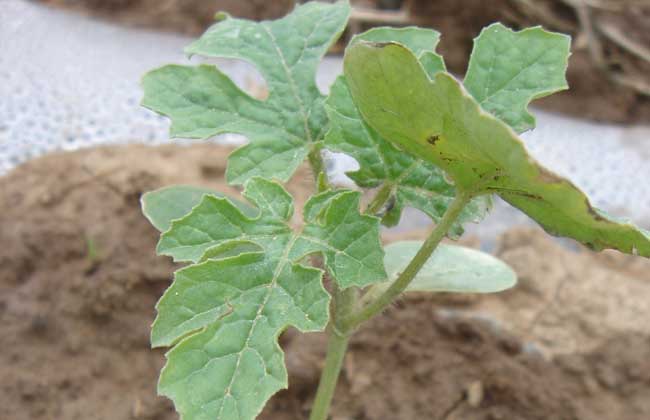
Watermelon blight is a high-temperature, high-humidity soil-borne disease, also known as watermelon Phytophthora blight, dead vines, and so on. It occurs throughout the country, and the damage is worsening year by year. It is more severe in the south than in the north, and is especially serious in rainy years during the watermelon growing period. Besides watermelon, it also harms melons and other cucurbit crops. Let us take a look below at the prevention and treatment methods for watermelon blight!
Damage characteristics
Watermelon blight generally attacks the root crown of the melon, and can also attack leaves, vines, and fruit. In the early stage of disease at the root crown, dark green water-soaked lesions appear, and the lesions rapidly develop to encircle the stem base, becoming soft-rotted, constricted, and causing the whole plant to wilt and die, with leaves appearing green-wilted and the vascular bundles not changing color. When the leaves are affected, dark green water-soaked spots appear and rapidly expand into nearly round or irregular large yellow-brown lesions; under high humidity the entire leaf rots, and after drying the diseased leaves turn light brown and are very easily broken. When the stem is damaged, it shows water-soaked dark green spindle-shaped depressions, and the part above the diseased area dies. When the fruit is damaged, it shows water-soaked dark green round depressions that rapidly spread to the entire fruit surface, the fruit becomes soft-rotted, and a sparse layer of white mold grows on the surface of the lesions.
Occurrence pattern
The pathogen of watermelon blight prefers high temperature and high humidity environments. The optimum temperature for disease onset is 28-30°C, and disease onset is inhibited below 15°C. Under suitable temperature conditions, how early or late the rainy season comes and the amount and number of rainy days are the decisive factors for disease onset and the degree of epidemic. The peak of field disease onset usually follows immediately after the peak of rainfall. After the appearance of the first diseased plants, if daily rainfall reaches more than 50 mm or ten-day rainfall reaches more than 100 mm, the disease develops rapidly and easily becomes epidemic. If there is no rain for more than 10 days and no watering is done, the disease stops spreading. Under high-temperature and high-humidity conditions in the rainy season, poor drainage and ventilation and overly dense planting lead to severe disease. Low-lying terrain, poor drainage, uneven bed surfaces, plots prone to water accumulation and continuous cropping for many years, as well as excessive watering, overly dense planting, excessive application of nitrogen fertilizer, or application of contaminated fertilizer, all worsen the disease.
Prevention and treatment methods
1. Variety selection: Among the more than 60 watermelon varieties promoted in China in recent years, those showing resistance or tolerance to blight include Xiang Watermelon No. 3, No. 4, and No. 6, Hunan Qin Seedless Watermelon, Qiongxue, Qinghongbao, and others. As for some varieties that generally show relatively strong disease resistance, such as Jingxin No. 1, Zhengza No. 5, Xinhongbao, Jinhuabao, Tezaojialong, Yunzhong No. 1, Changmi No. 1 and No. 2, Zhongyu No. 1, Xiabao No. 3, Bafengshou No. 3, Qiongsu, and others, whether they are also resistant to blight remains to be further observed and identified in various places.
2. Agricultural control: Carry out crop rotation with non-cucurbit crops for more than 3 years, clean the fields, cut off the source of overwintering pathogen infection, promptly pull out diseased plants, and bury them deeply or burn them in a centralized manner. Do not use undecomposed organic fertilizer containing diseased residues. Plant at a reasonable density, cultivate with deep furrows and high beds, drain promptly after rain, and control field humidity. For watermelons grown under protected cultivation, use small amounts of water seeped under plastic film or drip irrigation to save water and maintain temperature, so as to help reduce humidity in the greenhouse. Strictly prohibit flood irrigation and sequential irrigation.
3. Chemical prevention: Before sowing, soak seeds in warm water at 55°C for 15 minutes, then dry them and sow or sow after germination, or mix 500-700 g of 20% tolclofos-methyl emulsifiable concentrate with 100 kg of seeds. Before disease onset, use fluopicolide propamocarb (Yinfalli) wettable powder at 600 times, or 70% propineb (Antaisheng) wettable powder at 400-600 times, or 60% pyraclostrobin metiram (Baitai) at 1200 times, or 70% metiram (Pinrun) at 700 times for root drenching or spraying.
4. Chemical control: Spray 72% cymoxanil mancozeb (Kelu) wettable powder at 700 times, or 50% dimethomorph (Anke) wettable powder at 2500 times, or 25% mandipropamid (Ruifan) at 2500 times, 70% fosetyl-aluminum · mancozeb wettable powder at 500 times, 72.2% propamocarb hydrochloride (Pulike, Zaisheng) aqueous solution at 800 times, 58% metalaxyl % mancozeb (Jinlei) wettable powder at 500 times, 64% oxadixyl · mancozeb (Shadufan) wettable powder at 500 times, once every 7-10 days, for 3-4 consecutive treatments. If necessary, the above fungicides can also be used for root drenching, applying 0.25-0.4 L of the prepared solution per plant. If spraying and root drenching can be carried out at the same time, the control effect is significantly improved.