What are the control methods for downy mildew in melons?
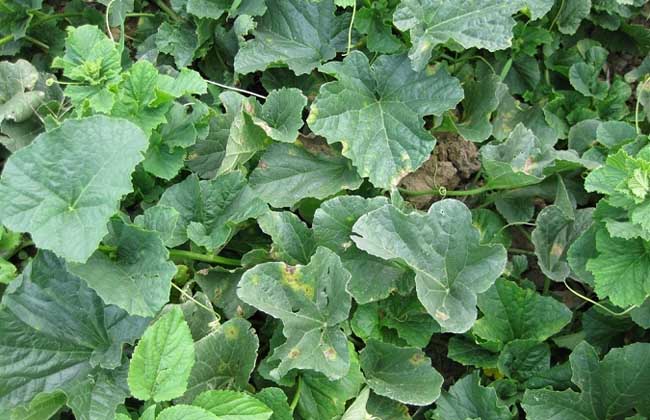
Downy mildew in melons is a fungal disease that affects melons. It mainly targets cucurbits grown year-round in greenhouses, can occur repeatedly, and once it appears it is usually impossible to control; it spreads extremely quickly, causing the middle and lower leaves to dry up and rapidly spreading upward, resulting in major losses. It can be controlled through field management or chemical spraying, among other methods. Let's take a look below at the control methods for downy mildew in melons!
Damage symptoms
Downy mildew in melons mainly damages the leaves. When seedlings are infected, water-soaked small spots appear on the cotyledons, later expanding into light brown lesions, and under high humidity a grayish-purple mold layer grows on the underside of the leaves. When mature plants are infected, light yellow lesions appear on the leaf surface and expand along the leaf veins into a polygonal shape; when there is dew or guttation on the leaf surface in the early morning, the lesions appear water-soaked, and in the later stage the lesions turn into light brown or yellowish-brown polygonal spots. Under continuous rainfall, the lesions rapidly expand or merge into large patches, causing the leaves to curl upward or dry out, with all the lower leaves drying up and sometimes only a few green leaves remaining near the growing point. If the fruit development stage enters the rainy season, the disease spreads rapidly and reduces yield by 30-50%.
Conditions for disease onset
The pathogen of melon downy mildew adapts to a wide range of temperatures, with 15-24°C being suitable for disease onset. In production, excessive watering or watering followed by moderate to heavy rain, a high groundwater table, and dense plant leaves make the disease likely to occur. It often starts on the leaves near the roots, and the pathogen spreads through wind and rain or irrigation water. Pathogen germination and invasion have high humidity requirements; the pathogen can invade only when there are water droplets or a water film on the leaves, and it develops rapidly when relative humidity is above 83%.
Control methods
1. Agricultural control: choose downy mildew-resistant varieties such as Yellow River Hami melon, red-fleshed netted melon, Snow White, and Suizhou large white melon. Practice crop rotation, drain promptly after rain, and never use flood irrigation. Fertilize rationally, train the vines promptly, and maintain ventilation and light penetration. Avoid neighboring or continuous cropping with cucurbit crops, and where conditions permit use rain-sheltered cultivation. Do not water after rain in July-August; if water is needed, water half the furrow and never use flood irrigation.
2. Nutritional control: after melons bloom, use 0.2 kg of urea and 0.5 kg of white sugar (or brown sugar) per mu, dilute with 40-50 kg of water and spray on the leaves, once every 5-6 days for 4-5 consecutive sprays; or use 500-fold dilution of organic active liquid fertilizer such as "Gaomeishi UA-102 Nutrient" at 50-70 kg per mu sprayed on the leaves and root soil, once every 7-10 days for 2 consecutive sprays, to enhance plant resistance and prevent disease onset.
3. Chemical control: at the early stage of disease onset, spray 70% phosethyl-Al · mancozeb wettable powder at 500-fold dilution, or 18% dimethomorph · mancozeb wettable powder at 600-fold dilution, or 64% oxadixyl · mancozeb wettable powder at 400-500-fold dilution, or 72% metalaxyl wettable powder at 800-fold dilution, or 50% thiram wettable powder at 600-fold dilution, or 25% metalaxyl wettable powder at 800-fold dilution, or 20% benalaxyl emulsifiable concentrate at 350-fold dilution, or 72% curzate wettable powder at 700-fold dilution, once every 7-10 days for 3-4 consecutive treatments.