Detailed Explanation of the Key Cultivation Techniques for the Four-Season Pomegranate
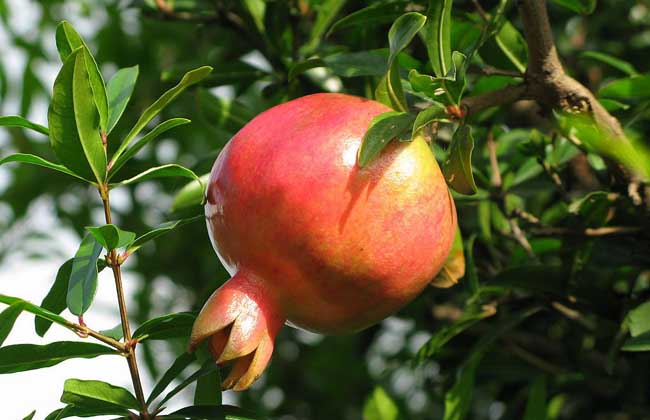
The four-season pomegranate is a very rare and precious variety in the pomegranate family, also known as the monthly pomegranate, flowering pomegranate, etc. It is a variety of the plant Punica granatum in the same genus. The plant height is only 50-70 cm, yet it has luxuriant branches and leaves and bears many large flowers and fruits. Even more astonishing is that a mature tree blooms every day throughout the year, with fresh fruits hanging on the tree all year round, truly a spectacular sight among bonsai. Let's take a look below at how to grow the four-season pomegranate!
Growth Habits of the Four-Season Pomegranate
The pomegranate originated in Central Asia in places such as Iran and Afghanistan, and is cultivated in temperate and tropical regions worldwide. It grows on mountains at an altitude of 300-1000 m. It prefers a warm, sunny environment, is drought-tolerant, cold-tolerant, and tolerant of poor soil, but is not tolerant of waterlogging or shade. It has low requirements for soil, but cultivation in well-drained sandy loam is preferable.
Cultivation Value of the Four-Season Pomegranate
1. Ornamental value: The four-season pomegranate has luxuriant branches and leaves, brilliantly colored flowers, and abundant fruits. From the appearance of red flower buds to fruit maturity, each flower hangs on the tree without falling for several months from spring through summer to autumn, possessing unique ornamental value.
2. Edible value: After the fruit of the four-season pomegranate matures, it has a rich flavor and is sweet and sour, with the effect of aiding digestion and promoting salivation, and is deeply welcomed by people.
3. Air purification: The leaves of the four-season pomegranate also have the effect of adsorbing atmospheric dust and absorbing toxic gases in the air such as sulfur dioxide, chlorine, hydrogen sulfide, and lead vapor, and can purify the air and reduce pollution.
Propagation Methods of the Four-Season Pomegranate
1. Cuttings: The four-season pomegranate can be propagated by cuttings in spring using two-year-old branches or in summer using semi-lignified branches. After insertion, roots form in 15-20 days.
2. Division: The four-season pomegranate can be propagated by division in early spring in April when the buds begin to sprout, by digging up robust root-sucker seedlings and planting them separately.
3. Layering: The four-season pomegranate can be propagated by layering in spring or autumn. No wounding is necessary. Before the buds sprout, press the root-sucker branches from the base into the soil. After rooting through the summer, cut them away from the mother plant, and they can become seedlings in autumn.
Planting Techniques for the Four-Season Pomegranate
1. Planting time: The four-season pomegranate can be planted in all four seasons, but autumn or early spring planting is most suitable. In the south, autumn planting is better, while in the north, spring planting is preferable. When cultivating the four-season pomegranate in the open ground, a site with sufficient light and good drainage should be chosen.
2. Applying sufficient base fertilizer: Before planting the four-season pomegranate, deeply plow and mature the courtyard soil, remove debris such as gravel and bricks and tiles, replace with fertile soil, with a deep plowing depth of about 50 cm. Dig planting pits according to the planting points, with a pit depth of 40-60 cm and a length and width of 0.6-0.8 m. Apply 25-50 kg of organic fertilizer per plant, mix with topsoil and backfill, then irrigate thoroughly to settle.
3. Planting techniques: When planting the four-season pomegranate, strictly select high-quality seedlings with complete root systems, relatively thick trunk diameter, smooth stems, and plump buds. Trim the broken root wounds flat. The planting depth should be such that after settling, the original soil mark on the root crown is level with the ground surface. Then irrigate promptly, and after the water seeps in, cover the tree disk with plastic film.
Cultivation Management of the Four-Season Pomegranate
1. Soil management: Leave a tree disk with a diameter of 1 m under the tree. In areas where summer soil temperature is too high or in courtyards with cement hardening, organic matter (straw, chaff, sawdust, etc.) can be used to cover the tree disk, or grass can be grown on the tree disk (planting lawn) to achieve cooling and moisture retention and promote normal growth and development. If no covering or grass growing is carried out, carry out 3-4 times of intertillage and weeding on the tree disk each year, with an intertillage depth of 5-10 cm.
2. Reasonable fertilization: After the seedlings survive in the current year, apply a small amount of fertilizer to the tree disk once a month from May to July, watering 1-2 kg of decomposed manure water plus a small amount of urea per plant. Before leaf fall in autumn, dig a ring-shaped trench and apply 20-30 kg of organic fertilizer per plant. From the second year to the full fruit-bearing stage, apply base fertilizer once a year in a ring-shaped trench, and apply compound fertilizer and decomposed manure water 3-4 times by hole application or broadcast application on the tree disk. The fertilization amount should be adjusted according to the yield. At the same time, pay attention to foliar topdressing during the growing season, mainly nitrogen fertilizer in the early stage and mainly phosphorus and potassium fertilizer in the middle and late stages, with a total fertilizer solution concentration not exceeding 0.3%. For foliar topdressing, biogas slurry or decomposed manure water can also be sprayed.
3. Irrigation and drainage: The key periods for irrigating pomegranate are mainly the three periods of bud break, fruit enlargement, and before leaf fall. Keeping soil moisture at 60-80% is more suitable. At other times, it should be flexibly controlled mainly according to soil moisture. Pomegranate is drought-resistant but not waterlogging-resistant. During the growing season, attention should be paid to drainage to prevent prolonged water accumulation in the soil and tree disk, which can cause waterlogging damage.
Shaping and Pruning of the Four-Season Pomegranate
1. Shaping: The monthly pomegranate tree prefers light. The shaping of courtyard pomegranate should consider both the growth and fruiting characteristics of the pomegranate and a certain ornamental quality. The commonly used tree forms are mostly trunkless clump or no-central-leader tree forms, mainly including the "V" shape, natural open-center shape, etc.