What does a coconut palm look like? A detailed introduction to its appearance and characteristics
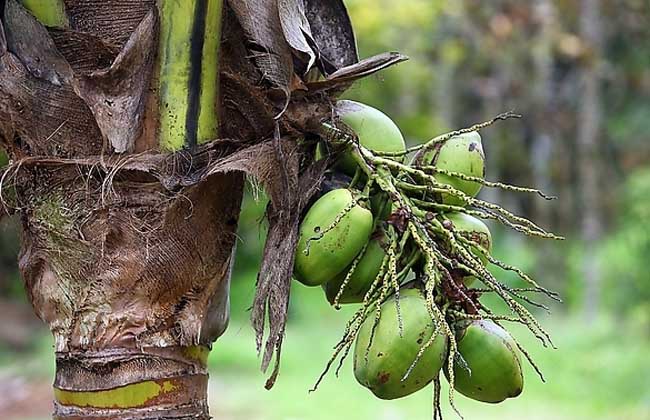
The coconut palm is a large plant of the genus Cocos in the palm family Arecaceae, an important tropical woody oil crop. The famous tropical fruit, the coconut, is the fruit of the coconut palm. Its wide distribution is related to the fact that the coconut fruit can drift thousands of kilometers across the sea with the wind and waves and then reproduce far from the mother tree. China's "Records of the Grand Historian" already recorded the coconut more than two thousand years ago. It has extremely high economic value, and every part of the whole plant has its uses.
The trunk of the coconut palm is straight, 15-30 m tall, with a single crown and a neat shape. The leaves are pinnately parted, 4-6 m long, with numerous segments that are leathery, linear-lanceolate, 65-100 cm long and 3-4 cm wide, with acuminate tips. The petioles are thick and strong, more than 1 m long. The spadix is axillary, 1.5-2 m long, and much branched. The nut is obovoid or nearly spherical, slightly three-ridged at the apex, 15-25 cm long, with a bony endocarp and 3 germination pores near the base, containing 1 seed.
The coconut palm usually begins to bear fruit after 5-6 years, with 15-18 years being the peak production period. A single plant bears 40-80 fruits, and some bear more than 100. Its economic life exceeds 80 years. The number of leaves produced each year varies with tree age; before the peak production period it tends to increase with tree age, and after the peak production period it decreases slightly but can still remain constant. The number of spathes emerging in a year is greatest from May to June and lowest from November to December. After a spathe emerges, it takes 3.5 months for the inflorescence to appear. Flowering is most abundant from July to September, and it takes 12 months from fertilization to the fruit developing and ripening.
The coconut palm is native to southeastern Asia, from Indonesia to the Pacific Islands. In China, it is cultivated in the southern islands of Guangdong, the Leizhou Peninsula, Hainan, Taiwan, China, and the tropical areas of southern Yunnan. The main varieties are three types: green coconut, yellow coconut, and red coconut. Through long-term natural selection and artificial selection, many types and variants have formed. At present, from the perspective of cultivated varieties, they are often analyzed and identified as wild species and cultivated species, among which cultivated varieties can be further divided into tall types, dwarf types, and hybrids.
The coconut palm is suitable in areas with an annual average temperature of 26-27°C, a small annual temperature difference, and an annual rainfall of 1300-2300 mm with even distribution, with more than 2000 hours of annual sunshine, and coastal areas below 50 m elevation are most suitable. It is a light-loving tropical crop that grows and develops well under conditions of high temperature, abundant rain, sufficient sunlight, and sea breezes. It is suitable for growing in low-altitude areas. The most suitable soils for its growth are marine alluvial soil and riverbank alluvial soil, followed by sandy loam, then gravelly soil, with clay soil being the worst.
There are more than 360 comprehensive utilization products of the coconut palm, which can produce different products and are fully used in different industries. It is a unique renewable, green, and environmentally friendly resource in tropical regions. Coconut meat can be pressed for oil, eaten raw, or used in cooking, and can also be made into coconut milk, desiccated coconut, shredded coconut, canned coconut jam, coconut candy, and biscuits. Coconut water can be used as a refreshing drink. Coconut fiber can be made into brushes, carpets, ropes, and so on. Coconut shells can be made into various handicrafts and high-grade activated carbon. The trunk can be used as building material. The leaves can be used for thatching roofs or weaving. The coconut palm is an excellent tree species for greening and beautifying the environment in tropical regions, and coconut roots can be used as medicine.