Is the wild walnut a walnut? Understanding the relationship between wild walnuts and walnuts in one article
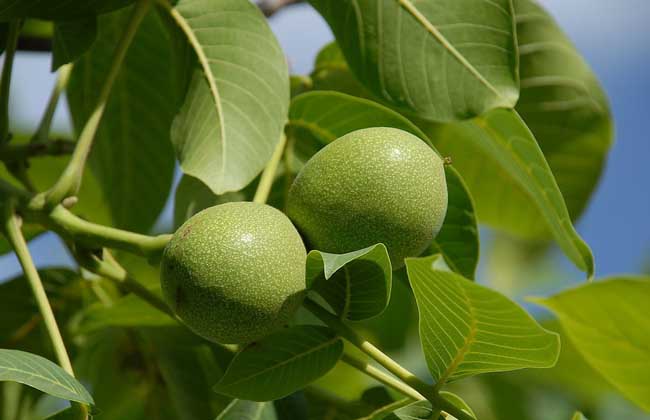
The wild walnut is a type of walnut, also known as mountain walnut, autumn walnut, and by other names. It is a deciduous tree or small tree of the genus Juglans in the family Juglandaceae. Its main differences from other species in the same genus are that after the leaflets mature, the underside is densely covered with short soft hairs and stellate hairs, the fruit clusters are long and drooping, and the seeds contain 34% oil. It is edible, can be made into soap, and used as lubricating oil. The wood, bark, and fruit peel have various economic and medicinal uses. It is often used as rootstock for edible walnuts.
The wild walnut tree reaches 12-25 m in height, with a diameter at breast height of 1-1.5 m. Young branches are grayish green and covered with glandular hairs, and the pith is separated into thin plates. The terminal bud is conical and exposed. The odd-pinnately compound leaves are usually 40-50 cm long, with both the petiole and rachis hairy, and have 9-17 leaflets. The leaflets are nearly opposite, without petiolules, hard papery, ovate-oblong or long ovate, 8-15 cm long and 3-7.5 cm wide, with acuminate tips, oblique rounded or slightly oblique cordate bases, and finely serrate margins. Both surfaces have stellate hairs, sparse above and dense below, and the midvein and lateral veins also have glandular hairs. There are 11-17 pairs of lateral veins.
The male catkins of the wild walnut are borne in the leaf scar axils at the tips of the previous year's branches, and the inflorescence axis has sparse hairs. The male flowers have glandular hairs, about 13 stamens, yellow anthers, and the connective slightly protruding. The female inflorescence is upright, borne at the tip of the current year's branch, and the inflorescence axis is densely covered with brown hairs, with the female flowers arranged in a spike. The female flowers are densely covered with brown glandular hairs, the ovary is ovate, and the style is short. The infructescence usually has 6-10 fruits, or only a few due to female flower infertility. The fruit is ovate or nearly round, the exocarp is densely covered with glandular hairs, and the endocarp is hard, with irregularly arranged sharp spine-like protrusions and depressions between the ridges. The flowering period is April-May, and the fruiting period is August-October.
The wild walnut grows in mixed forests at an altitude of 800-2000 m. Its natural habitats are mostly in warmer zones. It is a warmth-loving tree species, but it is strongly cold-resistant and not tolerant of damp heat. It requires sufficient sunlight and has relatively high demands for soil fertility. It is not tolerant of barren soil and prefers fertile, moist, well-drained slightly acidic to slightly alkaline soil. Its producing areas are distributed in Gansu, Shaanxi, Shanxi, Henan, Hubei, Hunan, Sichuan, Guizhou, Yunnan, Guangxi, ** and other places.
The seed oil of the wild walnut is edible, can be made into soap, and used as lubricating oil. The wood is firm and does not crack over time, and can be used for various kinds of furniture. The bark and exocarp contain tannins and can be used as raw material for tannin extract. The endocarp is thick and can be made into activated carbon. The phloem fibers of the bark can be used as raw material for the fiber industry. Wild walnut oil has the effects of moistening the intestines and relieving constipation, killing insects, and astringing sores. Wild walnut kernels have the effects of moistening the lungs and resolving phlegm, warming the kidneys and supporting yang, nourishing the skin, and relieving constipation.