What does wild walnut look like? Detailed introduction to its appearance characteristics
Wild walnut (Juglans hopeiensis) belongs to the Juglandaceae family, genus Juglans, and is a deciduous tree with a hard, wrinkled, yellowish-brown endocarp. The fruit is collected around White Dew, when the outer husk of the fruit is rotted, the inner shell is rinsed and sun-dried, and once cleaned, it becomes what people call a “walnut.” In fact, this is only one account; according to archaeological records, walnuts appeared as early as the Neolithic period or even earlier, which proves that China is one of the places of origin of walnuts.
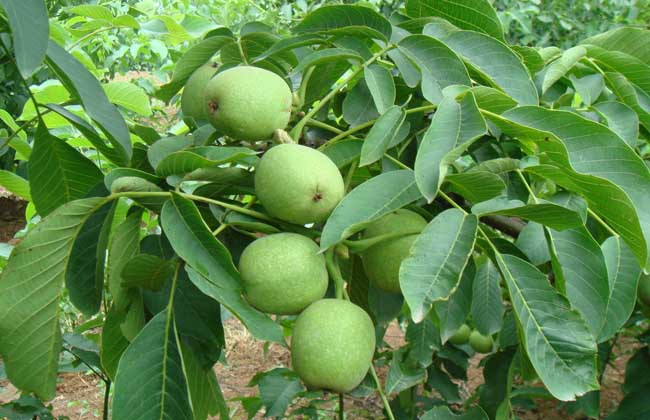
The wild walnut tree is generally 30-35 m tall, with silvery-gray bark. It has 7-11 leaflets, with entire margins or shallow serrations, and short downy hairs on the underside of the leaves. The flowering period is 4-5 months, with unisexual flowers and monoecious plants; the male inflorescence is usually 20-25 cm, while the female inflorescence is terminal, with 2-5 small flowers clustered together. The fruiting period is October; the fruit is nearly spherical, 3-5 cm in diameter, with a protruding tip. The exocarp is fleshy, grayish-green, with brown spots. The endocarp is hard, wrinkled, and yellowish-brown. The internal septum is well-developed and bony, making it difficult to extract the kernel.
Wild walnut is a temperature-loving tree species. The suitable temperature range and frost-free period for its growth are an annual average temperature of 9-16°C, an extreme minimum temperature of -25 to -2°C, an extreme maximum temperature below 38°C, and a frost period of less than 150 days. It is light-loving, and after entering the fruiting stage it requires even more sufficient light conditions. The annual sunshine duration must be above 2000 hours to ensure normal growth and development; if it is below 1000 hours, both the shell and kernel develop poorly. In cultivation, light conditions must be considered in site selection, planting density, cultivation methods, and pruning.
The extensive root system and tree body of wild walnut first require a deep soil layer (greater than one meter) to ensure good growth and development. It tolerates dry air but is relatively sensitive to soil moisture conditions; soil that is too dry or too wet is unfavorable for the growth and fruiting of walnuts. Therefore, mountain walnut orchards need engineering measures for soil and water conservation, while on flat land drainage problems must be solved, and the groundwater level should be below 2 m from the surface.
Wild walnut prefers loose soil and good drainage. It grows poorly on soil with too high a groundwater level and on heavy clay soil, but grows best on calcareous, slightly alkaline soil. Its adaptable soil pH range is 6-8, and the soil salt content should preferably be below 0.25%; if it slightly exceeds this, growth and fruiting are affected, and if the salt content is too high, it leads to death. It is fertilizer-loving.
The producing areas of wild walnut are mainly distributed in parts of the mountainous areas of Hebei, Tianjin, Shanxi, and Beijing. Varieties include Shizitou, Gongzimao, Guanmao, Denglong, Jixin, Hutou, and others. It can be made into handicrafts. With long-term handling and playing, the color of wild walnut becomes like agate and fine jade, and its value is high. Through carving by folk artisans, various animal and figure images and patterns are carved on the walnut to make nut carvings.