How to Grow Sugar Apple? A Detailed Guide to Planting Techniques and Management Methods
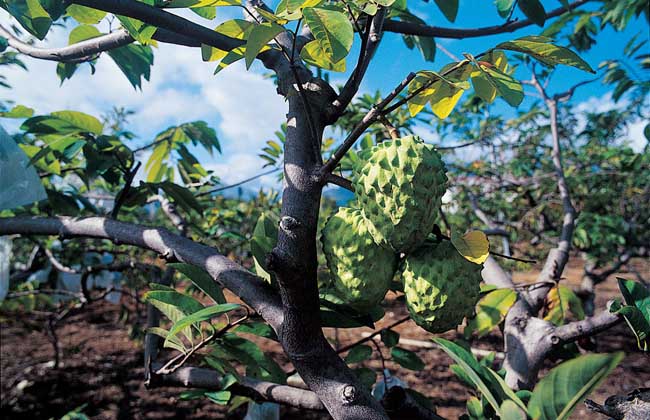
Sugar apple (Annona squamosa) is a perennial semi-deciduous small tree of the genus Annona in the family Annonaceae, named for its surface covered with polygonal, finger-sized soft wart-like protrusions. It is native to the tropical regions of the Americas. In China, it is cultivated in Hainan, Fujian, Taiwan, China, Guangdong, Guangxi and Yunnan. The fruit is mainly eaten fresh, is extremely rich in nutrients, and has very high cultivation value. Let's take a look at sugar apple planting techniques below!
Sugar Apple Planting Conditions
1. Climate: Sugar apple is a tropical to semi-tropical plant that prefers a warm and humid climate. The most suitable conditions for its growth are an average annual temperature of 21-23°C, annual rainfall of 1200-1800 ml, and air humidity of 70-95%. Generally speaking, the southern subtropical climate with frost-free winters, abundant rainfall and high air humidity is more suitable for growing sugar apple.
2. Soil: Sugar apple is a shallow-rooted plant, with most of its root system distributed within 35 cm of the soil layer. Its new roots lignify late, are aerobic, and are intolerant of waterlogging. Land sheltered from wind and facing south should be chosen for planting; in windy areas, a windbreak forest must be established, otherwise the plants are prone to wind damage and root and stem rot. Sandy soil or sandy loam that is fertile, well-aerated and well-drained is most suitable. The most suitable soil pH is 5.5-6.5. Overly acidic soil should be improved with lime. Although clayey soil and neutral soil can also support growth, the results are not as good as with sandy soil or sandy loam.
Sugar Apple Seedling Propagation Techniques
1. Seed propagation: Sugar apple seeds should be sun-dried before sowing to promote germination. The nursery should be chosen on a sunny, well-drained, fertile sandy loam site, preferably on gently sloping flat land. Before sowing in the nursery, the land should be deep-ploughed and sun-dried for 1-2 months, then decomposed organic fertilizer and a small amount of lime should be applied as base fertilizer, broken up and mixed evenly, and then trenches should be made and beds raised. Both drilling and broadcasting can be used, with 7-8 kg of seeds per mu. Cover with river sand or fine soil, press lightly, then water thoroughly and cover with grass or plastic film. The seedbed should be kept moist, but it also fears waterlogging, so care must be taken to strictly prevent excess water to avoid root rot. After germination, uncover the grass or plastic agricultural film to prevent the seedlings from being bent.
2. Grafting propagation: The grafting method for sugar apple mostly depends on the season. In spring, the phloem is not easy to peel, so cleft grafting is generally used, while in summer and autumn, budding is generally used. When budding is used for sugar apple grafting, it generally requires unbinding after 20-30 days, while with cleft grafting, the buds are generally lifted first and then unbound. For plants successfully grafted by budding, about 15 days after unbinding, the rootstock can be cut about 5 cm above the bud union. After cutting the rootstock, a large number of suckers will sprout from the base and should be removed promptly to avoid competing with the scion for nutrients and affecting bud germination. At the same time, the nursery should be kept clean, free of weeds, and with sufficient fertilizer and water supply. When the grafted seedling reaches about 50 cm in height and about 1.0 cm in stem diameter, it can be lifted from the nursery for field planting.
Sugar Apple Field Planting Techniques
1. Planting time: The field planting time for sugar apple is February to April each year; in areas with frost-free winters, it can be advanced to October to December of the previous year. In the Beijing suburbs, greenhouse cultivation should be planted in mid-to-late April (planting is possible regardless of whether the greenhouse is covered with film). At this time, the temperature rises, which is beneficial for the plants to recover from transplanting and grow. The planting spacing should be determined according to the specific conditions of the greenhouse.
2. Seedling treatment: Before field planting, sugar apple seedlings should be treated. First, they should be disinfected by spraying the seedlings with a 3-5 degree Baume lime sulfur mixture, and at the same time the seedlings should be graded and trimmed. Grade them according to seedling size and root quality, and use strong seedlings or plant good and poor ones separately. Seedlings transferred from elsewhere and those that have lost water during storage must have their roots soaked in water for 3-5 hours before planting.
3. Planting density: The spacing between plants and rows varies by variety. Generally, 3X4 m or 4X5 m is suitable, and the densest can be increased to 2x3 m. Before planting, the planting holes should be dug in advance. The size of the hole is 0.8x0.8x0.8 m. Topsoil mixed with decomposed organic fertilizer is placed at the bottom, and subsoil is placed on top. Then place the seedling in and plant it, firm it by stepping, water thoroughly once with settling water, and then cover with a layer of raw soil to prevent water evaporation. If planting on flat land with abundant rainfall, it is not advisable to dig large holes for planting; simply raising high ridges for planting is enough to prevent water accumulation in the holes from causing plant death.
Sugar Apple Fertilizer and Water Management
1. Fertilizing young trees: Generally, 1-2 year old young trees require 5 kg of organic fertilizer, 0.45 kg of urea, 0.35 kg of superphosphate, and 0.1 kg of potassium sulfate per plant. Except for the organic fertilizer, which is applied all at once before winter pruning, the remaining chemical fertilizers are applied respectively after the first, second and third flushes of new shoots mature and before winter pruning begins. The amount of fertilizer for winter pruning should be the highest, accounting for about 55% of the total annual amount, with the other three applications each accounting for 15%, to promote tree vigor growth and canopy formation.
2. Fertilizing mature trees: The fertilizer demand of fruiting sugar apple trees is greater, and the amount should be determined according to tree age, tree vigor and fruiting conditions. Generally, 3-4 year old trees require annual application of 10-15 kg of organic fertilizer, 2 kg of superphosphate, 0.5 kg of potassium sulfate, and 1.2 kg of urea, of which the organic fertilizer is applied all at once before and after winter pruning.
3. Irrigation management: Sugar apple most needs water during the budding stage, young fruit swelling stage, rapid fruit swelling stage, post-harvest recovery stage and dormancy stage. Timely and appropriate irrigation should be carried out according to specific conditions to ensure fruit set rate, large fruit rate and premium fruit rate, as well as the recovery of the root system and tree vigor. Hole irrigation and furrow irrigation are the better irrigation methods. Insufficient water will lead to poor plant growth, uneven budding, heavy shedding of young fruit, poor fruit development and a large increase in fruit cracking rate. But sugar apple is also most afraid of waterlogging; even short-term waterlogging can lead to the same results as water shortage, and can trigger root rot, leading to plant death. Therefore, drainage work must be done promptly.