How many years after planting does a bayberry tree bear fruit?
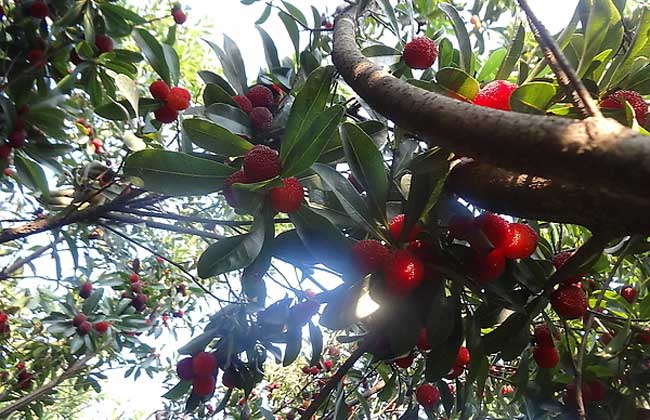
The bayberry tree is produced in most parts of China, growing on hillsides or in valley forests at an altitude of 125-1500 m. It is a famous fruit of Jiangnan in China. Do you know how many years after planting a bayberry tree will bear fruit? Below, the editor of Qiannong Network will introduce to you exactly how many years a bayberry tree needs to be planted before it bears fruit!
How many years after planting does a bayberry tree bear fruit?
If a grafted bayberry seedling is cultivated properly, it generally bears fruit in 4-5 years, and enters full bearing period after 8 years. The flowering period of bayberry is April, and the fruit ripens in June-July.
Reasons why bayberry trees do not bear fruit
1. Insufficient light: the canopy of large trees around the bayberry tree is too large, blocking the sunlight, so the bayberry tree cannot get sufficient light.
2. The soil is too fertile: the bayberry tree will only grow taller vertically and will not grow leaves horizontally, and this is also not conducive to fruiting.
3. Variable climate: snow, heavy rain, and cold air come one after another, and spring is the key season for bayberry growth, so to a certain extent, the variable climate also affects the growth and fruiting of bayberry trees.
4. The fruiting age has not yet been reached.
5. There is no male pollinator tree.
Treatment methods for bayberry trees that do not bear fruit
1. Spray the canopy with paclobutrazol: from the end of July to the end of September, spray the canopy with 200×10 to the power of negative 6 to 500×10 to the power of negative 6 paclobutrazol. The concentration depends on the variety and tree vigor. For example, for thick leaves and strong tree vigor, the concentration should be relatively higher. Spray in the current year, and it can go into production the next year. The effect lasts 2-4 years. After the effect disappears, it can be used continuously. You can also apply 0.5 g of paclobutrazol per sq m to the soil according to the projected canopy area.
2. Pruning and suppressing shoots: in spring, adopt the principles of “control the top and promote the bottom, control the outside and promote the inside, thin out large branches, and keep more small twigs” for pruning, or “open skylights” to promote ventilation and light penetration in the canopy and promote flowering and fruiting. When autumn shoots stop growing, you can use ropes to pull branches, hang medicine bottles, or use branches to prop the branches, so as to open up the canopy, increase the opening angle of large branches, and moderate tree vigor. From early August to mid-to-late October during flower bud differentiation, use a knife to girdle the trunk and branches 1-2 rings at a distance of 1-1.5 m from the canopy to promote flowers and fruit set. The girdled branches should account for 1/2-2/3 of the whole tree. In spring from February to March or in autumn from early September to mid-October, the orchard should also be deep-plowed to cut roots.
3. Arrange male bayberry trees for pollination: in production, it is required that for every 60-90 bayberry trees there should be no fewer than 2 male (staminate) bayberry trees.
4. Fertilization and earthing up: mainly use decomposed pig and cattle pen manure, composted fertilizer, and screened garbage fertilizer, applied 3 times a year, the 1st time in late February, the 2nd time in mid-to-late May, and the 3rd time in early August. For each large tree, apply 15-30 kg of garbage soil fertilizer plus 40-50 kg of mixed soil and manure. Earth up once a year. 200-250 kg per tree.
5. Prevention and control of pests and diseases: bayberry has relatively strong disease resistance, but when scale insects, bagworms, etc. occur on the tree, pesticides should also be sprayed during the larval stage for control. Leaves are easily infected by leaf spot disease, and 0.5% Bordeaux mixture should be sprayed for control. Although wart disease on branches and trunks occurs less often, it should also be controlled. After removing the diseased spots, use 1:6-10 strong alkaline water to brush and disinfect the wounds.