What Does a Mangosteen Tree Look Like? A Detailed Introduction to Its Physical Characteristics
Mangosteen is also known as shanzhu, shanzhuzi, and daonianzi. It can refer either to the mangosteen plant or to the fruit of this plant. It is a famous tropical fruit that can be eaten raw or made into candied fruit. It originated in Southeast Asia and generally only begins to bear fruit after 10 years of planting. It has very strict requirements for its environment and is as famous as durian, known as the "Queen of Fruits."
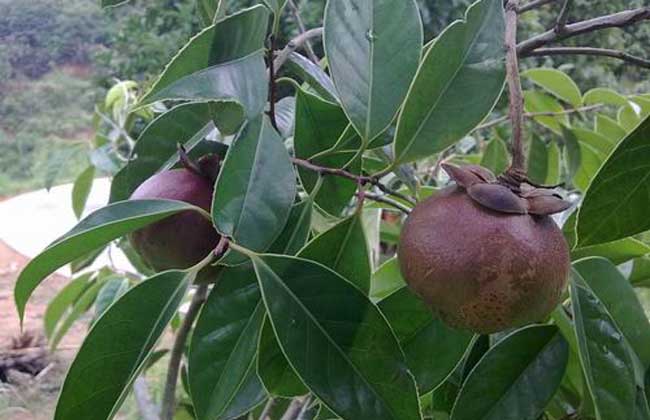
The mangosteen tree is a small tree, 12-20 m tall, with many dense branches that are decussately opposite, and the branchlets have obvious longitudinal ridges. The leaves are simple and opposite, elliptical or oblong-ovate-elliptical, 11-21 cm long and 4.5-10 cm wide, thick and leathery, dark green and glossy on the upper surface. The underside is pale yellow-green, the petiole is short and thick, the leaf base is obtuse, the leaf tip is acute, the margin is entire, and the veins are obvious; the midrib is pale green and raised, and the lateral veins are in 15-27 pairs. They are parallel to each other and almost perpendicular to the main vein, and the leaves are easily broken. When a leaf is broken, yellow resin flows out.
The mangosteen tree generally has a single terminal flower, and sometimes 2-3 flowers can be seen growing together. There are only female flowers and no unisexual male flowers. When fully open, the flower is 5-6.2 cm in diameter. There are 4 sepals in two rows, paired two by two, yellow-green with red edges. There are 4 petals, obovate, of unequal size, very thick, imbricate, with the tips incurved or recurved, red. They fall off 1-2 days after the flower opens. There are 10-23 stamens, usually 16, free at the base or nearly connate, with yellow anthers. The ovary is nearly spherical, 4-8-loculed, the style is very broad and thick, and the stigma is 4-8-lobed. The flowering period is September-October.
The berry of the mangosteen tree is subspherical, 3.5-7 cm in diameter, with the calyx persistent. The rind is 0.6-1 cm thick, fibrous, and when an unripe fruit is damaged, yellow sap flows out; the ripe fruit is purplish red. Inside the fruit there are 0-4 seeds, usually 1-2, brown, coarse, with fibrous lines on the surface. A well-developed seed is about 2-2.5 cm long, about 1.5-2 cm wide, and 0.7-1.2 cm thick, with a seed weight of 0.1-2.29, and an average seed weight of 19. The main root is strong and deep in the soil, while the lateral roots are few and weak, with few root hairs; transplanting damages the roots, making it difficult to survive. The fruiting period is November-December.
The stem of the mangosteen tree is straight, and the bark is rough, blackish brown, with yellow bitter resinous sap. The crown is conical. The branches are opposite and bilaterally symmetrical. The branches are stout, and the young twigs generally have 4 strip-like angles.