What kind of environmental conditions does pomelo cultivation require?
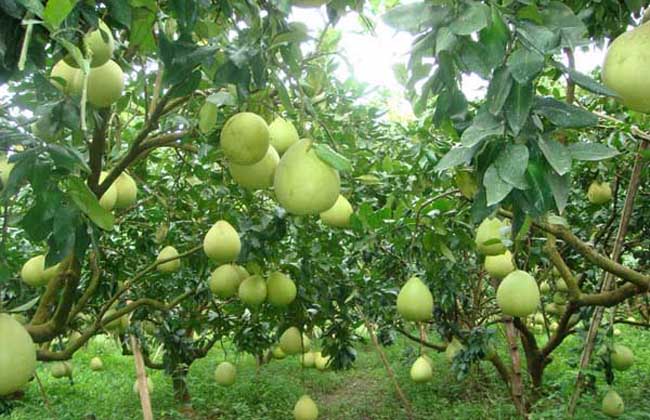
The pomelo is an evergreen tree. Its leaves resemble those of mandarins and tangerines, mostly long oval or long ovate, while the winged petiole is heart-shaped; the fruit is mostly gourd-shaped, pear-shaped or spherical, with a surface that is mostly yellow or orange, glossy with dimples, generally with a pungent aroma, and a relatively thick peel that can be removed by hand. The following explains the pomelo cultivation environment.
Site selection: pomelos are not demanding about soil. As long as the soil layer is deep and drainage is good, they can be planted, but sandy loam soil is best. Pomelos like to grow in warm, humid places, and the best time to plant them is during the spring and autumn rainy seasons each year, as they can then absorb plenty of water.
The fruit is larger than that of citrus, with a single fruit often weighing more than 1 kg and measuring 15-25 cm in diameter. Between the peel and the flesh there is a white spongy layer. The flesh is red or yellowish-white, with white being more common, rich in juice with a strong fragrance, and sweet or sweet-and-sour in taste, sometimes with a bitter note, which mainly comes from the bioflavonoids it contains. Pomelos can be kept in natural conditions for several months without spoiling.
The segment contains 12-15 segments. In cultivation, bagging is often done to make them seedless; in the natural state, a single fruit can contain more than 100 seeds. Ordinary pomelos usually ripen between October and November, while early-maturing varieties can be marketed as early as September, and late-maturing varieties as late as January-February of the following year. The root system is relatively shallow, mostly concentrated at about 1 to 3 m.