Planting Methods and Key Technical Points for Yellow Peach Saplings
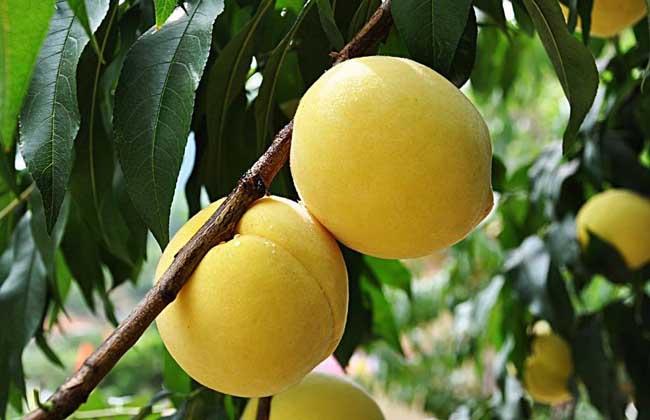
Yellow peach saplings belong to the yellow-fleshed peach category of nursery stock and are grafted seedlings, propagated by grafting onto peach rootstock seedlings. Yellow peaches originated in China, and many yellow peach varieties are cultivated in our country, so yellow peach saplings can be divided into saplings of fresh-eating yellow peach varieties such as Fenghuang saplings and Jinhuang saplings, saplings of processing yellow peach varieties such as Guan 83 saplings, 19 Tao saplings and the Jintong series saplings, and saplings of yellow peach varieties used for both fresh eating and processing such as Jinxiu yellow peach saplings and Huangjinguan peach saplings. The main production areas of yellow peach saplings in China are concentrated in Wutai Town, Pingyi County, Shandong Province, Yuncheng in Shanxi, and Dalian in Liaoning, with Wutai Town, Pingyi County being the most prominent. Let us now take a look at the market prices and planting methods of yellow peach saplings!
Market Prices of Yellow Peach Saplings
Stem diameter 1 cm, height 100 cm, crown width 20 cm, price 2 yuan per plant.
Seedling Cultivation of Yellow Peach Saplings
The yellow peach nursery should be established on loose, fertile sandy loam plots with convenient drainage and irrigation, and continuous cropping must be strictly avoided. The peach seeds should be wild peach or small mountain peach collected in the current year. Sowing can be divided into autumn sowing and spring sowing. For autumn sowing, sow before the soil freezes; soak the sun-dried peach seeds in clean water for 48 hours and then sow directly. For spring sowing, the seeds should undergo sand storage treatment before the soil freezes, and can be sown only after dormancy is broken. Sand storage method: soak the peach pits in cold water for 48 hours, take clean river sand and mix it with water until it holds together when squeezed in the hand and crumbles when lightly touched after release. Mix 1 part seeds with 3 parts moist sand, open a trench in the open ground in a shaded place, with a trench depth of 60-70 cm, and the length and width depending on the amount of seeds. First spread a 10 cm thick layer of moist sand on the bottom of the trench, then place the seed-sand mixture on top, piling it up until it is 10 cm below ground level, spread a 10 cm thick layer of moist sand on top, and finally cover with 15 cm of soil. Sow in late March, with two rows per ridge, sowing about 30,000 seeds per mu, and strengthen fertilizer and water management during this period to promote plant growth.
Grafting Methods for Yellow Peach Saplings
Seedlings that have not been grafted are called seedling seedlings or wild seedlings. Cultivating yellow peach saplings requires grafting, and grafted yellow peach saplings fall into two types: 1. Finished seedlings: in early June, when the seedling seedlings have grown to a height of about 60 cm, grafting is carried out using the "D"-shaped bark-lifting bud grafting method. The scion should be selected from yellow peach varieties with excellent comprehensive traits. The grafted saplings can grow to a stem diameter of about 1 cm by autumn and can leave the nursery in the same year. 2. Bud seedlings: also called semi-finished seedlings or autumn-forced buds, generally grafted in mid-to-late August, using "D"-shaped bud grafting or bark-peeling patch grafting. The grafted peach buds do not sprout again in the same year. In the following spring, cut off 1 cm above the grafted bud to cultivate large yellow peach saplings.
Planting Methods for Yellow Peach Saplings
Yellow peach saplings are planted from November to before March of the following year, mainly in autumn, after the peach saplings shed their leaves and before the soil completely freezes, so that the saplings recover quickly the following spring and the survival rate is high. Traditional planting generally uses a plant-to-row spacing of 3 m × 4 m, planting 55 plants per mu. The dense planting method of Daxing Fruit Products Professional Cooperative in Pingyi County, Shandong Province uses a plant-to-row spacing of 1 m × 3 m, planting about 220 plants per mu, adopting a single-trunk spindle tree shape, which is simple to manage, saves labor, bears early and yields abundantly, and is more suitable for large-scale development.
Purchasing Guidelines for Yellow Peach Saplings
When planting yellow peach saplings, choose robust saplings with well-healed graft unions and a diameter of more than 0.5 cm, with well-developed roots, uniform and complete main and lateral roots, no mechanical injuries, no root nodules and no flood damage. As far as possible, purchase yellow peach saplings from the main production areas of the yellow peach varieties being planted, because only when there are large areas of fruiting trees can the use of high-quality yellow peach scions be guaranteed, thereby ensuring the purity of the yellow peach saplings. Many nursery bases only grow seedlings, and there are no fruiting peach trees locally. The scions must be purchased from yellow peach bases in other places, so the purity of the peach saplings cannot be guaranteed at all. In addition, if the peach sapling scions use buds from peach trees that have been propagated by multiple graftings, the quality will decline, so first-generation grafted yellow peach saplings should be used as far as possible, avoiding peach saplings grafted over multiple generations. Do not blindly believe in novel varieties advertised in some promotions. Some seedling merchants introduce a variety from elsewhere, then casually give it a name and maliciously hype it as a new variety, misleading growers. This issue must be taken seriously, and as far as possible plant saplings of stable varieties identified by authoritative agricultural science departments.
Pest and Disease Control for Yellow Peach Saplings
Yellow peach saplings do not suffer from many pests and diseases. According to local conditions, pesticides such as triadimefon, carbendazim or zineb can be sprayed to control powdery mildew and shot hole disease on yellow peach saplings, and imidacloprid can be sprayed to control aphids. The most important is the control of root nodule disease on yellow peach saplings. In mid-May, use 5 kg of lime sulfur mixture (3 degrees Baume) per mu, evenly dilute it with irrigation water and pour it into the seedling field to control the disease by root irrigation. Dichlorvos and Bordeaux mixture will cause serious phytotoxicity to yellow peach saplings and must be strictly prohibited.