Detailed Explanation of Key Management Techniques for Persimmon Trees
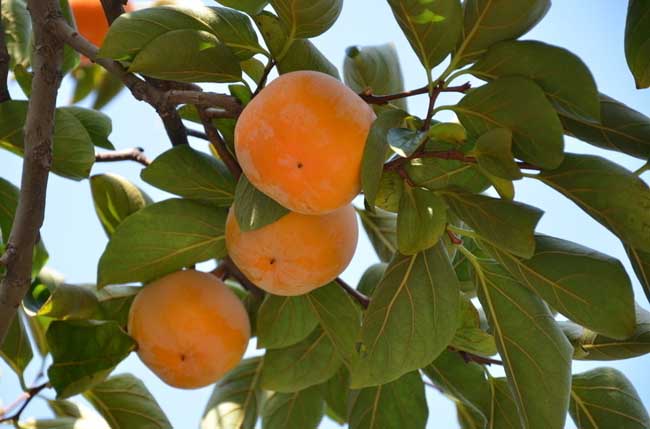
Persimmon trees are widely distributed in China and are planted in many places. Persimmons are delicious, juicy and nutritious, and are deeply loved by people. Persimmon trees have large root systems, a strong ability to absorb water and nutrients, and are easy to cultivate. When cultivating persimmon trees, maintenance and management work must be done well so that the persimmon trees grow healthily.
Tree Dish Management
1. Deep plowing of the tree dish to store water and preserve fertilizer: Deep plow the tree dish 2 times each year, the 1st time in spring from March to April, and the 2nd time after fruit harvest and before the soil freezes. The deep plowing range is from the trunk to the edge of the canopy. It should be slightly shallow near the trunk and gradually deeper outward to prevent root damage.
2. Mulching the tree dish with grass: Covering the area under the tree dish with grass is an effective way to improve soil nutrients and moisture conditions, and is one of the important measures for high yield and high quality of persimmon trees. Its benefits are, first, it can slow sudden changes in ground temperature under the tree dish and achieve the purpose of keeping soil temperature stable; second, it can reduce evaporation and runoff and keep soil moisture relatively stable; third, it can increase soil organic matter content. The mulching time is in March each year. Before mulching, apply an appropriate amount of nitrogen fertilizer and potassium fertilizer, then water, and then mulch. The suitable mulching thickness is 15-20 cm, and the coverage range should be within the canopy range, but do not mulch within a 30 cm radius around the trunk. After mulching, scatter a small amount of soil here and there to press down the grass and prevent wind blowing and fire.
Applying Base Fertilizer in Autumn
The suitable time for applying base fertilizer in autumn is from mid-to-late September to early October. At this time, ground temperature is high, microbial activity is vigorous, organic matter decomposes and heats up quickly, and this is beneficial for root absorption. The fertilizer should be mainly organic fertilizer, supplemented with quick-acting fertilizers such as N, P and K. Apply 100-200 kg of farmyard manure, 10-20 kg of human excrement and urine, and 15 kg of plant ash per tree, and mix in 0.5 kg of urea and 4 kg of superphosphate.
Use trench application or ring-shaped trench application. Dig a trench 50 cm wide and 60 cm deep along the outer edge of the canopy, or a ring-shaped trench. Place topsoil and undecomposed crop straw in the bottom layer of the trench, and apply a mixture of decomposed farmyard manure and fine fertilizer into the 20-30 cm soil layer. No matter which fertilization method is used, decomposed farmyard manure and fine fertilizer must not be applied too deep, so as not to affect fertilizer efficiency.
Skillful Application of Supplemental Fertilizer
Persimmon trees are given supplemental fertilizer 2 times each year. The first time is in March in spring, carried out together with mulching the tree dish with grass. The second time is in late July during the period of rapid fruit enlargement. Supplemental fertilizer should be mainly quick-acting fertilizer, mainly nitrogen fertilizer in the early stage and mainly potassium fertilizer in the later stage, supplemented with an appropriate amount of phosphate fertilizer. Where irrigation conditions are available, apply supplemental fertilizer on time; where irrigation conditions are not available, apply supplemental fertilizer opportunistically with rain according to the weather. Generally, according to the size of the canopy, dig several small holes per tree, apply chemical fertilizer, and then fill them level with soil.
The amount of supplemental fertilizer should be specifically determined according to the size of the canopy and the load. Generally, for mature trees, apply 0.5-1.5 kg of nitrogen fertilizer, 0.5-1 kg of potassium fertilizer, and 0.25-0.75 kg of phosphate fertilizer per tree. During the growing season, in combination with pesticide spraying, carry out foliar fertilizer spraying 3-4 times with 0.5% urea, 200-times potassium dihydrogen phosphate, or photosynthetic micro-fertilizer, etc.
Reasonable Pruning
In production, persimmon trees are often neglected in pruning and allowed to grow naturally, resulting in strong upper parts and weak lower parts, poor light, bare inner canopy, outward movement of fruiting positions, and reduced yield. In pruning, the principles should be mastered: less heading back, prompt retraction after fruiting, and not too many long unpruned branches.
1. Winter pruning should mainly be light pruning, combining thinning and retraction, adjusting the framework, and improving ventilation and light conditions. Thin out some overly dense branches, thin and weak branches, overlapping and crossing branches, and diseased, pest-damaged and dead branches. Pay attention to retracting weak large perennial branches to stimulate the growth of new branches. Head back small branches to promote secondary buds to sprout into branches.
2. Summer pruning should master the principle of combining thinning, pinching, bud notching and ring cutting, that is, thinning out large branches and overly dense, weak and improperly positioned new shoots in the inner canopy. Because the retained branches have improved light and nutritional conditions, they easily form flower buds and bear fruit. Before germination, notch buds on vigorous one-year-old branches to promote the growth of medium and short branches. For new shoots sprouted from bud notching and other branches, pinch the tips when they are 30-40 cm long. After pinching weak branches, flower buds easily form at the top. After pinching vigorous branches, the secondary branches they produce can form flower buds in the same year and bear fruit the next year. To increase the fruit-setting rate, carry out ring cutting on large auxiliary nurturing branches during the flowering period.
3. Branch bending in autumn. The best time for branch bending in the year is September, but in the seasons of vigorous branch growth in May-June in summer, upright vigorous branches can be bent at any time, and vigorously growing new shoots can be twisted. In September, the main targets of branch bending are the main branches and auxiliary nurturing branches. The opening angle of the basal main branches should be about 90°. If less than 70°, bend downward; if greater than 70°, bend upward; if the orientation is inappropriate, bend to the left or right. Note that such large branches should not be bent forcefully, as they are prone to splitting. The correct method is to make 3 saw cuts on the back side, then brace the base with your foot, slowly bend downward with both hands, and finally fix it in place. All upper main branches and side branches should be bent flat.
Prevention and Control of Pests and Diseases