Where are the main pineapple producing areas distributed?
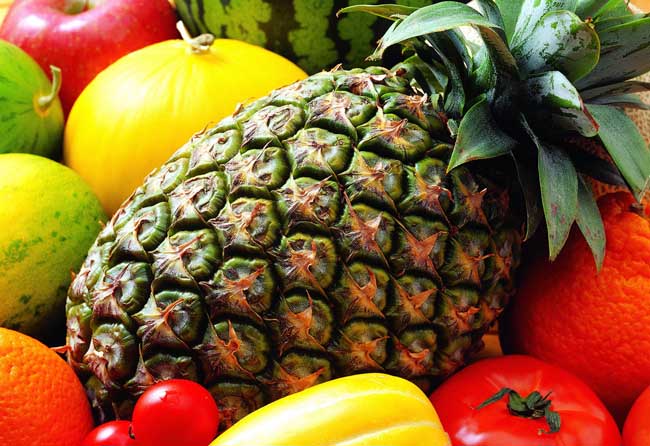
What places are pineapple producing areas? Pineapple is commonly known as fengli, and is one of the famous tropical fruits and a common fruit in our daily life. Do you know what places are pineapple producing areas? Then let's take a look together below at where the pineapple producing areas are and what place is the origin of pineapple!
Basic characteristics of pineapple
Pineapple is one of the famous tropical fruits. Its edible part mainly consists of the enlarged fleshy inflorescence axis and flowers arranged spirally on the outer periphery. The flowers usually do not set fruit, and the persistent perianth lobes enclose a cavity, within which are stored shrunken stamens and styles. The fibers of the leaves are very tough and can be used for fabrics, making ropes, knotting nets, and making paper.
The pineapple stem is short, and the leaves are numerous, arranged in a rosette, sword-shaped, 40-90 cm long and 4-7 cm wide, with acuminate apex, entire or with sharp teeth, green on the ventral side, powdery green on the dorsal side, often brownish red along the margins and apex; the leaves borne at the top of the inflorescence become smaller and are often red. The inflorescence emerges from the leaf rosette, shaped like a pine cone, 6-8 cm long, and enlarges when fruiting. The bracts are green at the base and light red in the upper half, triangular-ovate; the sepals are broadly ovate, fleshy, reddish at the apex, about 1 cm long. The petals are oblong-elliptic, pointed at the tip, about 2 cm long, purple-red in the upper part and white in the lower part. The multiple fruit is fleshy, more than 15 cm long. The flowering period is from summer to winter.
Distribution of pineapple producing areas
Pineapple is widely distributed between the Tropic of Cancer and the Tropic of Capricorn and is one of the world's important fruits. It originated in Central and South America, was introduced to China in the 17th century, and was already cultivated by the 18th century. At present, more than 80 countries and regions in the world cultivate it economically, with the main producing areas concentrated in Thailand, the Philippines, Indonesia, Vietnam, Brazil, South Africa, and the United States. China is one of the top ten major pineapple producing countries, mainly distributed in tropical provinces such as Guangdong, Hainan, Guangxi, Fujian, and Yunnan.
What types of pineapple are there?
Generally, cultivated pineapple varieties are divided into 4 categories, namely the Cayenne group, the Queen group, the Spanish group, and hybrids.
1. The Cayenne group, also known as Sarawak, was named after the French expedition discovered it in the Cayenne region of Guyana in South America. It is extremely widely cultivated, accounting for about 80% of the world's pineapple cultivation area. The plant is tall and robust, with spineless leaf margins or a few spines at the leaf tips. The fruit is large, with an average single fruit weight of more than 1100 grams, cylindrical, with flat fruitlets, shallow fruit eyes, and short and wide bracts; the flesh is light yellow, juicy, moderately sweet and sour, with soluble solids of 14%-16%, and can reach more than 20% at the high end, and acid content of 0.5%-0.6%. It is the main variety for canning.
2. The Queen group is the oldest cultivated variety, with a cultivation history of more than 400 years, and is one of the main cultivars in South Africa, Vietnam, and China. The plant is medium-sized, with leaves shorter than those of the Cayenne group and spiny leaf margins; the fruit is cylindrical or conical, with a single fruit weight of 400-1500 grams, conical protruding fruitlets, deep fruit eyes, and bract tips extending beyond the fruitlets; the flesh is yellow to dark yellow, crisp and tender, with high sugar content, juicy and sweet, and a rich aroma, mainly for fresh eating.
3. The Spanish group has larger plants, softer leaves, yellow-green in color, and red spines on the leaf margins, but there are also spineless varieties. The fruit is medium-sized, with a single fruit weight of 500-1000 grams, and the fruitlets are large and flat, with the center raised or sunken; the fruit eyes are deep, the flesh is orange-yellow, strongly aromatic, and high in fiber, used for canning and juice.
4. Hybrids are improved varieties bred through sexual hybridization and other means. The plant is tall and upright, with spines on the leaf margins, light purple flowers, and a somewhat irregular fruit shape, with a single fruit weight of 1200-1500 grams. The flesh is yellow, crisp in texture, low in fiber, and pleasantly sweet, with soluble solids of 11%-15% and acid content of 0.3%-0.6%. It can be eaten fresh or processed into cans.