How to Grow Square Watermelons: A Detailed Guide to Planting Methods and Key Techniques
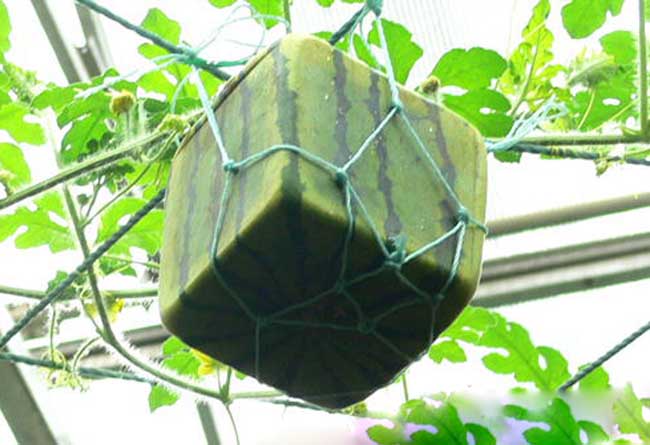
How to grow square watermelons? Compared with traditional round watermelons, square watermelons are pressed into shape by molds, so their internal tissue is denser, their sweetness is also higher than that of round watermelons, and they also have advantages such as being convenient to transport. In addition, words can be written on the watermelon, and any kind of text or pattern can be written on it.
Square Watermelon Planting Methods
1. Variety selection: For square watermelon cultivation, choose large-fruited, strongly disease-resistant, thick-skinned varieties suited to sparse planting. In our area, varieties such as Xinong No. 8, Xincheng, and Zhengza No. 5 are mainly chosen.
2. Seedling raising methods
① Preparation of nutrient soil: Use 7 parts of garden soil that has not grown melons within 3 years, 1 part of fully decomposed human, livestock, and poultry manure, and 2 parts of plant ash. For each cubic meter of the mixed soil, add 100 grams of 50% carbendazim wettable powder, 3 kilograms of superphosphate, and 500 grams of 3% phoxim granules, and mix them evenly.
② Seed treatment: Sun-dry the seeds for 1 day, remove deformed, mixed, and shriveled seeds, soak the seeds in a 100-fold formaldehyde solution for 1 hour, then rinse with clean water, rub by hand, wash off the mucilage, then transfer to room-temperature water and soak the seeds for 6-8 hours, stirring once every 3-4 hours, then remove the seeds, drain the water, spread the seeds on a wrung-out towel or gauze, and cover with another 1-2 layers of gauze to make a germination bed. After 2-3 days, 70%-80% of the seeds germinate. Pick out the sprouted seeds in batches and sow them in batches.
③ Sowing and seedling management: Use nutrient pots for seedling raising. Fill the nutrient pots with nutrient soil, leaving 1-1.5 cm at the top, press lightly, water thoroughly, place the germinated seeds inside, 1 seed per hole, cover with nutrient soil, cover with plastic film, and put up an arched shed. After emergence, remove the plastic film in time to prevent seedling burn. Ventilate on sunny days, keep the temperature at 28-32°C, maintain humidity at about 75%, and water preferably in the morning on sunny days, following the principle of neither dry nor wet. Pest and disease control during the seedling stage can be carried out together with watering. Harden the seedlings 1 week before transplanting.
3. Timely transplanting
① Land preparation and fertilization: Choose a field with high terrain, smooth drainage, and a wind-sheltered, sunny location. Deep plow, harrow finely, level the beds, open fertilizer trenches, and apply per mu 3000 kilograms of decomposed farmyard manure, 25 kilograms of ternary compound fertilizer, 10 kilograms of superphosphate, and 50 kilograms of decomposed rapeseed cake as base fertilizer, then make beds 3 meters wide.
② Transplanting: Seedlings can be transplanted when they grow to 2 leaves and 1 heart. Single-row transplanting should be used, with a plant spacing of 3 m × 0.4 m. Water thoroughly to settle the roots, and at the same time add a certain amount of fungicide.
Field Management of Square Watermelons
1. Timely topdressing: Inspect the seedlings and replant missing ones. The replanted seedlings should preferably be close in age to the field seedlings. Pay attention to controlling underground pests such as cutworms and root maggots. When the vines grow to 30 cm, apply fruit-setting fertilizer before pressing the vines, with per mu 10 kilograms of urea, 5 kilograms of ternary compound fertilizer, and 50 kilograms of rapeseed cake.
2. Pruning and vine pressing: Use two-vine pruning, that is, keep the main vine and the robust side vine arising from the base of the main vine, and set fruit on the main vine. Generally carry out 3-5 vine pressings, and stop pressing vines after the fruit is set firmly.
3. Water management: Promote growth during the vine extension stage and the fruit swelling stage, and control water during the flowering and fruit-setting stage.
4. Fruit selection and mold application: Artificial pollination can be carried out. Select and keep the 2nd and 3rd female flowers on nodes 12-20 of the main vine for fruit setting. If fruit cannot be set on the main vine, select and keep fruit on the 2nd and 3rd female flowers of a backup side vine. When the fruit grows to the size of a fist, mold application can be carried out. The mold is a square glass container, 40 cm long and 25 cm wide, and its size can be adjusted. Under the pressure of the mold, after the watermelon becomes square, appropriately widen the mold again. Do this 2-3 times, and a square watermelon with uniform color and a regular shape can be grown. Remove the mold when the watermelon is 70% ripe, and harvest when it is 80% ripe.
5. Pest and disease control: Thiophanate-methyl and carbendazim can be used to control anthracnose, fusarium head blight, and powdery mildew; Xiaobingling can be used to control fusarium wilt; and Yisaoguang and Decis can be used to control aphids.