Where is the loquat grown, and when does it ripen?
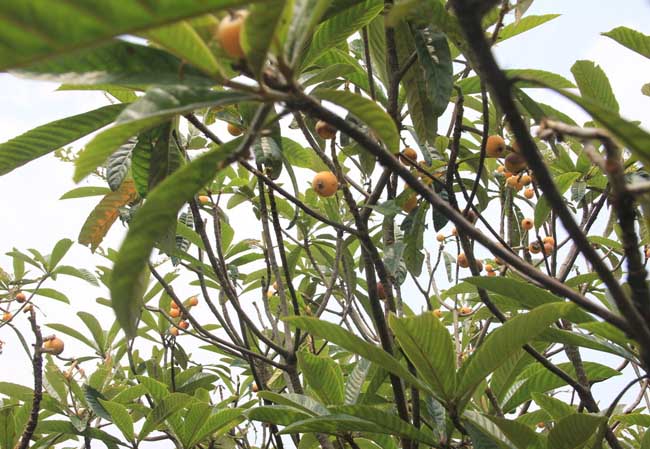
The loquat originates from southeastern China and is named for its leaves, which resemble the pipa instrument. Unlike most fruit trees, the loquat blooms in autumn or early winter, and its fruit ripens from spring to early summer, earlier than any other fruit, so it is called "the one among fruit trees that alone embodies the qi of all four seasons." Let's take a look below at where the loquat is grown and when it ripens!
The distribution of loquat
The loquat is mainly grown in Gansu, Shaanxi, Henan, Jiangsu, Anhui, Zhejiang, Jiangxi, Hubei, Hunan, Sichuan, Yunnan, Guizhou, Guangxi, Guangdong, Fujian, and Taiwan, China. It is widely cultivated everywhere, and wild plants are found in Sichuan and Hubei.
The loquat is also cultivated in Japan, India, Vietnam, Myanmar, Thailand, and Indonesia.
Tangqi Ruantiao Baisha in Yuhang District, Hangzhou, Zhejiang; Dongshan in Suzhou (Zhaozhong Baisha loquat); and Baokeng Jiefangzhong in Putian, Fujian, are the three major loquat production areas of China.
The ripening period of loquat
The loquat blooms from October to December and fruits from May to June. However, because the loquat has evolved into many varieties, and because the production area and variety differ, the ripening period of the loquat also differs. Some early-maturing varieties are already on the market in March. The market times of China's main loquat production areas are as follows:
① On the market in March: Yunxiao loquat from Fujian, Mengzi loquat from Yunnan.
② On the market in April: Putian loquat from Fujian, Longquan loquat from Sichuan.
③ On the market in May: Dongting loquat from Jiangsu, Santan loquat from Anhui, Tangqi loquat from Zhejiang, Qingpu loquat from Shanghai.
The growing conditions of loquat
The loquat likes light, tolerates slight shade, prefers a warm climate and fertile, moist, well-drained soil, tolerates slight cold but not severe cold, and grows slowly. It grows well in areas with an average temperature above 12 to 15, where the winter temperature does not drop below -5°C, and where the temperature during the flowering and young fruit stages does not fall below 0°C.
Under normal circumstances, it can also be cultivated in Henan Province, but if the temperature during the fruiting period drops below minus 2 degrees, the young fruit will be damaged by frost, so the suitable cultivation areas are the middle and lower reaches of the Yangtze River and areas to the south. Fertile soil is best.