Kiwifruit Variety Classification and Introduction to Common Varieties
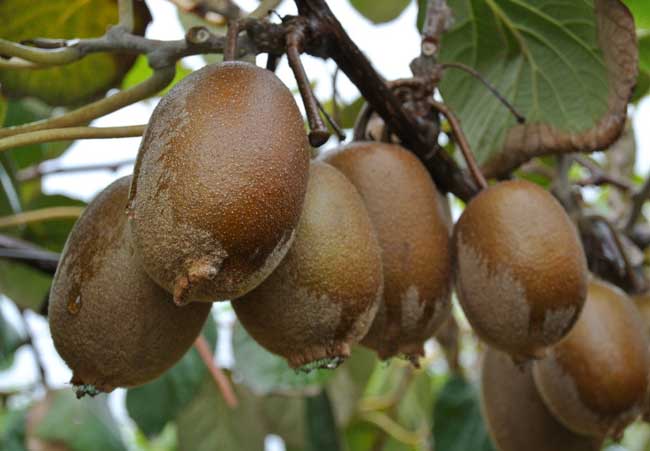
Kiwifruit is the name for the cultivated fruit species of Chinese kiwifruit. There are 59 species of kiwifruit native to China, among which four varieties have relatively high cultivation value in production, including Chinese kiwifruit, delicious kiwifruit, and red-fleshed kiwifruit. Let's take a look below at what the kiwifruit variety classifications are!
Guichang
"Guichang" kiwifruit grows in Xiuwen County, Guizhou, a place with a long history and rich culture, located in central Guizhou. This place became world-famous because the Ming dynasty sage Mr. Wang Yangming attained enlightenment here, and it is praised by people as the "Holy Land of Wang Studies." It has a mid-subtropical climate, with mild weather, abundant rainfall, no severe cold in winter, and no extreme heat in summer. The altitude within the area is 1200-1400 m. The superior climate environment is conducive to the planting and development of "Guichang" kiwifruit.
"Guichang" kiwifruit was cultivated by grafting local wild kiwifruit. The average single fruit weight is 70-100 grams. The fruit body is long cylindrical, and the flesh is emerald green. It has the unique qualities of tender flesh, juicy texture, rich juice, refreshing sweetness, and a balanced sweet-sour taste. Guichang kiwifruit is praised as the "king of kings" among similar products nationwide for its superior quality. No swelling agents were used at any point during cultivation; it is completely organic and natural.
"Guichang" kiwifruit, with its unique quality, was rated as a "Guizhou Province High-Quality Agricultural Product" and a "Guiyang Tourism Product" in 2000. In 2004, it obtained pollution-free agricultural product origin certification. In March 2011, Xiuwen kiwifruit obtained the national geographical indication trademark, and the product sells well nationwide.
Yueyin 2205
Yueyin 2205 is also called Zaoxian and was introduced from Jiangxi in 1984. The tips of the branches are light brown, one-year-old branches are purple-brown, and the lenticels are relatively sparse. The leaves are approximately heart-shaped. The flowers are mostly solitary, with about 37 styles. The fruit is cylindrical, with an average single fruit weight of 87.3 grams and a maximum fruit weight of 130 grams. The flesh is yellow-green, fine in texture and juicy, with a balanced sweet-sour taste and a relatively strong flavor and aroma. It contains 12.4-14.7% soluble solids, 6.09-11.08% total sugar, and 93.7-147.5 mg/100 g vitamin C. The core is medium in size, and the average number of seeds per fruit is 600-800. It matures in early to mid-August. The storage period at room temperature is 5-7 days.
The Yueyin 2205 plant has moderate growth vigor, produces branches 2-4 times a year, has a budbreak rate of 40%-65%, a shoot-forming rate of 82.5%-100%, and a fruiting shoot rate of 53%-77%, mainly bearing fruit on medium and short fruiting shoots. It bears fruit 2-3 years after planting, and a four-year-old plant can reach a yield of about 600 kg per mu. It has relatively strong resistance to wind, insects, high temperature, and drought.
Wuzhi No. 3
Wuzhi No. 3 was bred by the Wuhan Botanical Garden of the Chinese Academy of Sciences. It was introduced to our county in the spring of 1987. The budbreak period is early to mid-March, and the flowering period is mid-April. The maturation period is late August. The fruit stalk is relatively short, the fruit is oval, the peel is dark green and covered with sparse down, the average single fruit weight is 85 grams, and the maximum single fruit weight is 150 grams. The flesh is light green, and the core is yellow and relatively small. The texture is fine, juicy, rich in flavor, and of superior quality. It has 15% soluble solids, 7.32% reducing sugar, a sugar-acid ratio of 8:1, and a vitamin C content of 184.8 mg/100 g flesh. It begins to soften after 1 week of storage at room temperature.
The Wuzhi No. 3 plant has strong growth vigor, a budbreak rate of 53%, and a flowering shoot rate of 83%. It mainly bears fruit on inflorescences, with an average of 8 flowers per inflorescence, and a small number of conjoined flowers with double ovaries. A three-year-old tree yields 15-17 kg per plant. It is relatively resistant to disease and drought.
Cuiyu
Cuiyu kiwifruit is a new variety jointly bred by the Hunan Horticultural Research Institute and Zhang Shicheng of Longzhuangwan Township, Xupu County, Hunan Province. In September 2001, it passed provincial expert appraisal. Its fruit quality is excellent, the fruit shape is relatively large, the flavor is rich and delicious, the fruit is extremely storage-resistant, and it is high-yielding and stable-yielding. It is an early-to-mid-maturing variety with excellent comprehensive traits. The fruit of this variety is conical, with protruding fruit, green-brown peel, and a smooth hairless fruit surface. The average single fruit weight is 85-95 grams, and the maximum single fruit weight is 129-242 grams. The flesh is green or emerald green, dense, tender, and juicy, with a rich sweet flavor, and the soluble solids content is 17.3-19.5%.
Cuiyu kiwifruit has a vitamin C content of 143 mg/100 g, total acidity of 1.4%, and total sugar of 16%-22%. It matures in mid-September. Three-year-old plants each yield 20 kg, with the highest plant yield reaching 49 kg, and in full production period the yield per mu can reach 2500-4000 kg. Its comprehensive traits are superior to the control varieties Fengyue, Zaoxian, Kuimi, Mixiang, Qinmei, Jinkui, Hayward, and others. Cuiyu has extremely strong storage tolerance, similar to the excellent New Zealand variety Hayward, and far exceeding other main cultivated varieties. It can be stored for more than 30 days at room temperature (around 25), with 89% sound fruit, and if harvested around the Start of Winter it can be stored until February-April of the following year.
Cuiyu kiwifruit also has an even more prominent advantage: the fruit can be eaten without becoming fully soft. It can be eaten when the firmness is around 5 KKG/CM, with a rich sweet flavor and no astringency. This characteristic is also superior to Hayward.
Hongyang