Detailed Explanation of Key Points for Red-Fleshed Kiwifruit Cultivation Techniques
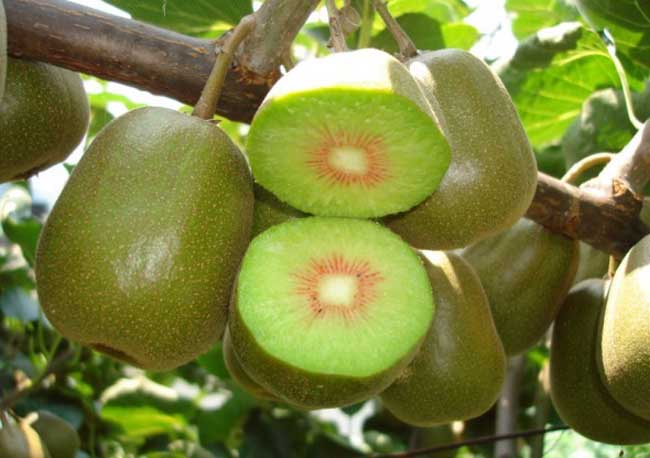
Red-fleshed kiwifruit is a fruit that serves both as food and medicine. Every 100 grams of fresh flesh contains 100-420 mg of vitamin C, which is 5-10 times higher than citrus, 11-13 times higher than lemon, and 20-80 times higher than apple. It belongs to the red-fleshed variety of Actinidia chinensis, is a very early-maturing red-fleshed cultivar, and its offspring have stable genetic traits, strong stress resistance, relatively large fruit, a rich sweet and delicious flavor, and relatively good storage tolerance.
Cutting Propagation
Using dormant branch cuttings for red-fleshed kiwifruit propagation has the characteristics of abundant cutting sources, more nutrients stored in the branches, and rapid new shoot growth of the seedlings after rooting, and the seedlings can leave the nursery in the same year.
1. Selecting cuttings: Thin dormant branches root earlier after cutting. Thick dormant branches root later and are prone to water loss and flower withering under adverse climatic conditions. However, using branches that are too thin as cuttings makes it difficult to grow robust seedlings. Therefore, branches with a diameter of 8-10 mm should be selected as cuttings.
2. Timely cutting: Kiwifruit trees are generally pruned from January to mid-February. The pruned branches can be used as cuttings, cutting and inserting them promptly. If the cuttings are collected early but planting is delayed, apply a protective agent to the cut end, then wrap them in plastic film for storage, or store them at 5°C, or store them in a cool open-air place. Regardless of the storage method used, strict precautions must be taken to prevent the cuttings from losing water and drying out. The cutting period should not be later than April. The cutting bed soil should be clean fine sandy soil or sandy soil.
3. Cutting treatment: To improve the seedling survival rate, after red-fleshed kiwifruit cuttings are trimmed, soak them in a 50-fold rooting promoter solution for 20 hours so that the cuttings fully absorb water and promote rooting. When using a wooden box as the cutting bed, the cuttings can be shorter, preferably about 10 cm. When using field soil as the cutting bed, the cuttings should be longer, preferably 15-20 cm. In both cases, they should be inserted deeply.
4. Timely potting: After the cuttings root, they can be potted. The potting soil should have good water retention, otherwise it will affect the growth of the cutting seedlings. In the early stage of transplanting, the pot diameter should preferably be 10.5-12 cm. As the seedlings grow, they should be transplanted into larger pots in a timely manner. After the new shoots of the cutting seedlings elongate, they need to be supported with stakes as early as possible.
Artificial Pollination
After artificial pollination, red-fleshed kiwifruit can produce large fruit. Fruit without seeds will all drop. The more seeds the fruit contains, the larger the fruit.
1. Pollen collection: Collect the swollen flower buds of the male flowers before they open. Or collect the flowers after they open but before the anthers dehisce. Then sift the male flowers directly through an iron sieve with 2-3 mm mesh. Or cut out the anthers with scissors. Or use an anther collector. Then spread the anthers thinly on kraft paper or the like and place them at room temperature of 22-25°C and humidity of 50% for 1 day and night to allow the anthers to dehisce. After dehiscence, collect the pollen with a sieve of 80-100 mesh. When storing kiwifruit pollen, first place it in a container such as a tea canister containing a desiccant, then wrap 1 teaspoon of pollen separately in medicine wrapping paper, and store it in a cold storage room, taking it out for use whenever necessary.
2. Pollination method: Within 3 days after the male flowers open, carry out artificial pollination with a cotton swab or the like. Within 5 days after the male flowers open, fertilization capacity can still be maintained. When the petals have not yet turned brown, artificial pollination is reliable. Lycopodium powder can be used as a pollen extender. The extension degree is generally 30-50 times the pollen volume. To enable the pollen to adhere to more pistils, the pollen and lycopodium powder can be placed in a plastic bag and fully shaken and stirred. Kiwifruit pollen that has already been diluted and extended with lycopodium powder must be used on the same day. Pollination tools can be cotton swabs or feathers. Pollination work should be careful and meticulous. When the stigma of the female flower is in good condition, artificial pollination can sometimes be carried out even in rain.
Orchard Establishment
Kiwifruit is a perennial vine plant with strong growth vigor, rapid growth, large leaves, and dioecious flowers, entering the fruiting stage after 3 years. It has the characteristics of liking light, liking moisture, and liking slightly acidic soil, while fearing strong light, waterlogging, and saline-alkaline soil. Choose loam or sandy loam with convenient transportation, fertile soil, and convenient drainage and irrigation. When cultivated on such soil, the root system is well developed, the aboveground part grows vigorously, the fruit set is abundant, and the fruit is large with good color. Next are gravelly soil and clay soil. However, before planting, it is best to remove sand (stones) and replace the soil, or mix in sand for improvement. The soil pH should be between 6.5-7.2. Hilly land, gentle slopes, and flat land can all be used for planting. When establishing an orchard on sloped land, contour-line strip terraces or fish-scale pits should be built according to the contour lines to conserve water and fertilizer. Kiwifruit fears strong winds, especially dry hot winds in summer, which often break branches, cause leaf margins to scorch, and make leaves drop. Therefore, the orchard site should avoid wind gaps, and shelterbelts should be established in windy areas.
For orchard establishment, it is best to grow the seedlings oneself for one's own use, as this can ensure quality. If purchasing seedlings, attention must be paid to distinguishing grafted seedlings from seedling-grown seedlings. Seedling-grown seedlings have smaller leaves, more fuzz, dark green leaf color, and prominent leaf tips. Grafted seedlings have large leaves, less fuzz, lighter leaf color, and round or oval leaves with non-prominent leaf tips. In the Guanzhong area, wild delicious kiwifruit should be selected as rootstock, so that the seedlings grow robustly and have strong stress resistance. Jinyan kiwifruit is a dioecious plant. When establishing an orchard, in addition to planting female plants, a certain number of male plants must also be configured. It is required that the flowering period of the male plants coincides with that of the female plants, with a long flowering period, a large amount of pollen, strong compatibility, and a high pollen germination rate. Male plants have small and round leaves with deep green color, while female plants have large leaves with slightly lighter color. Male plants have short and thick internodes, while female plants have slightly thinner and longer internodes. Male plants have short petioles, while female plants have long petioles. In the buds of male plants, the central main bud has exposed fuzz. In the buds of female plants, the central main bud is prominent, smooth and round, without fuzz. Kiwifruit buds are plump and exposed, and are easily knocked off during transport and other processes, so attention should be paid to protecting them.