What are the prospects for kiwifruit cultivation? Market potential analysis
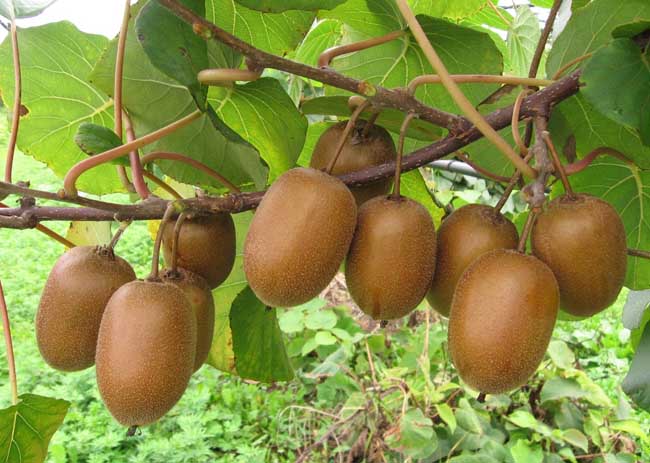
Kiwifruit belongs to the genus Actinidia in the family Actinidiaceae. It is a deciduous vine fruit tree, rich in various vitamins and nutrients, and is known as the “king of fruits”. It has high economic value and cultivation value. At present, many people are developing kiwifruit cultivation. Let us now look at the prospects for kiwifruit cultivation!
Kiwifruit cultivation prospects
1. Kiwifruit is known as the “king of fruits” and the “champion of VC”. Its fruit is tender and juicy, sweet and sour to the taste, and pleasantly fragrant. The VC content in 100 grams of fresh fruit flesh is as high as 100-480 mg (in individual cases, such as Actinidia chinensis var. hispida, up to 1350 mg), several times, dozens of times, or even hundreds of times higher than that of citrus and apples. It also contains large amounts of sugars, proteins, amino acids and various other organic substances, as well as a variety of minerals essential to the human body.
2. Kiwifruit is comprehensive in nutrition. It has certain auxiliary and therapeutic effects on various cancers, cardiovascular diseases, high blood pressure, constipation and obesity, and has remarkable effects on beauty care.
3. Kiwifruit can be processed into many products such as juice, fruit wine, fruit crystals, preserved fruit and jam, and the potential for value-added processing is huge. More than 30 countries around the world already cultivate it. In 2004, total output was 1.009 million tons. The earliest and largest exporter was New Zealand, where 70-80% of fresh fruit produced is for export. By 2004, China had only 58,000 hectares under kiwifruit cultivation, producing 350,000 tons of fresh fruit, only a little more than 200 grams per capita, which simply cannot meet the demand for fresh consumption and processing.
Hilly areas, low mountains and gentle slopes in subtropical and temperate regions with good ecology and vegetation and an altitude above 50 m are most suitable for commercial kiwifruit cultivation. Other places cannot achieve high yield and good quality, or cannot set fruit at all, or cannot overwinter. If farmers in these places can seize the opportunity and establish orchards to high standards, they can obtain good returns for decades. At present, the ex-orchard price of high-quality kiwifruit is 4-6 yuan per kg, the selling price in Shanghai and Beijing is 20-24 yuan per kg, and in Shenzhen it is 2 yuan each.
Kiwifruit cultivation returns
1. Early-stage cultivation investment
(1) Land preparation, trenching (hole digging) and fertilizer burial, etc., require about 600-700 yuan per 667 sq m. If using one's own labor or asking relatives and friends for help, the cost can be reduced by at least half.
(2) Fertilizer burial: purchasing pig manure, cattle manure and oil cake, etc., requires 600-700 yuan per 667 sq m. If barnyard manure can be
solved on one's own, the cost can be halved.
(3) Grafted seedlings: 56 plants per 667 sq m, at 2.5 yuan each, requiring 140 yuan.
(4) Trellis construction
① T-shaped trellis: about 40 steel bar and cement posts per 667 sq m, at a cost of 20 yuan each, totaling 800 yuan. 40 angle irons, at 20 yuan each, totaling 800 yuan. 667 sq m requires 150 kg of galvanized No. 8 iron wire, requiring 750 yuan. The three items total 2350 yuan.
② Hedge trellis: The hedge trellis is most suitable for mountainous areas or terraced fields. 667 sq m requires about 40 cement posts, totaling 800 yuan. 150 kg of No. 8 galvanized iron wire, requiring 750 yuan. The two items total 1550 yuan.
③ Large trellis: suitable for flat or gentle slope land such as low hills and hills. The trellis investment is comparable to that of the hedge trellis.
④ Simple wooden trellis: In areas with timber resources, it may be used as a substitute, but it is best not to use this kind of trellis. Wooden posts must be soaked in preservative and coated with asphalt before use. About 1000 yuan of investment is required per 667 sq m.
(5) In the second and third years, low-improvement fertilizer burial requires an investment of 2400-2800 yuan per 667 sq m.
(6) Depending on the type of trellis, etc., about 6500-5000 yuan is required per 667 sq m over 3 years after planting.
In addition, building warehouses (dwellings) and so on also requires some investment.
2. Cultivation return budget
① Intercropping: In the first 3 years, intercropping peanuts, melons, soybeans, etc., can yield a net profit of 200-300 yuan per 667 sq m per year, totaling 600-900 yuan over 3 years.
② Kiwifruit returns: In the 4th year, 667 sq m can produce 300-400 kg of fruit. Calculated at 4 yuan per kg, this can bring in 1200-1600 yuan, with a net profit of 600-1000 yuan. From the fifth year, it enters the full production period. At 1000 kg of commercial fruit per 667 sq m, this can bring in 4000 yuan, with a net profit of 3000-3200 yuan.
③ Pig raising: Be sure to raise 1 pig per 667 sq m. This not only solves problems such as organic fertilizer and cost reduction, but also improves the soil and greatly enhances quality. Each pig can yield a net profit of 150-200 yuan. Calculated at 10 pigs, this can yield a net profit of 1500-2000 yuan.
④ Three-dimensional netted chicken raising in the orchard: Raising native chickens can eat insects and control weeds. Stocking 20 birds per 667 sq m can yield a net profit of 150-200 yuan.
⑤ After entering the full production period, all investment can be paid back in 1.5 to 2 years. After that, a net profit of 3000-3200 yuan per 667 sq m can be obtained each year. If one household plants 6670 sq m or 1 hectare, a net profit of at least 33000-49000 yuan can be obtained per year.
Cultivation precautions
1. Be sure to select improved varieties: There are great differences in climate and soil between north and south China, so be sure to select improved varieties that can adapt to the local area. New varieties should be trial-planted and promoted only after success. Improved varieties suitable for cultivation in the Yangtze River basin include: Kuimi, Jinfeng, Fengmixiao, Jinkui, Miliang No. 1, etc. Varieties suitable for cultivation in the Yellow River basin include: Huaguang No. 2, Qinmei, etc. In the Northeast, it is best to plant Actinidia arguta.
2. Only low hills, hills, flat land in low mountains or gentle slope land with an altitude above 50 m and below 500 m and good vegetation and ecology are suitable for commercial cultivation. Do not cultivate in other places.
3. Varieties must be pure: Many growers have suffered greatly from impure varieties. Ensure variety purity above 98%.