Detailed Explanation of Pistachio Planting Techniques and Cultivation Management Methods
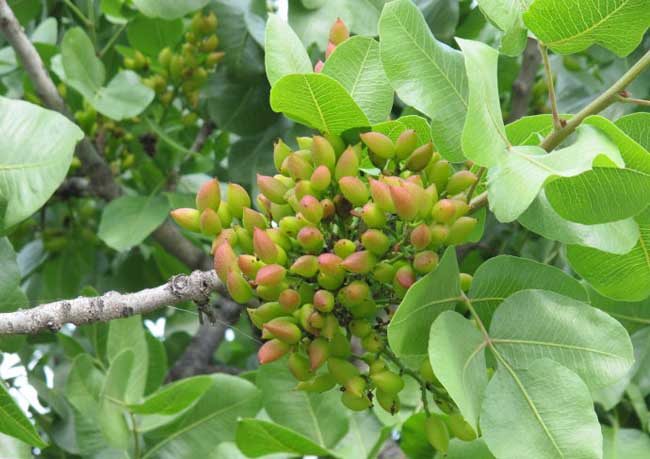
Pistachios are mainly produced in Syria, Iraq, Iran, the southwestern part of the former Soviet Union and Southern Europe. They are **also cultivated in China; pistachios are suitable for normal growth in this region and offer good economic returns, while also serving as an excellent tree species for soil and water conservation.
Growth Habits
Pistachios are light-loving, growing on sunny slopes at an altitude of 600 m-1200 m, in deep calcareous soil; they grow particularly well in well-drained loose sandy loam. The plant is not tolerant of moisture and is afraid of waterlogging.
Orchard Site Selection
Although pistachios are tolerant of barren soil, drought and cold, and highly adaptable, for production it is best to choose plots with deep soil layers and well-aerated loam and sandy loam for planting. Since pistachios are extremely vulnerable to late frost damage, attention should be paid to selecting the middle of hillsides, open flat land, valley land and south-facing slopes sheltered from wind and facing the sun for orchard establishment, and orchards should not be established on the windward side of the prevailing wind direction.
Seedling Planting
For pistachio planting, a plant and row spacing of 3 m × 4 m or 4 m × 5 m is suitable, with 33-55 plants planted per mu. In high-density orchards, 83-111 plants can be planted per mu. Both finished seedlings and bud seedlings can be used for planting. Before planting, dig planting holes 60 cm deep and 60 cm in diameter. When planting, keep the roots level with the ground, firm the soil while planting, and then water thoroughly.
Fertilizer and Water Management
1. Scientific fertilization: Young trees are given base fertilizer once a year, about 20 kg per tree. Bearing trees are fertilized once every 2-3 years. Generally, fertilization is applied 3 times a year. The first should preferably be in early spring or autumn and winter, mainly with quick-acting nitrogen fertilizer. The second is during the fruit expansion period, mainly with nitrogen and potassium fertilizers. The third is after fruit harvest, mainly with organic fertilizers such as compost and barnyard manure, usually applied in combination with deep plowing in autumn.
2. Timely irrigation: Winter irrigation before the onset of winter gives better results.
Training and Pruning
Pistachios are light-loving with a strong trunk, so in high-density orchards the free spindle shape is often the main form, while in low-density orchards the natural open-center shape is mainly used.
1. Free spindle shape: It is characterized by a central leader, with 10-15 main branches alternately borne at different positions on the central leader. The main branches maintain an 80-90 degree angle with the trunk, and small and medium-sized fruiting branch groups are borne directly on the main branches.
2. Natural open-center shape: Its main feature is good ventilation and light penetration. The trunk height is about 40-50 cm. Select and retain 3-4 main branches on the trunk with a basal angle of 45-75 degrees, and 2-4 lateral branches, with branch groups arranged on the lateral branches.
Pistachios have strong branching ability, and the pruning principle is to thin more and cut less. Pistachios mainly bear fruit on short fruiting branches. Young trees and trees in the initial fruiting stage grow vigorously and have more medium and long fruiting branches. Generally, when new shoots grow to about 50-60 cm, pinch the tips in time to promote secondary shoots and increase fruiting branches, retain back branches and upright branches, and twist the tips in time. Generally, the tree shape can be formed by the winter of the second year after planting.
Flower and Fruit Management
1. Strengthen comprehensive orchard management (that is, soil, fertilizer and water management) to enhance tree vigor, promote flower bud differentiation, and apply more organic fertilizer.
2. Reasonably arrange pollinator trees. Pistachios are not self-fruitful. Generally, for every 2 rows of the main cultivated variety, 1 row of a pollinator variety is arranged to create conditions for normal pollination of pistachios, which helps increase the fruit-setting rate.