Detailed Explanation of Greenhouse Strawberry Cultivation Methods and Technical Points
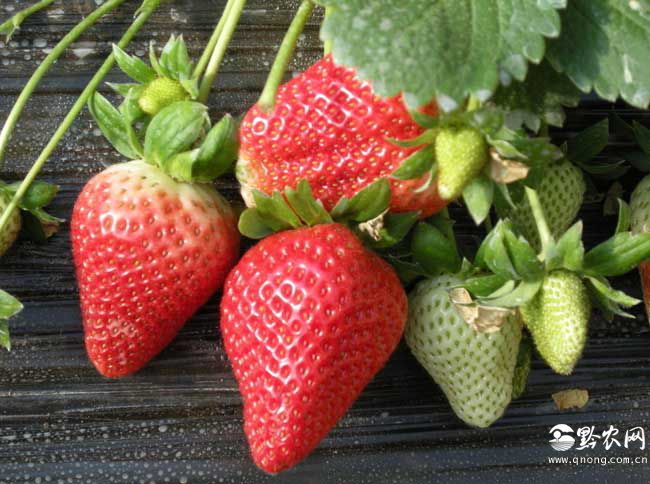
Strawberry belongs to the Rosaceae family and is a perennial herbaceous plant. In world small berry production, strawberry ranks first. Strawberry is an economic crop with fast fruiting, early maturity, easy propagation, short cycle and high benefit. Below, the editor of Qiannong Network briefly introduces how to grow strawberries in a greenhouse!
1. Select suitable varieties or mix different varieties: Choose varieties such as Fengxiang and Mingbao that under low-temperature conditions have many flowers, a large amount of pollen, large and uniform fruit, good coloring, mild acidity and few deformed fruits. Varieties such as Qiuxiang, Baojiao Zaosheng and Quanmingxing have less pollen and produce more deformed fruits, so varieties such as Chunxiang and Dana should be planted as pollinizer plants to facilitate pollination and fertilization, reduce deformed fruits and increase the rate of large fruits.
2. Select disease-free strong seedlings: Disease-free strong seedlings have well-developed root systems and strong disease resistance, and the strawberries produced are large, high-yielding and of excellent quality.
3. Apply sufficient high-quality base fertilizer: Increasing the application of high-quality decomposed farmyard manure can provide sufficient nutrients for strawberry growth, flower bud differentiation, flowering and fruit setting, and fruit development, enlarge fruit size, and improve fruit sugar content and coloring. Apply 2000 kg of decomposed chicken manure per mu as base fertilizer, combining furrow application with broadcast application.
4. Implement crop rotation and avoid continuous cropping: Implementing crop rotation can improve the disease resistance of strawberries and reduce the number of deformed fruits and diseased or insect-damaged fruits. The vacant land between greenhouses can be fully used for cyclic rotation.
5. Increase light: Insufficient light from 2 weeks before flowering to the flowering period of strawberries will affect pollination and fertilization and produce deformed fruits. Insufficient light during the fruit coloring period will lead to bland fruit taste and poor color. On the premise of ensuring the temperature inside the greenhouse, the added straw mats should be uncovered as early as possible and covered as late as possible. Hang reflective curtains on the north side inside the greenhouse to increase light by using reflected light. On cloudy or rainy days or snowy days, incandescent lamps can be used for supplementary lighting.
6. Ridge cultivation and plastic film mulching: Ridge cultivation can reduce contact between the fruit and water dripping from the greenhouse film, enhance sunlight exposure to the fruit, reduce the occurrence of gray mold, and promote fruit coloring. Plastic film mulching can increase ground temperature, reduce air humidity, avoid direct contact between the fruit and the soil, and help keep the fruit surface clean.
7. Strictly control temperature: The suitable greenhouse temperature is 22-25°C during the day and 8-10°C at night during the flowering period, and 20-24°C during the day and 6-10°C at night during the fruit enlargement period. Too high a temperature inside the greenhouse will shorten the fruit development period and make the fruit smaller.
8. Water and topdress appropriately: Water appropriately during the flowering and fruiting period, and drip irrigation should be used. Insufficient water during the flowering period will lead to poor pollination and fertilization and produce deformed fruits. Insufficient water during the fruit enlargement period will affect fruit enlargement. During the flowering and fruiting period, 0.3% potassium dihydrogen phosphate solution should be sprayed continuously 3-4 times.
9. Assisted pollination: Poor pollination and fertilization is the root cause of deformed fruits, and using bees for assisted pollination can effectively reduce the occurrence of deformed fruits. Generally, during the flowering period, 1 box of bees is placed in each greenhouse for pollination.
10. Timely prevention and control of pests and diseases: Spraying pesticides during the strawberry flowering period can easily induce deformed fruits. If pests and diseases occur during the flowering period, pesticide should be sprayed during the period with fewer flowers, the beehive should be moved out of the greenhouse before spraying, and moved back to the greenhouse 1 week after application.