What Are the Prospects for Passion Fruit Farming? Market Conditions and Profit Analysis
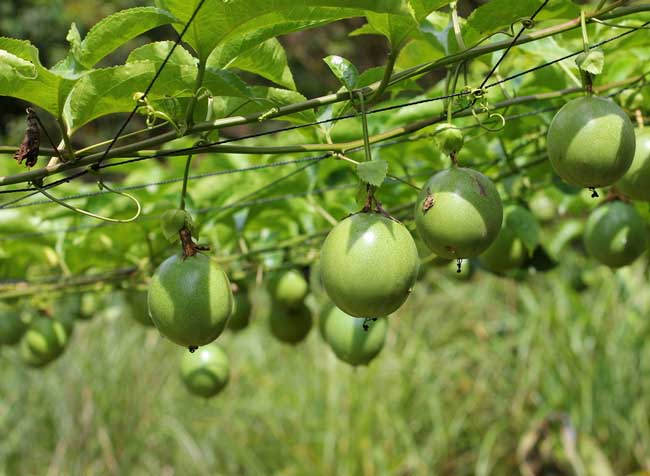
Passion fruit originates from South America. Its juice carries the aroma of many fruits, including guava, pomegranate, pineapple, mango and banana, which is how it got the name "passion fruit," meaning a fruit of a hundred fragrances. Passion fruit is a perennial evergreen climbing vine fruit with strong adaptability and resistance to pests and disease. It grows vigorously, and from planting to harvest generally takes only a few months, so it comes into production early with high and stable yields. The fruit stores and ships well, sells widely and delivers high economic returns, earning it the laudatory name "money tree" abroad. The juice of passion fruit has the rich fragrance of many fruits and high nutritional value. It can be eaten as a fresh fruit and also made into juice drinks, and it is also the most ideal fruit for processing into jam, jelly, ice cream, pastries, biscuits and other foods. Passion fruit juice is a pure natural "green" juice drink, excellent in color, aroma, taste and nutrition, with good health-preserving effects. Drinking it has remarkable benefits such as relieving fatigue, refreshing the mind and counteracting alcohol, reducing inflammation and fading spots, and caring for the skin and preserving youthful looks. It fully deserves the title "king of juices"!
Analysis of the Prospects for Passion Fruit Farming
The beverage trends in our country can roughly be divided into three stages: "chemical beverages," "pure beverages" and "green beverages":
1. The first generation of beverages is commonly known as "chemical beverages," such as soda, cola and Sprite, all of which are made by blending chemical ingredients like coloring, flavoring and saccharin with water. Although they have color, aroma and taste, they contain very little nutrition and cannot escape the suspicion of being "polluted."
2. The second generation of beverages is commonly known as "pure beverages," such as mineral water, filtered water, distilled water and purified water. Out of fear of pollution, people turned to pursuing purity. Although "pure beverages" are pure, they have no color, aroma or taste, let alone any nutrition to speak of.
3. The third generation of beverages is commonly known as "green beverages," such as orange juice and coconut juice. The most popular beverages in the world today are naturally juice drinks that are pollution-free and complete in color, aroma, taste and nutrition.
Passion fruit grows easily and quickly, resists pests and disease, is free of pesticide pollution, self-pollinates, and sets fruit heavily. It generally comes into production in half a year, and in the planting year the yield per mu can reach more than 1.5 tons. One planting can be harvested for many years in a row, the fruit stores well, and the fruiting period lasts as long as 8 months. Few fruits can compare with it, making it the best new variety of processing-type green fruit in the world today. Passion fruit juice is excellent in color, aroma and taste and is extremely rich in nutrition, fully deserving the title "king of juices"! It is not hard to foresee that the time for large-scale development of passion fruit has arrived, the passion fruit industry has become a golden industry, passion fruit drinks will surely sweep the whole country, and it is only a matter of time before passion fruit juice becomes a beverage served at state banquets!
However, passion fruit is still little known in many parts of our country, and the development of plantings has not yet begun, while the market supply of passion fruit falls short of demand. Today, pure natural health juice drinks are gradually replacing other beverages. Passion fruit juice is the new beverage variety with the strongest vitality, so the timing is perfect for developing passion fruit plantings, and the prospects for development are infinitely broad!
Estimated Output Value per Mu of Passion Fruit
1. Estimated output value per mu in the planting year
Calculated at an average minimum yield of 20 jin per plant and a minimum market price of 1.50 yuan per jin: 110 plants × 20 jin/plant × 1.5 yuan/jin = 3300 yuan, and the profit per mu = 3300 - 800 yuan = 2500 yuan. Planted in the current year, income begins in half a year, profit can be made in the same year, and the input-output ratio exceeds 1:3, so the returns are very considerable!
2. Estimated output value per mu in the second year
Because spending on seedlings, materials and land preparation is saved, the fruit yield also increases noticeably, with output per mu reaching 3000-5000 jin. The output value reaches more than 4000 yuan, and net profit exceeds 3500 per mu. What is more, the returns are even more remarkable. Even if in the future all the fruit is sold at the factory raw-material price of five mao per jin, the output value would still be around 2000 yuan, and the profit per mu would be no less than 1000 yuan, so the economic returns remain very significant.
Risk Analysis of Passion Fruit Farming
Passion fruit is not choosy about soil and can be grown in front of and behind houses, on hillsides and in paddy fields. It produces quickly, yields heavily, needs no pesticide spraying, is easy to manage, costs little and offers huge profit margins. The risk of developing passion fruit plantings is almost zero, making it a good path for farmers to escape poverty and become well-off.
Passion fruit is a new fruit variety introduced from abroad in recent years. Its planting and promotion have only just begun, and there is unlimited room for development. In fact, in countries such as the United States and Brazil it was already the "king of juices" 20 years ago! Passion fruit can not only be eaten fresh directly, but is also the best fruit variety for juice processing.
In our country, it is not hard to imagine passion fruit being used on a large scale for juice production, and it will not be long before passion fruit juice becomes a beverage at state banquets. This year alone, two passion fruit juice factories have started production of passion fruit juice, but they cannot operate normally because the supply of raw materials falls short. They urgently need to develop large planting bases on a large scale, and according to requirements a planting scale of at least 200,000 mu is needed to meet production demand. Moreover, once passion fruit planting reaches a certain scale, large beverage manufacturers such as Huiyuan Juice, Wahaha and Nongfu will certainly not stand by..... Based on this trend, passion fruit will remain a golden fruit for ten years. In short, as a golden industry, passion fruit planting and development carry no risk at all within 10 years.