A Detailed Guide to Summer Black Grape Cultivation Techniques and Management Methods
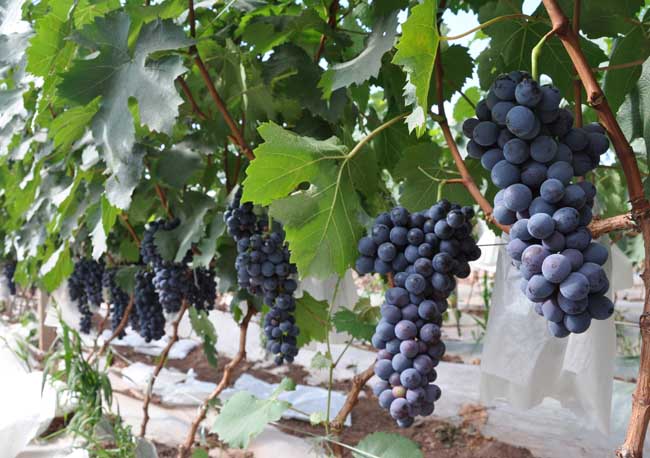
Summer Black grape originated in Japan and is a descendant of Kyoho grape. It is an early-maturing European-American variety that can ripen as early as July. Its characteristics are early maturity, seedlessness, high sugar and low acid, rich aroma, fine and crisp flesh, and medium firmness, which is relatively firm among European-American grapes. Below, the editor will introduce Summer Black grape cultivation techniques for everyone!
Understanding Summer Black Grape
Under natural conditions, the clusters are mostly conical, with some being double-shouldered conical, with an average cluster weight of 400 grams and an average berry weight of 3.5 grams. After treatment with a specialized Summer Black expansion formula, the clusters become cylindrical or conical, the berries are tightly set, and the cluster shape is uniform, with an average cluster weight of 670 grams and a maximum cluster weight of up to 1 kilogram; the berries are nearly round to short oval, with an average berry weight of 9.35 grams, and large berries can reach more than 12 grams. The skin is purple-black or blue-black, colors quickly, and colors uniformly, with a thick bloom and an attractive appearance; the flesh is firm and crisp, with a soluble solids content of 17.3%, up to a maximum of 22%, a rich sweet taste, and excellent quality; flower bud differentiation is good, with high yield, disease resistance, and storage and transport tolerance. In Jinhua, it ripens around June 25, and the ripe fruit can remain on the tree for as long as 1 month without dropping berries, cracking, or changing flavor.
1. The grape growth period is about 150 days to 160 days (seedling raising requires about 30-40 days), and the lifespan and economic cultivation period of grapes can generally reach 30 to 50 years.
2. Uses of grapes: grape berries are brightly colored, juicy, and delicious; they are rich in nutrients: they contain 10-30% sugar, 0.5-1.4% organic acids, 0.15-0.9% protein, 0.3-0.5% inorganic salts, and also contain various vitamins and amino acids needed by the human body; winemaking: besides being made into raisins and grape juice, grapes can also be used for winemaking; beautification and shade: planting grapes on the rooftop platform of a residence can both beautify the roof and provide shade.
3. Planting season: spring planting is suitable when the temperature is between 15-25°C, such as from early March to April; layering can begin in early April; such as from early March to April; layering can begin in early April.
Preparatory Work in the Early Stage
1. Select good varieties: there are many grape varieties, such as Kyoho, Fujiminori, Golden Finger, etc. They mature early and have strong adaptability. High-quality varieties can be selected according to the local weather and the purpose of the fruit.
2. Soil layer selection: choose sandy loam soil with convenient transportation, convenient drainage and irrigation, deep soil layer, and loose soil texture (it has good air permeability and soil temperature rises quickly) as the best soil quality.
3. Land preparation: prepare the land in the autumn and winter of the previous year, apply decomposed organic fertilizer and mix it evenly with the soil. Before land preparation, apply about 1,500 kilograms of decomposed fertilizer per mu, and at the same time add 100 kilograms of superphosphate, then deep-plow the soil about 30 cm, break the soil into fine pieces, and form a seedbed with a required ditch width of 0.8 m and a depth of 0.4-0.6 m, in preparation for planting.
4. Select the trellis type: for cultivation trellis types, V-shaped trellis, high-wide-drop T-shaped trellis, and horizontal pergola can be selected. Single-wall hedge trellis is not suitable. Build the orchard, select materials, and set up the trellis reasonably according to the selected trellis type.
5. Reasonable planting: from late November each year to March of the following year, select robust seedlings, leave 2-3 plump buds, short-prune them, and then plant. After planting, water thoroughly and cover with black plastic film to retain moisture and prevent weeds. Cultivation trellis types are divided into hedge trellis and flat pergola, and the corresponding planting density is generally advisable at row spacing × plant spacing of 2.5 m × 1.2 m (double-cross V-shaped trellis), 2.8-3 × 1 m (high-wide-drop T-shaped trellis), and 4 m × 1 m (horizontal pergola).
6. Advocate protected cultivation: besides open-field cultivation, Summer Black grape can also use protected cultivation where conditions permit. Greenhouse forcing cultivation can advance ripening by 10 to 15 days and increase economic benefits. Although rain-shelter cultivation cannot bring it to market earlier, it can reduce the occurrence of diseases.
Management of Young Trees
1. Topdressing to promote growth: fertilization follows the principle of applying thin fertilizer frequently. Generally, topdressing begins after 8 leaves have unfolded, once every 10-15 days. Before August, quick-acting nitrogen fertilizer is mainly applied, using 0.3% urea or 0.5% ammonium bicarbonate solution in April-May; apply around the seedling roots after breaking the film. In June-July, apply 0.3%-0.5% compound fertilizer; after August, mainly apply phosphorus and potassium fertilizer; topdressing continues until the end of September.
2. Tying vines and shaping: after planting the seedlings, promptly erect concrete posts and tighten the wire. Insert a bamboo pole for the planted seedling, and when the new shoot grows to 50-60 cm, guide the vine onto the pole, and promptly do the work of tying the vine, removing tendrils, and pinching. The "V"-shaped horizontal trellis and high-wide-drop T-shaped trellis are pinched at the first wire, leaving the top two secondary shoots and guiding them to grow to the left and right sides to form two arm vines; the horizontal pergola is pinched when it is close to the trellis surface.
3. Spraying to prevent diseases and pests: in the first year, the main focus is on controlling black pox and downy mildew. After 3 leaves have unfolded, spray a fungicide once every 8-10 days to prevent disease, and Kobo, Pencozeb, Kelu, etc. can be used alternately. In the middle and late stages, while spraying, add Baolifeng No. 1 or No. 2, and when pests are found, add insecticide and spray together.
4. Winter pruning: winter pruning is cut off at the junction of the two arm vines. Secondary shoots on the arm vines with a diameter ≥0.5 cm retain 2-3 buds, and those less than 0.5 cm are cut off. For seedlings that have not grown to the first wire, prune and retain 2-3 buds at the base, and shape them again in the second year. For pergola trellises, retain 3-4 branches on the trellis surface.