Detailed Explanation of Mulberry Planting Techniques and Management Methods
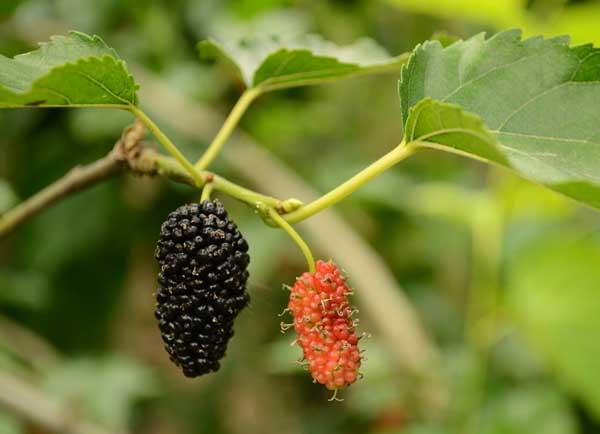
Mulberry trees prefer sunlight and tolerate slight shade when young. They prefer a warm and humid climate and are cold-resistant. They are drought-tolerant and extremely resistant to waterlogging. They have strong adaptability to soil, tolerating poor and slightly alkaline soils, and prefer deep, moist, fertile soil. The root system is well-developed and wind-resistant. They have strong sprouting ability and tolerate pruning. They have a relatively strong resistance to smoke and dust. There are three ways to plant mulberry trees: buying mulberry saplings for planting, propagating from mulberry branches, and propagating from seed. The specific planting methods are as follows:
Mulberry Sapling Planting Method
1. On sloping land and semi-dry paddy fields, plant in flat trenches; in paddy fields, plant in raised beds. Before planting, dig planting trenches: mark lines according to the predetermined row and plant spacing, then dig the planting trenches deeply, with a trench width of 30—50 cm and a depth of 50 cm. First dig down 3-5 cm, keeping topsoil and subsoil separate, then dig 15 cm deeper within the trench to loosen the subsoil so that mulberry roots can penetrate deeply. The planting trenches should connect with the drainage ditches around the mulberry field so that water can be drained promptly after rain.
2. Apply basal fertilizer: Apply basal fertilizer at planting time, preferably organic fertilizer such as compost, barnyard manure, or mixed manure, at 1500—2000 kg per mu. It can also be mixed with 50 kg of superphosphate. After applying the basal fertilizer, mix it thoroughly with the loosened lower layer of soil.
3. Trim the sapling roots: Before planting, prune off overly long or damaged mulberry roots, leaving roots about 15 cm long. Remove diseased and pest-infested saplings, and plant large and small saplings separately. Before planting, first coat the roots with a slurry of phosphate fertilizer and yellow mud water to improve the survival rate.
4. Planting: Fill part of the topsoil into the planting trench over the basal fertilizer, about 7—10 cm thick. When planting, first set up a planting rope marked with row and plant spacing, place the mulberry sapling into the planting trench, spread out the sapling roots so that the sapling is upright and the roots are extended, then fill topsoil over the roots, hold the sapling stem, and gently lift it upward so that soil particles fully fill the gaps around the roots. Pour on a ladle of clean water mixed with human and livestock manure, break up all the subsoil finely and fill it into the trench, then firm it down. Generally, the suitable planting depth is to bury the root crown 5-6 cm. Then, according to the requirements for tree form development, prune the sapling stem.
5. Watering and drainage: During drought after planting, water promptly; if water accumulates, drain promptly; if any saplings are missing, replant promptly.
6. Fertilizing and weeding: When new shoots grow to 3—4 cun high, apply the first fertilizer, with manure water + 7-10 jin of urea per mu; when they grow to 5-6 cun high, apply the second fertilizer together with weeding, with 500-1000 jin of farmyard manure + 40 jin of compound fertilizer + 20 jin of urea per mu. Keep the fertilizer 3 cun away from the mulberry saplings to avoid burning them to death, and apply it deeply in trenches then backfill with soil. After the second fertilization, spray a dryland herbicide such as Henaisi and Duer once, taking care not to spray it on the mulberry saplings; after 20 days, apply the third fertilizer, with 100 jin of bio-organic fertilizer + 40 jin of urea per mu. After this fertilization, spray once with dimethoate + dichlorvos, with the concentration being one knapsack sprayer tank of water plus 2 capfuls of dimethoate and 2 capfuls of dichlorvos. Do not spray other pesticides to avoid poisoning the silkworms.
Mulberry Branch Propagation Method
1. Site selection and land preparation: Choose fertile, non-waterlogged dry paddy fields, plow well and rake level.
2. Branch selection and planting methods
Select mature branches about 1 m from the root. The best planting time is during winter pruning in December, planting as they are cut to improve the survival rate. There are vertical and horizontal planting methods.
① Vertical method: Cut mulberry branches into sections about 5 cun long (with 3-4 buds), open trenches, then place the branches vertically (buds facing upward), backfill soil to bury the branches or leave one bud exposed, firm the mud, water thoroughly, keep moist for 20 days, cover with plastic film, and remove the film after buds sprout.
② Horizontal layering method: This is a new technique, most suitable for seedless improved varieties. After leveling the land, open trenches about 1.5 cun deep according to specifications, then place 2 branches cut to about 2 chi long horizontally (placing 2 branches is to ensure the number of sprouts), backfill about 0.8 cun of soil, press lightly, water, cover with plastic film, and remove the film after buds sprout.
3. Post-planting management
After the buds grow to 5 cun high, combine with weeding and apply a light application of 300-400 jin of farmyard manure + 15 jin of urea per mu. After 20 days, apply again, with 60 jin of compound fertilizer + 30 jin of urea per mu. After fertilizing, carry out pest control.
Direct Seeding and Intercropping to Establish the Field Method
This is a new technique for rapidly establishing a mulberry field and improving economic returns. The specific methods are as follows:
1. Preparation before sowing: Choose good land with loose soil that is easy to break up. After plowing and breaking up the soil, open drainage ditches, mark lines at a row width of 2.1 chi-2.4 chi, apply decomposed organic fertilizer along the lines, mix it evenly with the soil, and level the ground.
2. Sowing method: Sowing in February-March is most suitable. First, thoroughly break up and water the soil in a 3 cun wide strip along the mulberry rows, then dibble-sow mulberry seeds along the mulberry rows at a sowing rate of 2-3 liang per mu (3-6 seeds per 3 cun), cover the seeds thinly with fine soil, and finally cover with straw and water again. Intercrop economic crops such as soybeans, peanuts, and vegetables between the rows (not too close to the mulberry saplings). Intercropping can be done at the same time as sowing or slightly earlier, aiming to finish harvesting by May so as not to affect mulberry growth.
3. Management: After sowing, pay attention to watering during the seedling stage, and promptly weed, fertilize, and control pests. After the intercrops are harvested, fertilize promptly, and silkworm rearing can begin before long. To build up the trees, do not carry out summer pruning in the same year; in winter, prune about 1.5 chi above the ground, keep enough strong plants at 6000-7000 plants per mu (row spacing 2.1-2.4 chi, plant spacing 4-5 cun), dig up surplus saplings to sell or plant elsewhere, and apply heavy winter fertilizer.