Detailed Explanation of Large Cherry Planting Techniques and Management Methods
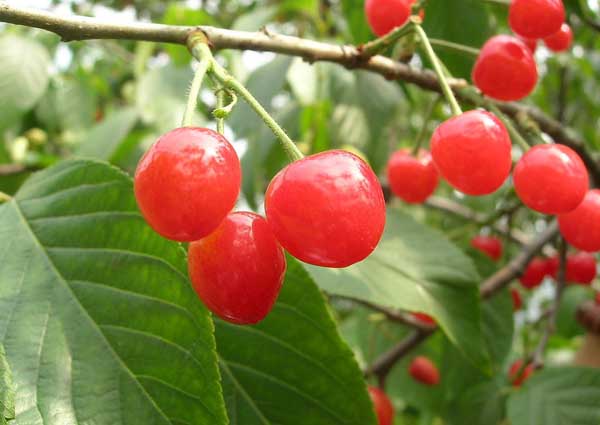
Cherry, also known as wedge thorn peach, oriole peach, cherry (che lizi), etc., is a general term for certain plants of the genus Prunus, including the subgenus Cerasus, the subgenus sour cherry, the subgenus laurel cherry, etc. The fruit can be eaten as a fruit; its appearance is brightly colored, crystal-clear and beautiful, red as agate, yellow as congealed fat. The fruit is rich in sugar, protein, vitamins, and calcium, iron, phosphorus, potassium and many other elements.
Cherry Planting Conditions
Cherry likes warmth and light, and adapts to the warm temperate East Asian monsoon-type continental semi-humid climate (moderate annual temperature, abundant rainfall, long frost-free period, early final frost, average annual temperature around 12°C, rainfall over 700 mm, frost-free period of about 250 days). Cherry grows on sunny hillsides or beside gullies, and is suitable for cultivation at an altitude of 300-600 m, around 33-39° north latitude. Large cherry is intolerant of wind and frost, and is suitable for cultivation in areas with an average annual temperature above 10-13°C, where early spring temperature changes are not drastic, summers are cool and dry, rainfall is moderate, and light is sufficient.
1. Afraid of drought
The root system of large cherry is very shallow, distributed only in the 5-30 cm soil layer. The main root is not developed, and it mainly extends diagonally sideways from lateral roots. Although the root system is shallow, the leaves are relatively large and continuously transpire water. If water is not replenished in time, the leaves will wilt, hence the saying that cherries never leave water. When establishing an orchard, it must be built in a place with irrigation water before a cherry orchard can be established.
2. Afraid of water
Cherry trees are afraid of waterlogging; soaking for one day can ruin the tree. Originally it is both afraid of drought and afraid of waterlogging. If the water content in the soil exceeds 25%, the root system of large cherry will suffocate, root rot and gummosis will occur, and it may even cause the tree to die. From this we know that when choosing a cherry orchard site, waterlogged lowland must not be chosen.
3. Large cherry is afraid of wind, and this also starts from the characteristics of the root system. Large cherry has shallow roots, few main roots, and many lateral roots, and can be broken by strong wind. That is to say, when establishing an orchard, one must also analyze whether the wind in the area is strong, and whether it will blow down the large cherry trees.
4. Afraid of stickiness
Large cherry trees also have relatively strict requirements for soil. They like granular loam, sandy loam, loam, and light-textured soil with deep soil layers, loose texture, and relatively high fertility, and do not like clay soil. In clayey soil, root development is poor.
5. Afraid of salt and alkali
Large cherry trees are relatively sensitive to saline-alkali land. If the salt content in the soil exceeds 0.1%, large cherry trees are prone to yellow leaf disease, and also to comprehensive nutrient deficiency symptoms such as boron deficiency, iron deficiency, and calcium deficiency. Using Dizhongbao trace element fertilizer will fundamentally solve this problem: irrigate 50 grams of Dizhongbao per tree (mixed with 30 jin of water). If the deficiency is severe, then spray 3-4 rounds of 300-fold Dizhongbao solution.
In addition to the above points, large cherry also has certain requirements for climate. It is suitable for planting in areas with an average annual temperature of 7-14°C, where the number of days per year with an average daily temperature above 10°C is between 150-200 days, and the lowest winter temperature must not fall below minus 20°C.
Large cherry trees have very high nutrient requirements. When the organic matter content in the soil reaches above 12%, they enter the fruiting stage in three years, reach the high-yield stage in four years, and the yield per mu can reach more than 2000 kg (2 tons). When the organic matter content in the soil is below 1%, the fruit is small, the taste is poor, and the yield is low.
Cherry Orchard Establishment Requirements
Convenient transportation and a water source; climate and soil are key; the back hill slope is safest, with low temperature, late flowering, frost damage prevention, and full fruit set.
Choosing a good orchard site is only the first step in planting large cherry. Next, good excellent large cherry varieties must be selected. The principles are: good taste is the first criterion, good color is very important, large size and high firmness, storage and transport tolerance and a good price. These are the overall requirements for large cherry varieties.
“Hongdeng” is a large cherry variety bred by hybridization at the Dalian Academy of Agricultural Sciences in 1963. Because of its advantages such as early maturity, large size, and bright color, it has become one of the fastest-developed varieties across the country.
“Napoleon”, also known as yellow cherry, yellow foreign cherry. It is an ancient variety native to Europe. Around 1880, it was introduced into China from Incheon, Korea, and it is currently the main cultivated variety in Yantai, Dalian and other places in China.
“Van” was bred in British Columbia, Canada. In 1983, the Zhengzhou Fruit Research Institute of the Chinese Academy of Agricultural Sciences introduced it from the United States. Its ripening period is in mid-to-late June.
“Italian Early Red”: introduced from Italy in 1989 by the Institute of Botany of the Chinese Academy of Sciences. The fruit is deep red and brilliant, the fruit stalk is relatively short, and the single fruit weight is similar to Hongdeng. It is also an excellent early-maturing variety.
Large Cherry Orchard Establishment and Planting
When we have chosen the orchard site and selected the varieties, the next work is orchard establishment and planting.
First, we plan the orchard as a whole. First divide the orchard into several operation plots. The plots must have roads connecting the whole orchard and windbreak shelterbelts. In particular, a windbreak must be established on the upwind side of the orchard.
After the operation plots are divided, preparation should begin in winter. Generally, apply 2000 kg to 3000 kg of organic fertilizer per mu. After fertilizing, deep plow and improve the soil so that the entire orchard reaches a 40 cm thick active soil layer.
The time to plant trees is the spring of the next year. When spring is warm and flowers are blooming, purchase robust seedlings. When purchasing seedlings, there is one point that requires special attention: choose seedlings of more than two varieties, because large cherry has a low self-fruit-setting rate. When establishing an orchard, pollinizer trees must be configured. Planting 2 to 3 varieties simultaneously in the same plot can solve the pollination problem. When choosing varieties, consult professionals and choose varieties with good compatibility. The quality of the seedlings is closely related to the success or failure of orchard establishment, so a newly built cherry orchard must use high-quality strong seedlings. It is best to choose two-year-old grafted seedlings, with a seedling height of 80-100 cm. The more developed the seedling root system, the better, with many and dense fibrous roots. At a position 1 cm above the graft union, measure the thickness of the seedling, which must reach 1 to 2 cm. Also select seedlings with plump buds on the branches and no insects or diseases.