A Detailed Guide to Muskmelon Planting Techniques and Management Methods
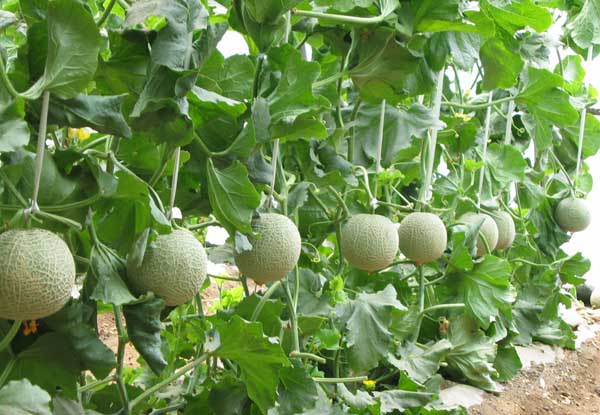
The muskmelon is the fleshy fruit of a plant in the Cucurbitaceae family, with multiple locules and numerous seeds, much like a berry, but the receptacle and exocarp of these fruits fuse together, often forming a thick outer rind, and in classification they are specifically called "pepo" fruits, of which the muskmelon is a typical example. The muskmelon originated in the tropical desert regions of Africa and was introduced to China around the Northern Wei period along with the watermelon; widespread cultivation began in the Ming Dynasty, and it is now commonly grown throughout China.
Seed Selection Methods
There are many muskmelon varieties, but the main varieties suitable for promotion and use across Yunnan include: American zucchini, Zaoqing zucchini, Cuiyu No. 1, Jingdian Biyu, Heixiuli and other high-yielding, disease-resistant variety groups; farmers can choose according to their actual needs.
Choosing the Sowing Period
Muskmelon likes warmth, tolerates heat, and fears cold. When the temperature falls below 15°C, growth stalls, but it adapts strongly to high temperatures and can still carry out considerable photosynthesis at 40°C, so muskmelons can be sown whenever the temperature is above 15°C.
Raising Strong Seedlings
1. Seed disinfection and germination
Generally, 1% copper sulfate or carbendazim can be used for seed soaking and disinfection. For direct sowing, seed can be mixed with aldicarb or 3% cartap powder to avoid damage from underground pests.
2. Seedling raising and sowing
For intensive cultivation, nutrient pots or nutrient bags can be used for raising seedlings. To prepare the nutrient soil based on 1000 kg, mix in 300-400 kg of fine manure, 2.5 kg of carbendazim (or alternatively 200-500 g of metalaxyl, or 100-200 g of cartap technical powder, or 100-200 g of aldicarb); 30-50 kg of superphosphate, 20-30 kg of compound fertilizer, add an appropriate amount of water (a soil moisture content of 40-50% is suitable), mix well, and pile and cover for 5-7 days. Then fill bags (pots) and sow, preferably one seed per bag (pot).
For direct sowing, sufficient basal fertilizer should be applied: 3000-5000 kg of decomposed farmyard manure per mu, 40-50 kg of superphosphate, and 30-50 kg of compound fertilizer. Apply deeply in furrows or in dug pits. Then cover with soil and sow, placing 2-3 disinfected and pre-germinated seeds in each pit.
Rational Close Planting
The planting density of muskmelon depends on the variety. Generally, for the dwarf type, the row spacing is 0.60-0.80 m and the plant spacing is 0.50 m, with 1600-2200 pits per mu and 4000-4500 plants being suitable; for the vining type, the row spacing is 1.50-2.00 m and the plant spacing is 0.50 m, with 700-800 pits per mu and 1400-1600 plants being suitable. Therefore, when purchasing varieties, farmers must understand whether the variety is a short-vine type or a long-vine type. If short-vine muskmelons are planted too sparsely, high yields cannot be obtained; if long-vine types (which sprawl everywhere) are planted too densely, the population is large, ventilation and light penetration are poor, disease resistance is weak, no fruit is set, and the yield is also very low. So one must understand the variety and determine the planting density according to the variety.
Planting Management
1. Seedling stage management
Muskmelon seedlings grow rapidly, especially those raised in nutrient bags or nutrient pots. To prevent spindly growth, water and temperature should be strictly controlled. After emergence, ventilation should be gradually increased to harden the seedlings, with the daytime temperature controlled at 20-25°C and the nighttime temperature controlled at around 10°C. At the same time, fertilizer and water management should be strengthened: every 5-7 days, water the seedlings once with compound fertilizer solution, and apply metalaxyl or metalaxyl-copper oxychloride along with it to prevent root rot. When the plants have 4-5 true leaves, spray once with Bordeaux mixture to prevent powdery mildew and white rust.
2. Field management
For transplanted seedlings or directly sown seedlings, frequent hoeing and cultivating should be done in the early stage to promote root development. All diseases originate from the root system; if the root system is not well developed and the plants grow thin and weak, diseases tend to be relatively severe. Afterward, management should focus on combining irrigation, intertillage, hilling up soil, and fertilization. At the same time, timely pest and disease control is needed, with emphasis on controlling downy mildew, powdery mildew, white rust, and root rot. The use of ecological pesticides such as Bordeaux mixture is encouraged, and attention should also be paid to using biological pesticides such as BT emulsion to control leafminers.
When the muskmelon has grown to 3-5 leaves, the growing tip should be pinched off for pruning management. Generally, the method of fruiting on "secondary vines" and "tertiary vines" is used so that muskmelons can be supplied to the market successively.
When the muskmelon has grown to 5-6 leaves, fertilizer should be applied in a timely manner as a top dressing, with 20-30 kg of compound fertilizer per mu to promote the growth of roots, vines, and young fruits; at the same time, irrigate once every 3-5 days to keep the soil moist.
3. Topping and pinching off growing tips
The main vine of the muskmelon rarely produces female flowers; it relies on secondary vines and tertiary vines to set fruit, and secondary vines mostly produce female flowers at the 1st-2nd nodes. Therefore, timely topping and pinching off growing tips is the key technique in muskmelon cultivation. After the muskmelon is planted out, when the main vine has 4-5 leaves, top and pinch off the growing tip in a timely manner. After secondary vines appear, select and keep 2-3 strong secondary vines and cut off the other weak secondary vines; when the retained secondary vines have 5-6 leaves, pinch off the growing tips again, select and keep 3 tertiary vines on the secondary vines, and cut off the other weak tertiary vines; after the tertiary vines set fruit, pinch off the growing tip leaving 2 leaves beyond the fruit, and take care to remove deformed fruits. Distribute the secondary and tertiary vines evenly, and press soil clods onto the secondary vines. Cut off old leaves and diseased leaves and carry them out of the field.