Detailed Explanation of Key Techniques for Growing Mulberries in Greenhouses
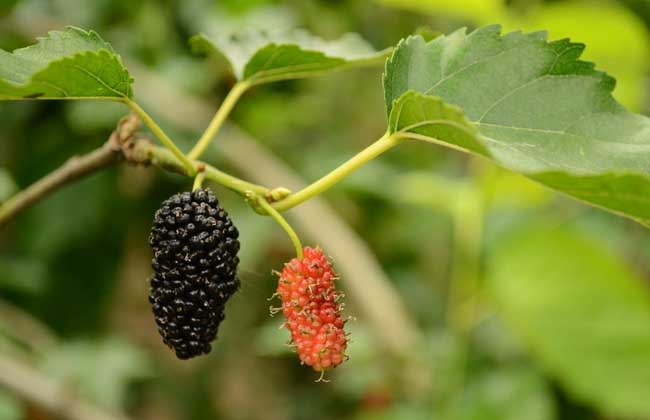
Mulberry is the ripe fruit of the mulberry tree, a deciduous shrub or small tree of the genus Morus in the family Moraceae, also known as mulberry fruit, mulberry berry, mulberry pao'er, etc. The fruit ripens from April to June each year, but the specific ripening time varies from place to place, earlier in the south and slightly later in the north. It grows in hills, mountain slopes, near villages, in fields and other places, and is cultivated throughout the country and around the world. Let's take a look at greenhouse mulberry cultivation techniques together below!
Greenhouse Mulberry Propagation Techniques
1. Seed propagation: Take purple ripe mulberries, rub off the fruit skin, wash the seeds, and sow them immediately or store them in wet sand. Spring sowing, summer sowing and autumn sowing are all acceptable, and summer sowing and autumn sowing can use new seeds of the current year.
2. Grafting propagation: For the bag grafting method, cut the scions 20 days before grafting and store them in wet sand, so that the cortex and xylem at the cut of the rootstock separate into a bag shape, then insert the scion until it is firmly inserted. For bud grafting, use "T" budding or tubular budding (ring budding) in spring and summer.
3. Layering propagation: In early spring, lay the mother plant horizontally and fix it to the ground, bury it in a trench with the top exposed, cover with soil and press firmly. After rooting, separate it from the mother plant and plant it in spring or autumn.
Greenhouse Mulberry Cultivation Techniques
1. Greenhouse construction: Choose a flat, sunny and wind-sheltered place to build the greenhouse, preferably 60 m long from east to west and 10 m wide, with a rear wall 2.8 m high, the main arch of the greenhouse 3.8 m high from the arch top to the arch foot, the front edge 1 m high, and the rear wall and west wall more than 60 cm thick. The frame uses double-layer galvanized steel pipes, with steel wires pulled east-west at intervals of 30 cm, and bamboo poles 6 cm thick tied north-south at intervals of about 60 cm. When covering the greenhouse, cover it with drip-free long-life film, and cover the film with 5 cm thick straw mats or thermal insulation quilts. If conditions permit, an automatic roller shutter machine can be installed.
2. Planting time: Greenhouse mulberry planting time is divided into spring and summer. Spring planting is from late March to early April, and summer planting is in early June. For spring planting, choose large seedlings more than 1 cm thick and more than 1.2 m tall for planting. For summer planting, use two-year-old or three-year-old large seedlings for planting.
3. Seedling planting: Plant seedlings in the greenhouse in a north-south direction, with a row spacing of 2 m and a plant spacing of 1.5 m, planting 222 plants per mu. Before planting, dig planting trenches 50 cm deep and 80 cm wide along the rows, or dig planting holes 60 cm square. Apply fully decomposed organic fertilizer into the planting trenches at 3000 kg per mu, mix it evenly with the soil, fill it level and irrigate to let it settle. After planting, firm the soil, then water 2 to 3 times. When the seedlings sprout, apply 20 kg of urea per mu as a top dressing. After growing through summer and autumn, the greenhouse can be covered in winter.
Greenhouse Mulberry Planting Management
1. Film covering and temperature raising: Like other deciduous fruit trees, fruit mulberry also needs a certain low-temperature dormancy process. It is generally believed that fruit mulberry can successfully pass the dormancy period after natural defoliation in late autumn and dormancy or low-temperature treatment for 30 to 40 days. The time for covering with film and raising temperature is generally best around New Year's Day. If the film is covered too early, natural dormancy will be insufficient, and germination, flowering and fruit size will be uneven, affecting yield and quality. If the film is covered too late, the goals of early listing, seizing the market and obtaining high efficiency cannot be achieved.
2. Greenhouse regulation: Before covering the film, water once thoroughly in advance to ensure normal water supply to the roots and supplement air humidity in the greenhouse. Before fruit mulberry sprouts, the relative humidity in the greenhouse should be kept above 85%. During the flowering period, the relative humidity in the greenhouse should be controlled, generally at about 50%. After fruit set, the humidity in the greenhouse should be increased to about 70%. When heating begins, the daytime temperature should generally be kept at 15 to 18°C, with a maximum not exceeding 25°C. When fruit clusters begin to appear, the daytime temperature should be controlled at about 27°C, with a maximum not exceeding 32°C, and the nighttime temperature should be adjusted to 15 to 18°C.
3. Reasonable tree shape: Generally, newly planted seedlings should be cut back to set the trunk at 30 cm above the ground. In the current year, each plant generally sprouts 5 to 6 new shoots, and when the new shoots grow to 20 cm, pinch off the tips. After the mulberries mature and are harvested in the second year, carry out summer pruning together with shaping. All fruiting mother branches can be heavily cut back, leaving 2 to 3 buds, to promote the sprouting of new shoots and cultivate them into fruiting mother branches for the next year. The cut-back time should be earlier rather than later, to ensure that the new shoots have sufficient growth time to accumulate nutrients for flower bud differentiation.
4. Reasonable pruning: The pruning methods for mulberry trees are the same year after year, so that a low-trunk tree shape is gradually formed. Greenhouse fruit mulberry pruning should follow the principle of "remove the weak and keep the strong, remove the inferior and keep the superior", so that the branches are distributed reasonably and the group advantage is brought into play. During winter pruning, remove slender weak branches and rotten or insect-damaged branches from the base, and cut back the retained fruiting mother branches, generally cutting off about 30 cm from the tips.
5. Fertilization and irrigation: During the dormancy period, open a fertilization trench 30 cm deep and 40 cm wide in the middle of the planting rows, apply 3000 kg of decomposed high-quality farmyard manure per mu, and mix in 25 kg of compound fertilizer. After fruit harvesting, combined with heavy pruning, apply 20 kg of urea per mu. After sprouting, foliar fertilizer can be applied 5 to 7 times with 250 times urea or 350 times monopotassium phosphate, and combined with spraying 1000 times Aimiting 1 to 2 times, to promote fruit set, enlarge fruits, promote early ripening and improve quality. After fertilization, water in a timely manner. During the sprouting stage and young fruit growth period, fruit mulberry is sensitive to water demand and must have sufficient water supply.
Alright, the editor has introduced greenhouse mulberry cultivation techniques to everyone here. Next, let's introduce the main pest control methods for mulberry trees!