When is the ripening time of Shatian pomelo?
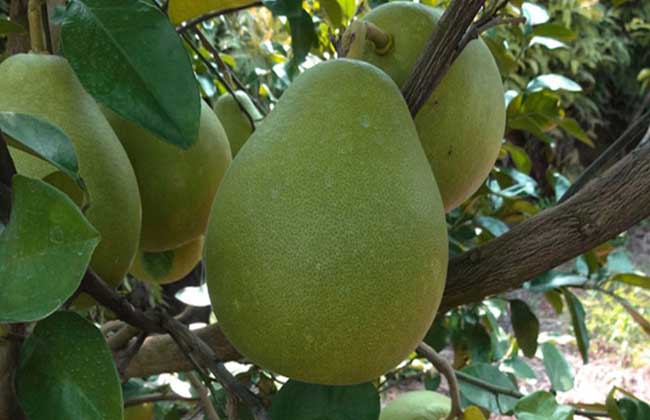
The Shatian pomelo originated in Shatian Village, Rong County, and now, in addition to Rong County's Shatian, it has expanded to the Liujiang, Guijiang, Lijiang and Hongshui River basins in Guangxi, among which Rong County, Pingle, Yangshuo, Gongcheng and other places have the highest yields and the best quality, and it has become a leading export commodity of Guangxi and one of China's most competitive fruits internationally. Let's take a look below at when the Shatian pomelo ripens!
When does the Shatian pomelo ripen?
The Shatian pomelo is a mid-season variety, flowering around April, with the fruiting period after late October, and mid-November being the best harvest time. Although it is already on the market around the Mid-Autumn Festival, Shatian pomelos before the Mid-Autumn Festival are not very tasty; those picked after Frost's Descent are better. A ripe fruit has a slightly deeper orange-yellow skin, a thick rind, and an appearance that is not particularly smooth, and the fruit shape is mostly pear-shaped.
Where is the origin of the Shatian pomelo?
The Shatian pomelo is a local specialty of Rong County, Guangxi Zhuang Autonomous Region. Because it was first planted in Shatian Village, Rong County, Guangxi, it is called Shatian pomelo. As early as the 1930s, it was exported to Hong Kong, China, Nanyang, Europe and the Americas and other places. It has now been expanded to the Xunjiang, Longjiang, Guijiang, Lijiang and Hongshui River basins in Guangxi and other places, and Guangdong, Hunan, Sichuan, Zhejiang and Jiangxi have also successively introduced it. In 2013, Guangxi became China's largest concentrated production area for Shatian pomelos, with the planting area of Shatian pomelos in the whole autonomous region reaching several hundred thousand mu.
What are the common Shatian pomelos?
1. Rong County Shatian pomelo: The Shatian pomelo originated in Rong County, and the history of cultivating Shatian pomelos there spans more than two thousand years. The fruit is large and beautiful in shape, sweet in taste, and resistant to storage. The fruit is gourd-shaped and pear-shaped, with a short neck-like shape at the stem end. The base of the fruit often has a ring-shaped mark the size of an old copper coin, with radial grooves inside, often called a chrysanthemum base or coin base. A single fruit weighs 1000-1500 grams. The fruit surface is golden yellow, and the flesh is shrimp-flesh colored, juicy, crisp and tender, with a sweet honey taste. It ripens in late October and is extremely storage-resistant; the fruit can be stored for 150-180 days, and the flavor is even better after storage. It has the reputation of being a fruit treasure and a "natural can."
2. Meizhou Shatian pomelo: Meizhou Shatian pomelo, also known as Meizhou golden pomelo, has a vigorous tree habit, and 1-2 year old branches are thick and relatively upright. The fruit is pear-shaped or gourd-shaped, with a single fruit weighing 500-1500 grams. The flesh is crisp, tender and refreshing, white or shrimp-flesh colored, with a rich sweet flavor and top-grade quality. The edible rate of the fruit is 40-60%, the juice content is 30-40%, and every 100 milliliters contains 0.3-0.6 grams of total acid and 100-200 milligrams of vitamin C. The fruit ripens from early October to mid-November.
3. Changshou Shatian pomelo: Changshou Shatian pomelo has a cultivation history of more than a hundred years in Changshou District. In 2001, it was rated as a famous brand product of the China International Agricultural Fair. In 2006, it won the honorary title of Chinese Famous Fruit. In 2009, it successfully registered the geographical indication trademark for Changshou Shatian pomelo. Its fruit appearance, shape and color are no different from Guangxi Shatian pomelo, except that the fruit is smaller than Guangxi Shatian pomelo, with an average single fruit weight of only about 750 grams.
4. Guilin Shatian pomelo: Guilin Shatian pomelo was introduced from Rong County Shatian pomelo. Its flesh is tender and soft, delicately sweet and fragrant, and rich in nutrients. Its vitamin C is more than twenty times that of apples. The pomelo fruit is pear-shaped or heart-shaped, and turns bright yellow when ripe. Each generally weighs 2 jin. Its biggest feature is that the stem end looks like a section of neck, and the bottom has a coin-shaped ring mark, known as the "coin ring."