A Detailed Guide to Bayberry Tree Planting Techniques and Management Methods
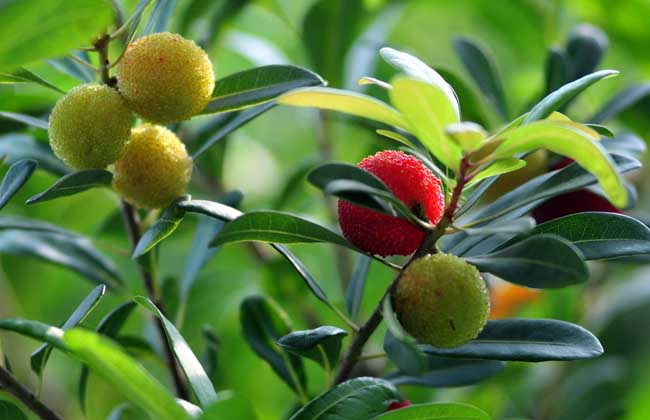
The bayberry tree is a fruit tree native to China, and its fruit has a unique flavor and is rich in nutrients, making it highly favored by consumers. In today's world, where dietary therapy and health are valued, the bayberry has attracted even more attention because of its good medicinal value. The entire bayberry tree is a treasure; its roots, trunk, branches, leaves, fruit, and seeds all have high utility value. The seeds contain 40% oil and can be used to extract premium vegetable oil. The leaves can be used to extract essence for making high-grade perfume. The bark of the roots and branches is rich in tannins and can be used as a dye, and the wood is dense in texture and can be used for fine woodworking.
The Growth Habits of the Bayberry
The bayberry prefers acidic soil. It originated in the temperate and subtropical humid climate of China, on mountain slopes or in valley forests at elevations of 125-1500 m. It is mainly distributed south of the Yangtze River basin and north of Hainan Island, that is, between 20 degrees and 31 degrees north latitude, similar to the distribution of citrus, loquat, tea trees, and moso bamboo, but its cold resistance is stronger than that of citrus and loquat.
The Influence of Terrain on Bayberry
Because the mountain types differ, they have different effects on the growth of the bayberry.
1. Foothill slope areas: In the main production areas, bayberries are most numerous in foothill areas. Because the terrain is lower, the soil has a higher water content, and the bayberry fruit tastes slightly bland.
2. Mountain valley areas: This type has deep soil and is fertile; the bayberry fruit is large and of excellent quality.
3. Steep mountain slope areas: This type of soil is relatively thin, and large, delicious fruit can be achieved, but the yield is on the low side.
Introduction to Bayberry Varieties
1. Dongkui: Dongkui bayberry originated in Huangyan, Zhejiang, and is famous for its exceptionally large fruit. Its main characteristics: the fruit is not perfectly round, with a single fruit weight of 20-25 grams, purple-red fruit color, relatively thick flesh columns, soluble solids 13.5%, sugar content 10.5%, juice content 74%, and acid content only 1.35%, far superior to other bayberries.
2. Wandao bayberry: Because its ripening period is 15—20 days later than other varieties, it is called Wandao bayberry. Wandao bayberry originated in Zhoushan City, Zhejiang, and is one of the excellent Zhejiang bayberry varieties. Its main characteristics: the fruit is spherical, with an average single fruit weight of 11.2 grams, purple-black, delicate flesh, sweet and sour and delicious, juicy and fragrant, and the flesh columns and pit separate easily; edible rate 94%-96%, soluble solids 12.6%. The fruit ripens at the end of June. Wandao bayberry shows no obvious alternate bearing, has excellent quality, and can be planted in appropriate amounts.
3. Daye Xidi bayberry: Produced in Wu County, Jiangsu. Its main characteristics: the fruit is round, with an average single fruit weight of 15 grams, purple-red flesh, soft and juicy, soluble solids 10%. The fruit ripens in late June. After ripening, this variety does not drop fruit easily, is relatively storage-tolerant, and is high-yielding but has alternate bearing, so it can be planted in small amounts.
4. Xiaoye Xidi bayberry: Xiaoye Xidi originated in Dongshan, Dongting, Wu County, Jiangsu, as well as Liyang, Changshu, Wuxi, and other places. The tree crown is tall and upright, the branches are slender, and there are many branchlets. The leaves are lanceolate, entire or with slight fine serrations at the tip, slightly recurved at the tip, and narrowly cuneate at the base. The fruit is medium to large, oblate, with an average single fruit weight of 10.5 grams. The flesh columns are round and tightly arranged, and the fruit surface is relatively smooth. When fully ripe, the fruit surface is dark purple-red; the flesh is relatively thick, the texture is relatively firm, the flavor is richly sweet, and the quality is first-rate, containing 12.1% soluble solids. It ripens from the end of June to early July. The tree vigor is relatively strong, the fruit-setting rate is high, and it is high-yielding and high-quality. It does not drop fruit easily before harvest, is relatively tolerant of storage and transport, and shows alternate bearing.
5. Zaoji Mimei: This is an early-maturing seedling variety selected from biqi bayberry by the Institute of Horticulture of the Zhejiang Academy of Agricultural Sciences and other units. It ripens in early to mid-June, more than 10 days earlier than ordinary biqi. The tree vigor is moderate, the leaves are relatively small, and both sides are slightly upturned. The fruit is oblate, and when fully ripe the fruit surface is dark purple-red and glossy, with a single fruit weight of about 9 grams, soluble solids content 12.4%, edible rate 93.1%, and a sweet-sour taste with excellent quality. This variety enters the fruiting stage relatively early and has strong stress resistance. Its flowering period is about 20 days earlier than usual, avoiding the damage of "luohuangsha," which is one of the reasons this variety has a high fruit-setting rate and stable yield.
6. Wanji Mimei: Wanji Mimei is a new high-quality late-maturing bayberry variety selected by the Institute of Horticulture of the Zhejiang Academy of Agricultural Sciences from the main cultivated variety biqi. This variety matures more than 5 days later than biqi, has excellent quality for both fresh eating and processing, good high yield, and stable traits. In January 2003, it passed the achievement appraisal organized by the Science and Technology Department of Zhejiang Province. In Yuyao, Zhejiang, this variety flowers from April 4-15 and its fruit ripens from July 5-10. It has good high yield; the yield of a 4-year-old tree can reach 5.7 kg, and the yield of a 6-year-old tree can reach 36 kg, increasing yield by more than 15% compared with biqi. The fruit is dark purple-red, and the fruit surface is smooth and beautiful without bayberry flower markings. The sweetness is rich, the taste is good, the flesh is dense, and it stores and transports well. The average single fruit reaches more than 12.5 grams, and the quality for both fresh eating and processing is excellent; the edible rate of the fruit reaches 95.6%, and the soluble solids content reaches 13.7%, with a maximum of 15.7%. Every year, 30-40% of spring shoots and summer shoots do not bear fruit and become reserve fruiting branches for the next year, so the yield is stable and alternate bearing is not obvious.
7. Crystal bayberry: Also called “Baisha bayberry,” its color is crystal-clear like jade, the fruit is round and large, and its taste is fresh, lively, mellow, and sweet. However, this kind of bayberry tree is not easy to cultivate; from raising seedlings to forming a grove and bearing fruit in large quantities, it takes 20 years.
8. Datanmei: Datanmei originated in Hangzhou, Yuyao, and other places. The tree vigor is medium, the tree crown is not very uniform, and the branches are slender. The leaves are thick and large but sparse, long elliptical or broadly obovate-lanceolate, with slightly wavy edges. The fruit is large, round or oblate, with a flat or slightly concave base, weighing about 14 grams, and the fruit stalk is extremely short. The flesh columns vary in length, with pointed tips or blunt tips bearing points, and the fruit surface is rough and uneven, deep red with a black tinge. The flesh is soft, juicy, contains 9.9% soluble solids, has a rich flavor, and is moderately sweet and sour with excellent quality. It ripens in early July, has relatively poor storage quality, and has relatively weak disease resistance and drought resistance.