What regions are the main production areas of strawberries distributed in?
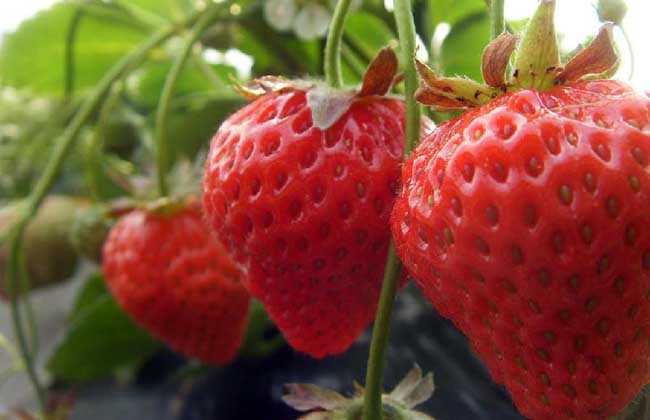
Strawberries, also called red berries, foreign berries, ground berries, etc., are a red fruit. Strawberry is the general term for plants of the genus Fragaria in the rose family (Rosaceae), and they are perennial herbaceous plants. Strawberries are heart-shaped in appearance, bright red and tender, with juicy flesh and a special rich fruity aroma. Let us take a look below at what the distribution areas of strawberry production are!
Distribution of strawberry production areas
1. The place of origin of strawberries: Strawberries originated in South America and are mainly distributed in Asia, Europe and the Americas.
2. Distribution of strawberries in China: Strawberries are cultivated in Hebei Province, Shandong Province and many southern provinces and cities in China. The national strawberry area is more than 1.5 million mu, with production areas mainly distributed in Sichuan, Hebei, Anhui, Liaoning, Shandong and other places. The strawberry planting area in Beijing is less than 50,000 mu, with Changping having the largest planting area.
The growing environment of strawberries
1. Temperature: Strawberries prefer a warm and cool climate. The temperature for strawberry root growth is 5-30°C, with the suitable temperature being 15-22°C. The suitable temperature for stem and leaf growth is 20-30°C. Buds suffer freezing damage at -15 to -10°C. During the flower bud differentiation period, the temperature must be maintained at 5-15°C, and during the flowering and fruiting period it is 4-40°C. When strawberries are overwintering in summer, if the temperature is higher than 30°C and the sunlight is strong, shading measures need to be taken.
2. Light: Strawberries are light-loving plants, but they also have relatively strong shade tolerance. Under strong light, the plants are short and sturdy, the fruits are small, the color is deep, and the quality is good. Under moderate light, the fruits are large, the color is light, the sugar content is low, and the harvest period is longer. Light that is too weak is unfavorable for strawberry growth.
3. Water: Strawberry roots are shallowly distributed and transpiration is high, so they have strict water requirements, but these differ slightly at different growth stages. In early spring and at flowering, strawberries need water content slightly lower than 70% of the soil's maximum water-holding capacity. During fruit growth and ripening, the demand is greatest, reaching more than 80%. After harvest, when runners are produced and new adventitious roots form, the soil water content also needs to be no less than 70%. Autumn is the period when the plant accumulates nutrients and flower buds form, and soil moisture must also be no less than 60%. Strawberries are not tolerant of waterlogging and require good soil permeability, so pay attention to field drainage during the rainy season.
4. Soil: Strawberries are suitable for growing in fertile, loose neutral or slightly acidic loam soil. Soil that is too heavy and clayey is not suitable for cultivation. In sandy soil, applying more manure and watering frequently can also allow strawberries to be grown.
How to choose strawberries
1. Look at the appearance: Strawberries that are too large and oddly shaped should not be bought. Large strawberries are mostly grown with hormones. Some strawberries are bright in color and large in size, with abnormal bumps on the surface, and after biting into them there is a hollow center. Long-term large consumption may harm human health.
2. Look at the color: When selecting, try as much as possible to choose those whose whole fruit is bright red and uniform, with a fresh and glossy color. It is not advisable to buy fruit that is not fully red or fruit that is half red and half green.
3. Smell the aroma: Naturally ripened strawberries have a strong fruity aroma, while dyed strawberries have no aroma, or only a faint green and astringent smell.
4. Look at the seeds on the strawberries: If they are white, they are naturally ripened; if the seeds are red, then they must be dyed.
5. Look at the surface: Only strawberries with fresh green leaves at the calyx, fine fuzz, a glossy surface, and no damage or rot are good strawberries. Strawberries with white or gray spots on the surface may be diseased strawberries.
6. Look at the inside: Naturally ripened strawberries have red flesh, with only a little bit of white at the core, and the fruity aroma is very strong. Dyed strawberries have white flesh and no aroma.