When Do Lychees Ripen? A Detailed Guide to Ripening Times
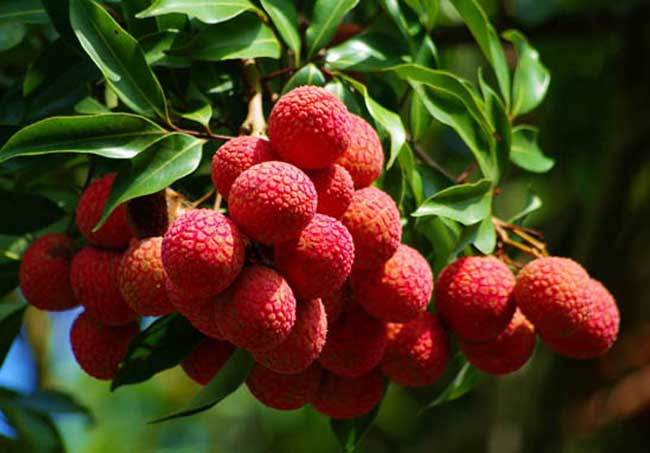
When do lychees ripen? Generally, lychees ripen from June to July every year, but because lychee varieties differ, their ripening times differ too. Below, the editor will explain in detail exactly when different varieties of lychees ripen!
Sanyuehong (March Red)
Sanyuehong generally ripens in late March on the lunar calendar. Because it reaches the market early, it is named Sanyuehong (March Red). It is the earliest-ripening variety, mainly produced in Xinhui, Zhongshan, Zengcheng and other places in Guangdong. The fruit is heart-shaped, broad at the top and pointed at the bottom, with crackled segments of uneven size arranged irregularly and a suture line that is not very obvious. The skin is thick and pale red; the flesh is yellow-white, slightly chewy, with a coarse texture and a large pit. It tastes sour with a hint of sweetness and leaves some residue in the mouth after eating.
Yuanzhi
Yuanzhi generally ripens in late May or early June. Also known as Shuidong or Shuidong Heiye, it is distributed in the suburbs of Guangzhou and the counties of the Pearl River Delta. Because it is suitable for planting in areas with plenty of water and its leaves are pointed and long, resembling black leaves but thinner, it is named "Shuidong Heiye." The fruit is short oval, with one shoulder higher and the other lower; the crackled segments are slightly flat and broad, not prickly to the touch, and regularly arranged. It should be deep red, and the flesh is soft, smooth and juicy, sweet with a touch of sourness and a faint fragrance.
Heiye (Black Leaf)
Heiye usually ripens in mid-June. Also known as Yezhi or Wuye, it is named for its deep green, nearly black leaf color and is cultivated in Guangdong, Fujian and Guangxi. The fruit is short oval, with a rounded or blunt top and a flat base; the skin is deep red and the shell is relatively thin. The crackled segments are flat and blunt, uniform in size and regularly arranged, and the cracks and suture line are obvious. The flesh is firm, crisp and refreshing, fragrant, sweet and juicy, and most fruits have a large pit. It stores relatively well.
Gualv
Gualv usually ripens from late June to early July. It is a premium variety among the lychees of Zengcheng, Guangdong, and one of the famous Guangdong lychee varieties; in feudal times it was listed as a tribute item. According to the Lingnan Lychee Manual: its fruit "has a protrusion slightly higher on one side beside the stem, called the dragon head, and a lower protrusion on the other side, called the phoenix tail. When ripe, red and green alternate, with a single green line running all the way through, hence the name." The fruit is as large as a chicken mark, the pit is as small as a pea, and the peel is dark red with green. The crackled segments are flat, the suture line is obvious, the flesh is thick and crisp, richly sweet and juicy, and it tastes fresh and fragrant in the mouth.
Huaizhi
Huaizhi usually ripens in early July. Also known as Miye, Fenghua, Gufeng, Huaizhi and Huaizhi, its fruit is spherical or nearly round, with a flat stem end and a thick, tough, deep red shell. The crackled segments are large, slightly raised or nearly flat, irregularly arranged, and occasionally with sharp spines near the stem end, dense but few. The flesh is milky white, soft, clear and juicy, sweet with a touch of sourness, and the pit is large and long, occasionally small. It is suitable for drying.
Guiwei
Guiwei usually ripens in early July. Also known as Guizhi, it is named for its osmanthus fragrance. Its characteristics are a spherical fruit, smaller than "Heiye," with a pale red shell that is thin and crisp; the crackled segments are raised, small and pointed, with sharp prickles that hurt the hand. From both sides of the stem there is a relatively deep ring groove around the top of the fruit. Toward the inside it is yellow-white, soft and plump, with a small pit and a very sweet taste. Guiwei has two strains, "Quanhong" and "Yatoulu," among which "Yatoulu" is the superior one. The difference between "Yatoulu" and "Quanhong" is that when "Yatoulu" is ripe, there is a green dot the size of a mung bean on the pale red shell.
Nuomizhi
Nuomizhi usually ripens in early July. Also known as Mizhi, it is mainly produced in Luogang and Xintang in the suburbs of Guangzhou, followed by Zengcheng, Conghua, Dongguan and other places. The fruit is heart-shaped or nearly round, and its crooked fruit stalk is a varietal characteristic. When first marketed it is yellow-waxy in color, and at the peak of the season it turns bright red. The crackled segments are large and narrow, arranged longitudinally, sparse and slightly convex; the suture line is broad and obvious; the top of the fruit is full and the stem end is slightly concave. The flesh is thick, the pit is small, and the flesh is yellowish-white and semi-transparent, with soluble solids reaching 20%. It tastes extremely sweet, with a rich fragrance, and is glutinous, tender and smooth.
Yuanhong
Yuanhong usually ripens in mid-July. Also known as Zhouxhe, it is mainly produced in Minhou County, Fuzhou City, Fujian. The fruit is heart-shaped, with a full top and a long stalk; the peel is purple-red, the crackled segments are small with small spines in the center, and the suture line is not obvious. The flesh is relatively thin and milky white, the pits vary in size, and the taste is sweet with a touch of sourness.